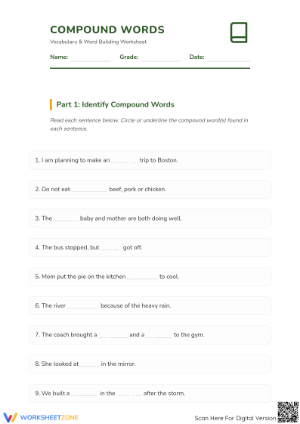
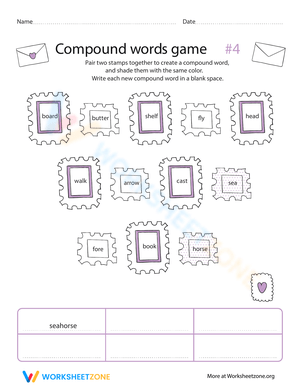
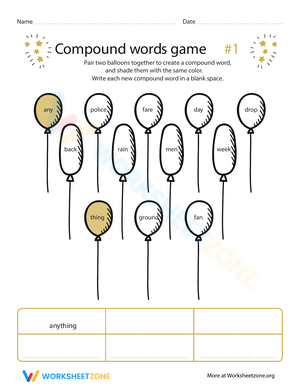
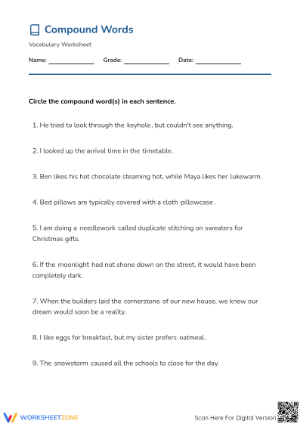
These meaning of compound words printable worksheets for 2nd grade give teachers a focused set of practice materials built around the skill most second graders need time to develop: not just recognizing that a long word contains two smaller words, but working out what those parts tell them about the whole. The set addresses both word-recognition and meaning-making — a distinction worth holding onto, because plenty of students can circle "rain" and "coat" inside raincoat by October, but explaining that a raincoat is specifically a coat worn in the rain takes another kind of thinking.
Transparent vs. Opaque Compounds: The Core Teaching Challenge
Second grade is where compound words move from vocabulary curiosity to a genuine reading strategy. Seven- and eight-year-olds start encountering multi-syllabic words in independent reading that they can't decode phoneme by phoneme at reasonable speed. Recognizing that a long word holds two familiar shorter words gives them a faster, more reliable route to meaning — one they can apply independently, without waiting for teacher confirmation.
The teaching challenge is semantic transparency. Compounds like toothbrush, raincoat, and backpack are transparent: the meaning follows directly from the parts, and students can verify their own interpretation. Words like butterfly and dragonfly are opaque — the parts don't explain the meaning, and students who apply the "two words" logic reach a dead end. Beginning with transparent compounds lets students build real confidence in the strategy before they encounter the edge cases where it doesn't fully hold, which is the sequencing approach these worksheets follow.
What's Inside the Set
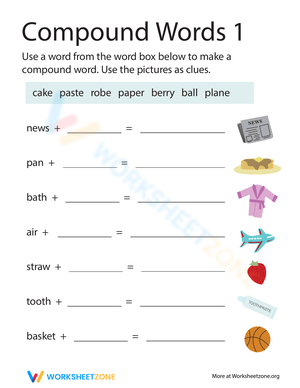
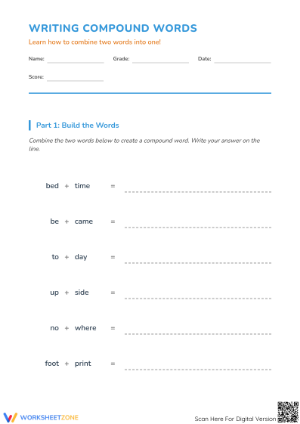
The meaning of compound words printable worksheets for 2nd grade in this collection address three related but distinct tasks: identifying the base words inside a compound, using those parts to construct a definition, and building new compound words by matching individual word pairs. That last task reinforces that the process works in both directions — students can analyze a compound they encounter in reading, and they can also synthesize one when writing. Both directions matter for 2nd grade fluency work.
Words in the set come from categories that second graders encounter naturally across the school day: nature terms (sunlight, snowflake, raindrop), household words (bathtub, hairbrush, bookshelf), and living things (ladybug, grasshopper). Keeping the vocabulary within familiar territory reduces cognitive load so students can concentrate on word structure and meaning rather than decoding the topic itself.
- Marking the two base words inside a closed compound word
- Writing a definition that connects both parts to the whole meaning
- Matching word cards to form correct compound pairs
- Sorting examples into transparent and semi-opaque groups
- Identifying false compounds — words like carpet that contain two recognizable smaller words but are not actual compounds
Common Student Errors Worth Anticipating Before the Lesson
The most predictable error at this grade is the false compound trap: students who have genuinely understood the strategy start applying it everywhere. Carpet becomes "car" plus "pet." Planet becomes "plan" plus something. One student will confidently insist that under is a compound made of "un" and "der." This is actually a sign the lesson worked — the rule has been internalized — but it needs a second check: does the proposed definition hold? A car and a pet do not logically combine into a floor covering, which is the signal that the analysis went wrong. Several worksheets include a built-in meaning-verification prompt to build exactly this checking habit.
A second error surfaces in the definition-writing tasks. When asked what scarecrow means, students who have correctly identified the parts often write "a crow that scares" instead of "something that scares crows." The grammatical structure of English compounds places the modifier first and the head noun second — scarecrow is a crow-scarer, not a scaring crow — and that word-order relationship is not intuitive for every 2nd grader. ELL students especially may come from home languages where modifier-noun order runs in the opposite direction. Brief whole-group modeling of this structure before independent practice prevents the error from becoming a fixed habit in student writing.
Lesson-Planning Strategies for Getting the Most From These Worksheets
The most effective placement is the first eight to ten minutes of the literacy block, used two or three days a week during a compound word unit. Students who arrive and immediately start marking base words come to the lesson already thinking about word structure, which shortens the reactivation time before new instruction begins. Morning work is another natural slot — the tasks are short enough to complete before the opening meeting without feeling rushed.
For literacy centers, pair the definition-writing worksheets with the word-matching worksheets so one station asks students to build compound words and the adjacent station asks them to explain what those compounds mean. The two tasks support each other in a way that neither does alone. This set of meaning of compound words printable worksheets for 2nd grade also travels home cleanly as independent practice — the task formats are self-explanatory, and parents can follow the logic without needing background in the lesson plan. For enrichment, ask students to record compound words they spot in independent reading books and bring them back to class for a quick meaning-analysis discussion.
Standard Alignment
These worksheets align most directly to CCSS.ELA-LITERACY.L.2.4.d, which asks students to use knowledge of individual word meanings to predict the meaning of compound words. That standard explicitly targets the meaning-inference step — not just structural recognition — which is why definition-writing tasks are central to this set rather than optional add-ons. The supporting standard is CCSS.ELA-LITERACY.RF.2.3, which addresses phonics and word recognition in multi-syllabic words; the morphological awareness students build through compound word work feeds directly into decoding unfamiliar longer words in grade-level texts. Teachers who introduce this unit in the fall find that L.2.4.d gains carry forward naturally into the prefix and suffix instruction that typically follows in late winter or spring.
Adapting the Worksheets Across Ability Levels
Students who need more support do better when the definition task is constrained rather than open-ended. A sentence frame — "A _______ is a _______ that _______" — guides them toward the correct grammatical relationship without giving the answer away. For word-recognition tasks, a printed word bank at the top of the worksheet reduces what students need to hold in working memory while keeping the core task intact: they still make the connection between parts and whole.
For students moving ahead of the class, the meaning of compound words printable worksheets for 2nd grade include enough semi-opaque examples — strawberry, daydream, nightmare — to generate genuine discussion about whether a compound's meaning follows logical sense or something more figurative. Ask these students to write a second sentence addressing that question. It is a higher-order vocabulary task that grows from the same worksheet without requiring a separate handout.
Frequently Asked Questions
My students keep identifying "words within words" in non-compounds like "carpet." How should I address this?
This pattern shows up in almost every 2nd grade classroom once the strategy takes hold — it means students have internalized the rule and are applying it broadly, which is the right instinct. The fix is adding a required meaning-verification step: after marking the two base words, students must ask whether combining those definitions produces something real and recognizable. A car and a pet don't combine to form a floor covering, so carpet fails the check. The definition-writing tasks in this set build that two-step habit — identify, then confirm meaning — directly into the practice structure.
Are these worksheets appropriate for English language learners?
Yes, with one teaching note worth keeping in mind. ELL students often handle the word-identification tasks well but struggle with the definition-writing step, because correctly written compound definitions follow English modifier-first order ("a coat for rain," not "a rain, a coat"). Students from languages that place the noun before the modifier need explicit modeling of that structure before working independently. Once the pattern is demonstrated and practiced, the clear and predictable task formats work well for this group.
How do these worksheets connect to 2nd grade spelling instruction?
The connection is direct. When students understand that a compound word is two complete words joined together — and that the spelling of each base word stays the same in the process — they reduce the number of new spelling patterns they need to memorize. Raincoat is not a new spelling challenge if a student already knows rain and coat. The same morphological awareness helps students catch errors in their own writing: a student who knows sunshine is built from sun and shine is far less likely to write "sunshyne."












 Interactive Worksheet Maker
 Quiz Maker
 Word Search Maker
 Crossword Puzzle Maker
 Word Scramble Generator
 Sentence Scramble Generator
 Handwriting Worksheet Generator
 Name Tracing Generator
 Fill In The Blank Generator