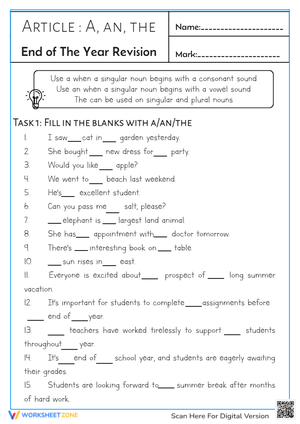
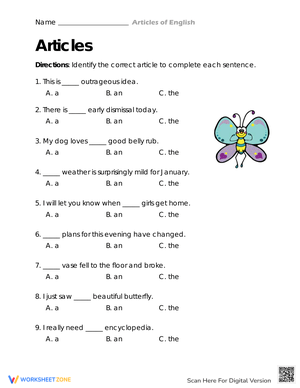
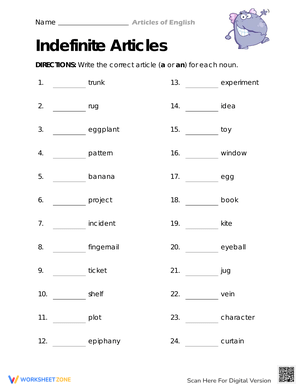
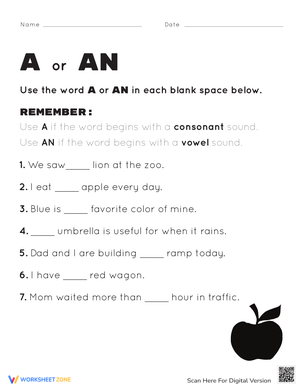
These articles a an the worksheets for 2nd grade give teachers a focused set of exercises that move students from identifying articles in short sentences to correcting article errors inside paragraph-length writing. Each worksheet concentrates on a distinct task format — picture-to-article matching, context-sentence fill-in, and sentence-level error correction — so the practice builds meaningfully across the set rather than repeating the same activity on every worksheet.
The Specific Skills Each Worksheet Targets
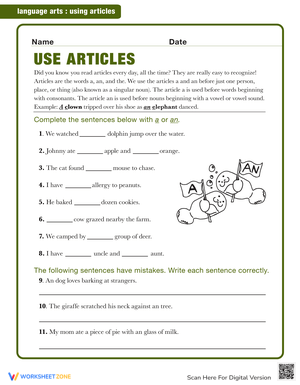
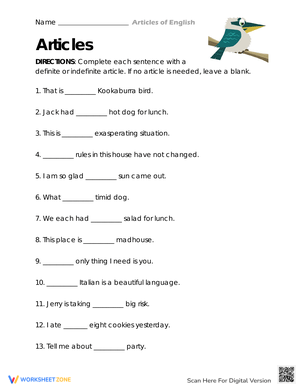
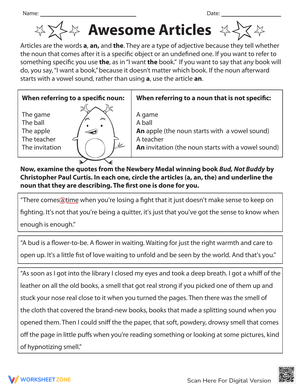
The worksheets cover all three articles, but the task demands shift as the set progresses. Early exercises ask students to underline and label articles as definite or indefinite, which surfaces immediately whether a child can distinguish the two categories or is just pattern-matching on familiar sight words. Fill-in exercises place blanks inside context sentences where the surrounding words signal whether a noun is being introduced for the first time or referenced again — so students have to reason about the distinction, not guess. The error-correction exercises present student-style paragraphs with deliberate article mistakes: wrong article, missing article, or article used where none belongs. That last format is the most diagnostic because the errors mirror exactly what shows up in second-grade drafts.
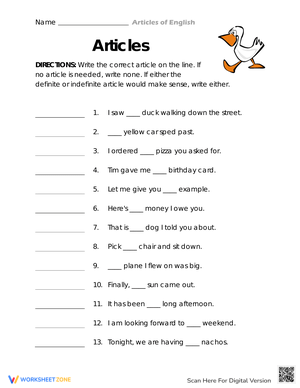
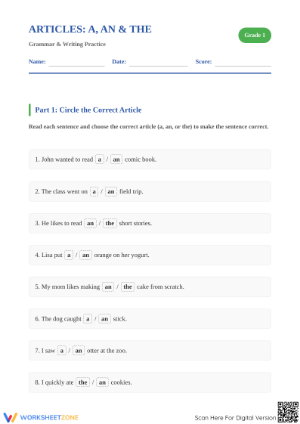
- Article identification and labeling in simple and compound sentences
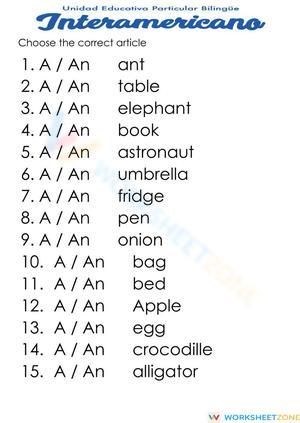
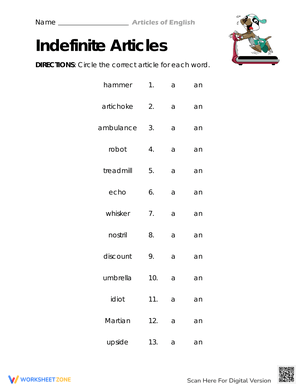
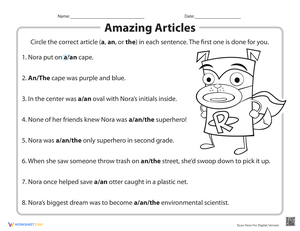
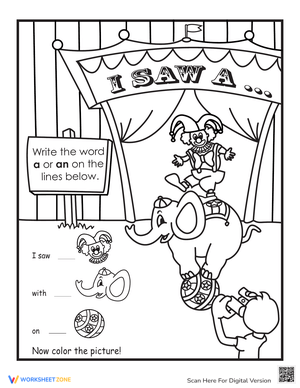
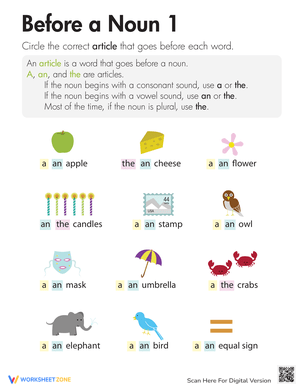
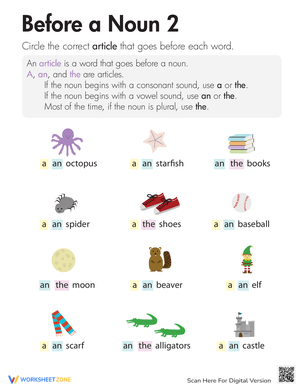
- Picture-to-article matching with noun images
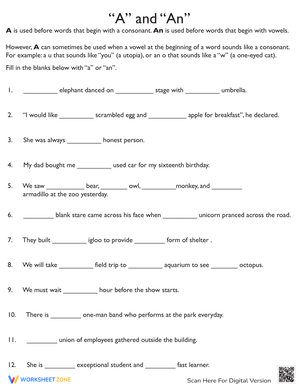
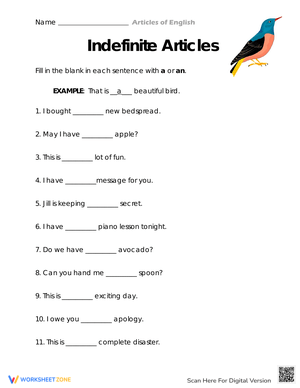
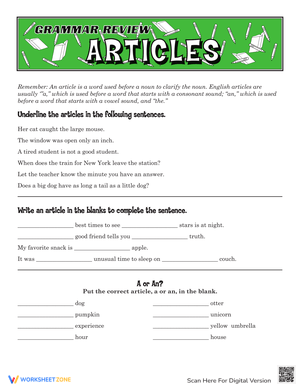
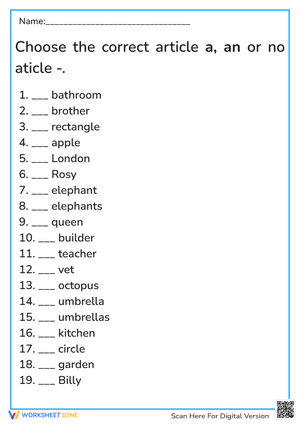
- Fill-in-the-blank within context sentences that signal definite vs. indefinite use
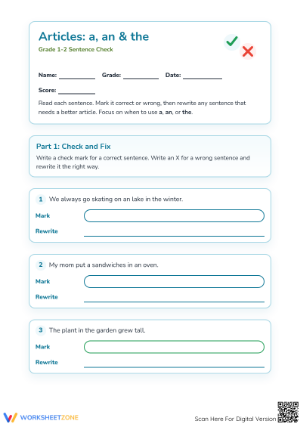
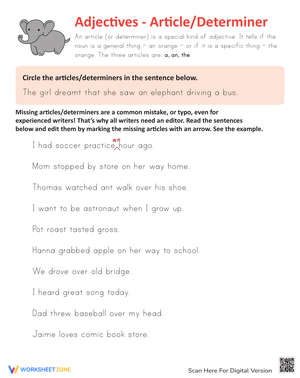
- Sentence-level error correction
- Paragraph-level editing with multiple article errors placed throughout
Errors Students Make That These Worksheets Put in Front of You
The most persistent error at this grade level is applying the vowel-letter rule to "a" vs. "an" instead of the vowel-sound rule. Second graders who have been taught "an before a vowel" correctly write "an apple" and "an umbrella," then write "an unicorn" without hesitating — the letter "u" is a vowel letter, and they are not yet processing that the initial sound is a consonant /j/. The reverse problem surfaces with silent-letter words: students write "a hour" because they see the consonant "h" and apply the consonant rule without registering that the "h" is silent. Asking students to say the word aloud before writing the article fixes this more reliably than re-explaining the rule a second time.
A separate error pattern shows up in students who are developing English fluency alongside grammar: article omission entirely. A sentence like "dog sat on mat" does not reflect confusion about which article to use — it reflects incomplete acquisition of when English requires an article at all. These students need oral practice first, saying "a dog" vs. "the dog" in context, before the written exercises carry meaning. The picture-matching worksheet is the right entry point because it reduces the decision to a single article choice without requiring the student to read and process a full sentence simultaneously.
Building These Worksheets Into Your Grammar Block
The most efficient placement is at the start of writing workshop — specifically in the two weeks before students begin their first multi-paragraph draft. That timing ties article practice directly to the context where the errors will appear, so the skill does not stay isolated inside "grammar time." Running one worksheet as a Monday warm-up after morning meeting, scanning the papers for error patterns midweek, then distributing a second worksheet on Thursday gives the practice more traction than completing the articles a an the worksheets for 2nd grade materials in a single sitting.
For small-group instruction, the paragraph error-correction exercises are the most useful. Four or five students who are still mixing up "a" and "an" in their drafts can work through a correction worksheet together while you listen to how they reason about each item — you hear the vowel-sound confusion directly rather than inferring it from a finished paper. The picture-matching worksheet functions well as an independent center task during literacy rotations because it does not require students to decode full sentences, keeping the cognitive focus where it belongs: on choosing the correct article.
How to Fit the Set to Different Learners
Students still confusing "a" and "an" regularly in their own writing need the identification and picture-matching exercises from the articles a an the worksheets for 2nd grade set first. Those formats narrow the task to one variable — which article belongs here — without also demanding that students manage sentence syntax or paragraph coherence. Students who have those two articles solid but still drop or misplace "the" are ready for the fill-in exercises where sentences contain clear first-mention and second-mention patterns, giving the definite-indefinite distinction enough context to feel meaningful rather than arbitrary.
For students who move through the set quickly, extend the error-correction exercises by asking them to rewrite a sentence twice — once with the indefinite article and once with the definite — and explain in a single sentence why the meaning changes. That extension produces writing you can assess in seconds per student and reveals whether a student genuinely understands what "the" signals or is simply correcting by feel. Students who find the paragraph correction exercises difficult can work through just the single-sentence items on those same worksheets before returning to the full paragraph sections after another round of fill-in practice.
Standard Alignment
These worksheets align directly to CCSS.ELA-LITERACY.L.1.1.h, which requires students to use determiners — including articles — accurately in writing and speaking. Second-grade instruction reinforces and extends that standard as students move from controlled single sentences into multi-sentence paragraphs where article choices must remain consistent across several nouns. The error-correction exercises also support CCSS.ELA-LITERACY.L.2.1 broadly, since editing for grammatical correctness within full sentences is a grade-two conventions expectation. In classroom terms, these worksheets belong inside the editing and conventions strand of writing workshop, not as grammar drilled in isolation from actual student writing.
What Finished Worksheets Tell You About Student Understanding
A completed worksheet carries more diagnostic information than a right-wrong tally. A student who does well on fill-in sentences but misses picture-matching items is likely using the sentence frame as a support — the article choice feels logical when surrounding words narrow the options, but that same student cannot apply the vowel-sound rule when only a picture label and a blank are present. Conversely, a student who succeeds on picture-matching but drops articles in the paragraph correction task is probably not reading the paragraph carefully enough to notice where articles are missing. That student needs to read the paragraph aloud while editing — hearing the gap in rhythm catches missing articles faster than silent visual scanning does.
Frequently Asked Questions
What is the difference between "a" and "an"?
Both are indefinite articles that introduce a singular, non-specific noun. The difference is purely phonetic. "A" goes before words starting with a consonant sound; "an" goes before words starting with a vowel sound. Spelling does not determine the choice — sound does — which is why "an hour" and "a university" both follow the rule correctly even though their first letters suggest otherwise.
When does "the" belong in a sentence instead of "a" or "an"?
"The" is the definite article. It signals that a specific noun is being referenced — one already introduced, or one that both writer and reader understand to be unique in context. "I saw a bird" introduces any bird in the world; "the bird flew back" points to the same one from the previous sentence. Second graders frequently drop "the" in their writing because they carry the shared context in their own heads and do not realize the reader does not automatically share it.
Why do we say "an hour" when "hour" starts with an "h"?
Because the "h" in "hour" is silent. The word opens with a vowel sound — the same initial sound as "our" — so the article rule calls for "an." This is worth teaching directly in second grade because it demonstrates that ears are more reliable than eyes when choosing between "a" and "an." Have students say the target word before writing the article, and the right choice usually becomes clear without further explanation.
Can these worksheets be used with English Language Learners?
Yes, with a deliberate starting point. ELL students often struggle with article omission more than substitution — many languages do not require an article before singular count nouns, so the concept itself needs explicit attention before the specific "a vs. an vs. the" distinctions make sense. The picture-matching exercises in the articles a an the worksheets for 2nd grade set are the best entry point: one noun, one article choice, no full sentence to decode. Move to the sentence-level fill-in exercises once students are choosing consistently and accurately on the matching tasks.












 Interactive Worksheet Maker
 Quiz Maker
 Word Search Maker
 Crossword Puzzle Maker
 Word Scramble Generator
 Sentence Scramble Generator
 Handwriting Worksheet Generator
 Name Tracing Generator
 Fill In The Blank Generator