


























Views
Downloads
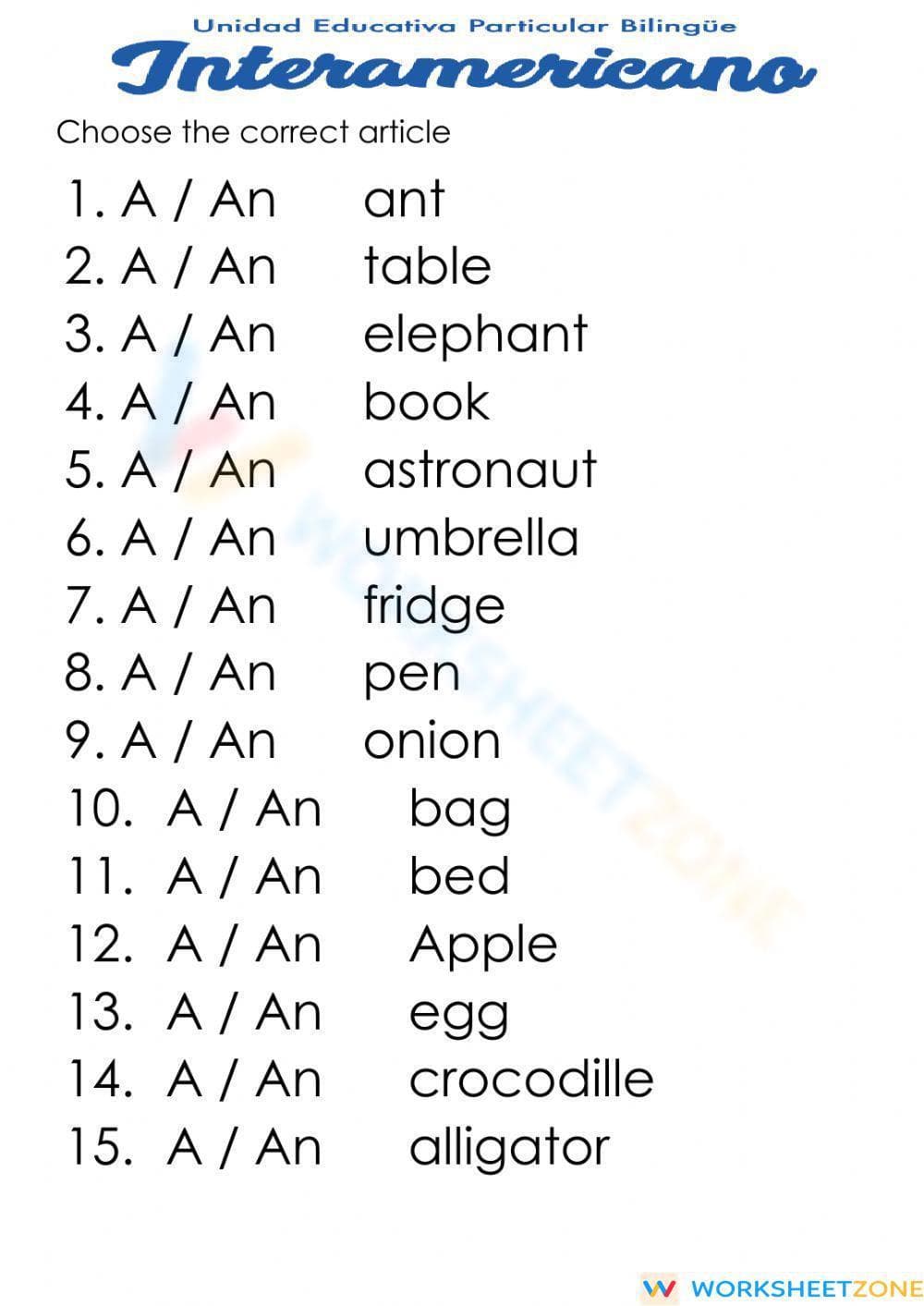

Grade 3 Indefinite Articles — Printable No-Prep Worksheet
Paste this activity's link or code into your existing LMS (Google Classroom, Canvas, Teams, Schoology, Moodle, etc.).
Students can open and work on the activity right away, with no student login required.
You'll still be able to track student progress and results from your teacher account.
This no-prep worksheet offers focused practice for Grade 3 students on choosing the correct indefinite article, "a" or "an." Students build foundational grammar skills by applying the rule across 15 examples, reinforcing a convention essential for clear writing and reading comprehension. It's a print-and-go solution.
At a Glance
- Grade: 3 · Subject: ELA
- Standard:
CCSS.ELA-LITERACY.L.1.1.h— Use determiners, including articles, in sentences.- Skill Focus: Indefinite Articles (A vs. An)
- Format: 1 page · 15 problems · Answer key included · PDF
- Best For: Warm-up, exit ticket, or independent practice
- Time: 5–10 minutes
What's Inside
This resource is a single-page PDF with one core task. Students see 15 numbered items, each with a common noun, and must select the correct article ("a" or "an"). The design is clean and simple. A complete answer key is provided on a separate page for fast grading or student self-checking.
A Seamless Classroom Workflow
Designed for immediate use, this worksheet streamlines teacher preparation. The entire workflow is exceptionally efficient, making it an ideal resource for busy classrooms or for substitute plans.
- 1. Print (Under 1 Minute): The single-page PDF is optimized for fast printing.
- 2. Distribute (1 Minute): With clear instructions at the top, students can begin working immediately with minimal verbal direction.
- 3. Review (3-5 Minutes): Use the included answer key to review answers as a class, have students self-grade, or collect for a quick formative check. The process requires less than 5 minutes of active teacher time.
Standards-Aligned for Core Instruction
This worksheet directly supports a key foundational language standard: CCSS.ELA-LITERACY.L.1.1.h, which requires students to "Use determiners (e.g., articles, demonstratives)." While a first-grade standard, its mastery is vital for writing fluency in later grades, making this a perfect review tool. Both standard codes can be copied directly into lesson plans or curriculum maps.
Flexible Instructional Uses
This worksheet can be integrated anywhere in your lesson cycle. Use it as a pre-assessment before a grammar lesson to gauge knowledge, or as an exit ticket to check understanding. For formative assessment, walk around as students work and note hesitation on vowel-sound words (like "onion"), revealing areas for reteaching. The task is designed for a quick completion time, typically between 5 and 10 minutes.
Perfect for Early Elementary Learners
This worksheet is ideal for 2nd and 3rd-grade students solidifying their understanding of articles, and for 4th graders needing a quick review. The simple, repetitive structure benefits English Language Learners (ELLs) by providing clear practice. For differentiation, have advanced students write a sentence for five nouns after choosing the article. It pairs well with a classroom anchor chart displaying the "a/an" rule with visuals.
This worksheet provides targeted practice on a fundamental component of English syntax, aligned with CCSS.ELA-LITERACY.L.1.1.h, focusing on the use of determiners like articles. Mastering the "a" versus "an" distinction is a critical early step for grammatical accuracy in student writing. Research underscores the importance of explicit skill practice in building automaticity, which frees up cognitive resources for higher-order thinking. The RAND AIRS 2024 report identifies foundational skills instruction as a high-impact practice for improving literacy outcomes. This single-page resource applies this principle, giving students structured repetition to internalize the rule that article choice is based on the initial sound—not letter—of the following word. Its format is consistent with effective, low-overhead instructional materials that support mastery.


