These conjunctions worksheets for 2nd grade target four coordinating conjunctions — and, but, or, and so — across five activity formats: identification, fill-in-the-blank, sentence combining, error correction, and open writing. The set addresses the pattern that shows up most reliably in second-grade writing: students produce correct sentences but default to connecting everything with "and," and the paragraph never pauses or turns.
The Four Words the Set Targets
Second-grade conjunction instruction narrows the field deliberately. Rather than surveying all connecting words, effective practice at this level isolates the four that appear most often in early chapter books and student writing. And adds. But turns. Or offers a choice between two possibilities. So shows what one thing causes or leads to. Students who feel the difference between those relationships — not just name them — are ready to make real choices in their own writing.
Each worksheet in the set targets one or two conjunctions at a time. Asking a second grader to choose among four options before any of them have settled produces guessing, not learning. Focusing a worksheet on but alone gives students enough repetition to internalize contrast before moving on.
What Each Worksheet Asks Students to Do
The activity types across these conjunctions worksheets for 2nd grade move from recognition to production — the same sequence a strong grammar unit follows in the classroom. Students begin by noticing conjunctions in text, then choose among options in structured sentences, then produce their own. The five formats in the set are:
- Identification: Students underline or circle target conjunctions in a short passage, building awareness before any writing is required.
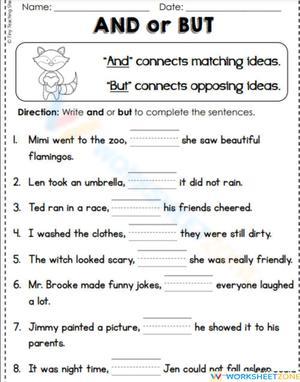
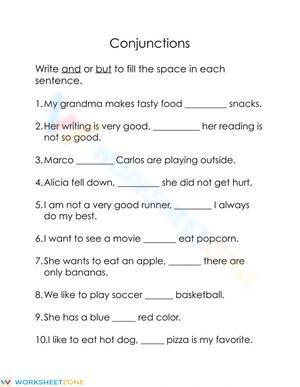
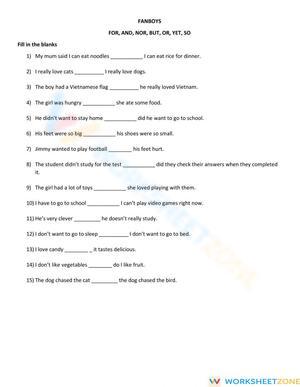
- Fill-in-the-blank: A sentence is given with a blank at the conjunction position. Students choose among two or three options and write a brief phrase explaining their choice.
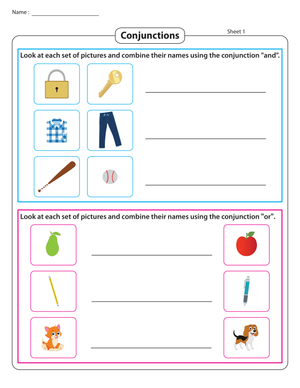
- Sentence combining: Two short sentences are provided; students rewrite them as a single compound sentence using the conjunction that fits the relationship between the ideas.
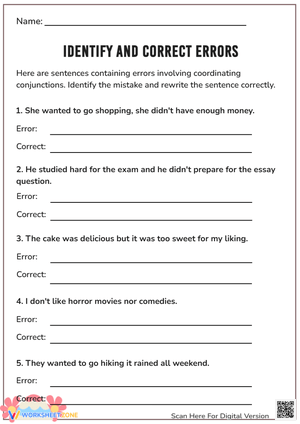
- Error correction: Students receive a sentence using the wrong conjunction, identify the problem, replace it, and rewrite the corrected version.
- Open writing: A prompt asks students to write two or three original sentences, each using a specified conjunction correctly.
The error-correction format earns its place in the set. Students who can identify a misplaced but in someone else's sentence have shown they understand what but actually does — that is a different kind of knowledge than selecting from constrained options on a fill-in-the-blank exercise.
The Error Patterns That Show Up Most
And overuse is the most predictable problem. Students write sentences like "I was tired and I didn't want to go and my mom said I had to and I went anyway" — grammatically defensible but revealing that but and so haven't taken hold yet. Several sentence-combining exercises pair clauses where "and" produces a flat or odd result, which pushes students toward the conjunction that actually fits the relationship.
A subtler error surfaces on the or exercises. Second graders frequently confuse choice with contrast, writing "You can have cake but you can have pie" — which reads as an offer with a caveat, not a genuine option between two things. Catching this in a small-group setting, where students read the sentence aloud and discuss what it's actually saying, tends to resolve the confusion faster than more written practice alone.
How to Work This Set Into Your Weekly Lesson Plans
The identification and fill-in-the-blank worksheets work well as warm-up tasks — the kind of practice students can begin in the first eight minutes of the day while attendance is taken. These formats consolidate a lesson already taught; they don't introduce new content.
Sentence-combining and error-correction worksheets belong later in the instructional sequence. A straightforward weekly structure: targeted instruction on Monday, guided practice Tuesday, a sentence-combining worksheet on Wednesday to gather formative data, small-group follow-up Thursday based on what the Wednesday work shows, and open writing on Friday that goes into the writing folder as a record of the week.
For literacy centers, identification and fill-in-the-blank worksheets slide into plastic sleeves so students use dry-erase markers to complete them across rotations. Keep the open-writing worksheets as printed paper — you need the actual student writing to assess whether the conjunction use was meaningful or accidental.
Standard Alignment
These worksheets address CCSS.ELA-LITERACY.L.2.1.C, which requires second-grade students to use frequently occurring conjunctions to demonstrate command of standard English grammar and usage. In practice, this standard shows up in two places: the grammar block, where conjunctions are introduced and practiced in isolation, and the writing block, where real evidence of understanding appears. A student who marks but correctly on every worksheet but writes "I was hungry and I didn't eat" in a journal entry has met the standard in one context and not the other. These conjunctions worksheets for 2nd grade address both — the recognition exercises build rule-level fluency, and the open-writing tasks push toward genuine application.
How to Use This Set With Mixed-Ability Classes
For students who need more support, identification is the right entry point. Circling a conjunction in a provided sentence demands far less production than placing one in an original sentence, and it builds familiarity with where conjunctions sit inside a compound sentence before students are asked to place them there themselves. Reading sentences aloud before marking anything also helps students who lose the meaning when reading silently — hearing "I wanted to go, but it was raining" makes the contrast audible before it's visible on the page.
For students who move through the set quickly, the open-writing worksheets can be extended: instead of writing two sentences with a named conjunction, ask them to write a short paragraph using two different conjunctions and annotate each with a phrase that describes the relationship it shows. That kind of reflection — not just using the word but explaining what it does — is solid preparation for the subordinating conjunctions and sentence variety work waiting in third grade.
Frequently Asked Questions
Which conjunction should second graders learn first?
And first, without question — students already use it constantly in speech, so the work is teaching them to reach for it more selectively rather than introducing something unfamiliar. From there, but is the most important step up because it introduces contrast, which is a conceptual move beyond simple addition. Or and so can follow in either order, though so tends to be immediately useful in writing because it makes cause-and-effect reasoning visible on the page.
How do these worksheets connect to the writing block, not just grammar instruction?
Identification and fill-in-the-blank exercises build recognition, but sentence-combining and open-writing tasks are where writing instruction actually happens. When students take two complete thoughts and rewrite them as one sentence, they make a real authorial decision about how ideas relate. Sharing a student's before-and-after sentences with the class — asking which version sounds like the writer knew exactly what they meant — turns grammar practice into a writing craft conversation.
Can parents support this practice at home?
The fill-in-the-blank and sentence-combining worksheets travel home well. The instructions are clear enough that a parent can support the practice without a grammar background. The one honest limitation: open-writing worksheets are better kept at school. Whether a student used a conjunction correctly in an original sentence is a judgment call that needs a teacher's eye — a parent may not have the context to give useful feedback. These conjunctions worksheets for 2nd grade do the most at home as reinforcement of concepts already introduced in class, not as first exposure.












 Interactive Worksheet Maker
 Quiz Maker
 Word Search Maker
 Crossword Puzzle Maker
 Word Scramble Generator
 Sentence Scramble Generator
 Handwriting Worksheet Generator
 Name Tracing Generator
 Fill In The Blank Generator