


























Views
Downloads

Printable Major Muscles Worksheet | Grade 10-11 Anatomy
Paste this activity's link or code into your existing LMS (Google Classroom, Canvas, Teams, Schoology, Moodle, etc.).
Students can open and work on the activity right away, with no student login required.
You'll still be able to track student progress and results from your teacher account.
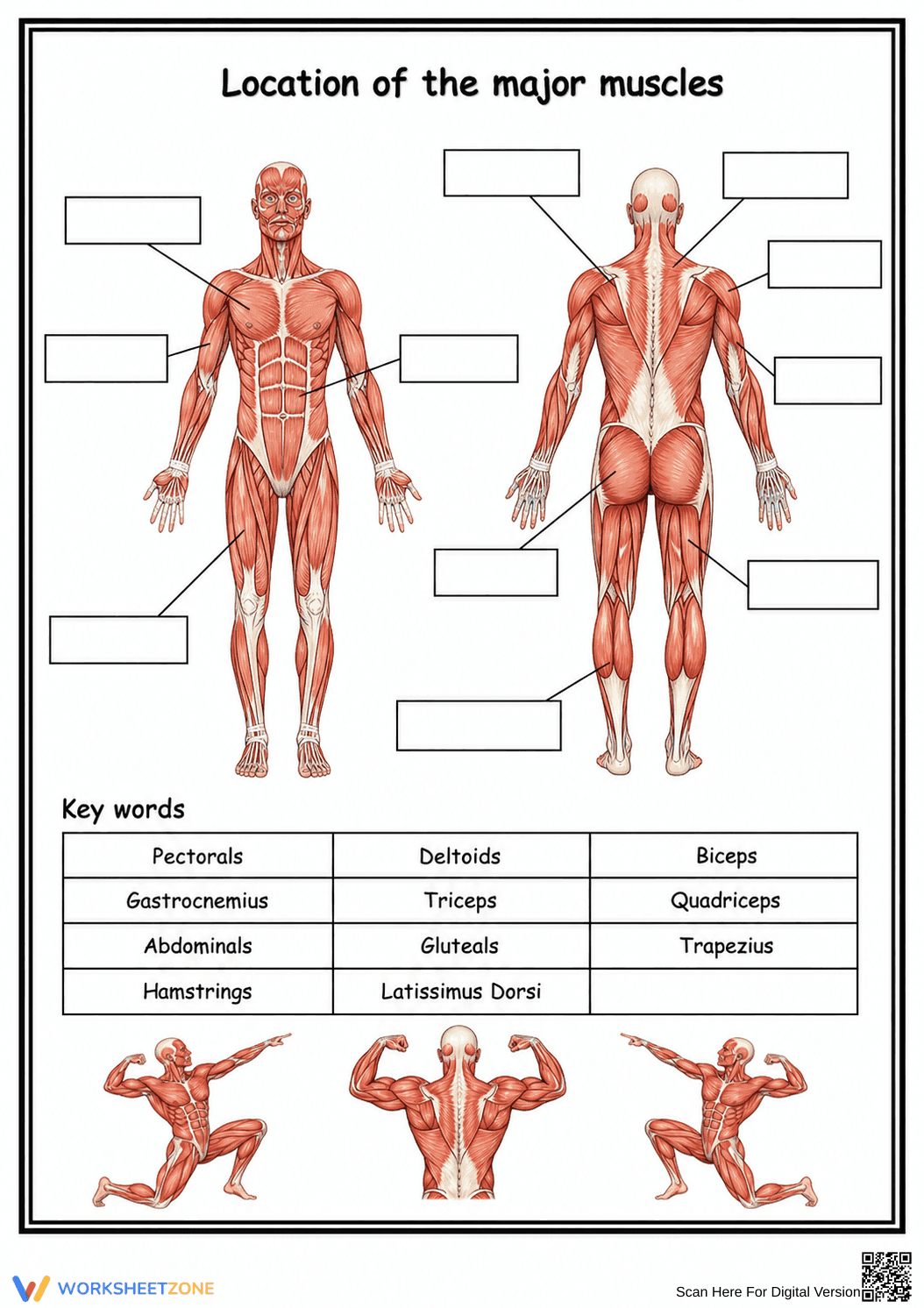
This printable anatomy worksheet helps students identify and label the major muscles of the human body. By mapping terms from a provided word bank to anterior and posterior anatomical diagrams, learners will solidify their understanding of the muscular system and its structural organization.
At a Glance
- Grade: 10-11 · Subject: Anatomy
- Standard:
HS-LS1-2— Illustrate the organization of interacting body systems- Skill Focus: Labeling major muscle groups
- Format: 1 page · 11 problems · Answer key included · PDF
- Best For: Independent practice or review
- Time: 10–15 minutes
Inside this single-page resource, educators will find a clear, high-quality anatomical diagram featuring both front and back views of the human muscular system. The worksheet includes 11 blank text boxes pointing to key muscle groups, accompanied by a comprehensive word bank containing terms like Pectorals, Latissimus Dorsi, and Gastrocnemius. A complete answer key is provided to ensure accurate grading and quick reference.
Zero-Prep Workflow
This resource is designed for immediate classroom implementation:
- Print (1 minute): Download the PDF and print class sets. The diagrams copy beautifully in black and white.
- Distribute (1 minute): Hand out as a bell-ringer, homework, or sub plan. The word bank makes it self-explanatory.
- Review (3 minutes): Use the answer key to check student work or project it for self-grading.
Total teacher prep time is under 2 minutes, making it an ideal grab-and-go solution.
Standards Alignment
This worksheet aligns with Next Generation Science Standard HS-LS1-2: Develop and use a model to illustrate the hierarchical organization of interacting systems that provide specific functions within multicellular organisms. By identifying specific muscles, students build the foundational vocabulary necessary to understand how the muscular system interacts with the skeletal system to facilitate movement. Both standard codes can be copied directly into lesson plans, IEP goals, or district curriculum mapping tools.
How to Use It
This versatile labeling activity fits perfectly into various instructional moments. Use it as a formative assessment after direct instruction on the muscular system, allowing students 10 to 15 minutes to match the terms to the diagrams independently. Alternatively, assign it as a pre-assessment to gauge prior knowledge before exploring complex muscle physiology. As a formative observation tip, watch to see if students easily distinguish between anterior muscles (like the pectorals) and posterior muscles (like the latissimus dorsi) without relying heavily on the word bank.
Who It's For
This worksheet is primarily designed for 10th and 11th-grade high school biology, anatomy, and physical education students. It serves as an excellent foundational tool for learners who need visual scaffolds, as the word bank provides built-in differentiation for students requiring vocabulary support. It pairs perfectly with a 3D anatomical model demonstration or a direct instruction lesson on human biomechanics.
Mastering anatomical terminology is a critical first step in understanding complex physiological processes. This worksheet supports standard HS-LS1-2 by requiring students to illustrate the organization of interacting body systems through accurate labeling of major muscle groups. According to a ScienceDirect TpT Analysis, visual mapping exercises combined with targeted word banks significantly improve vocabulary retention in high school science courses. By physically writing the terms next to their corresponding anatomical locations, learners engage in dual-coding, which strengthens memory recall and deepens comprehension. This straightforward, visually organized practice ensures students build the necessary structural knowledge to later explore how these specific muscles contract and interact with the skeletal system to produce human movement. Providing clear, immediate application of new vocabulary is absolutely essential for long-term mastery in the life sciences, giving students the confidence they need for advanced anatomical studies.


