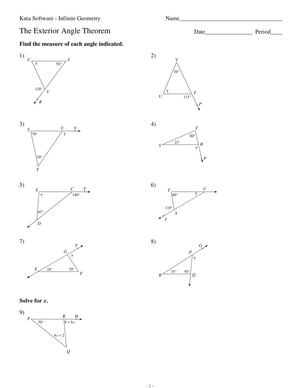
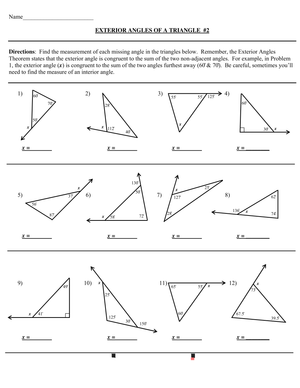
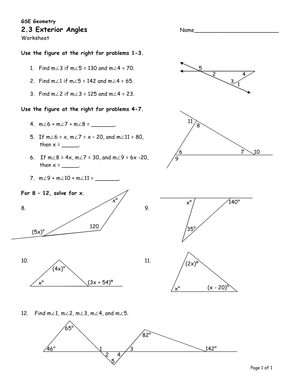
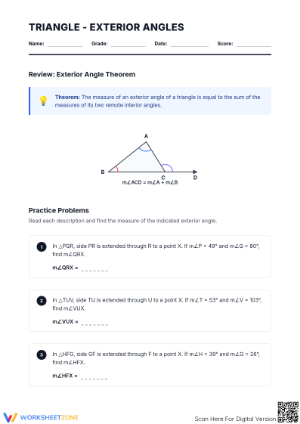
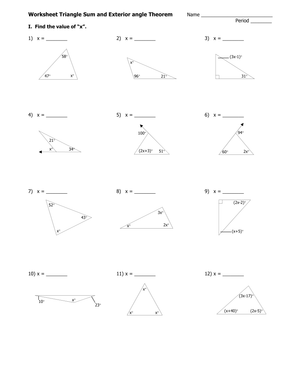
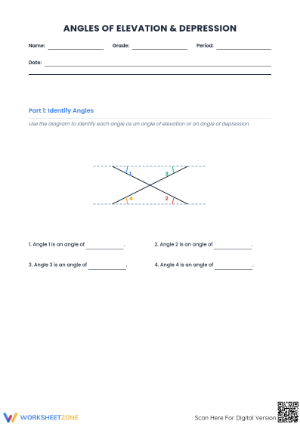
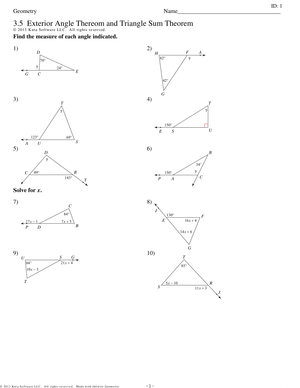
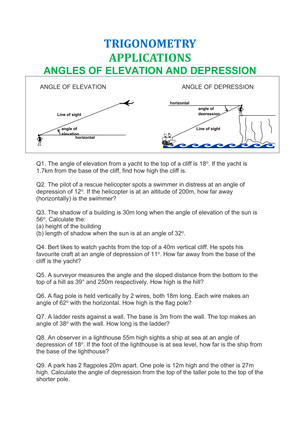
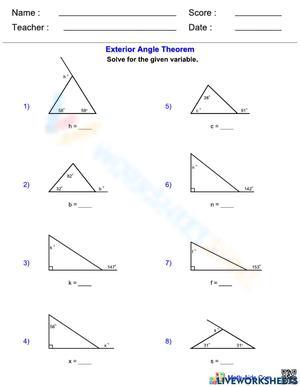
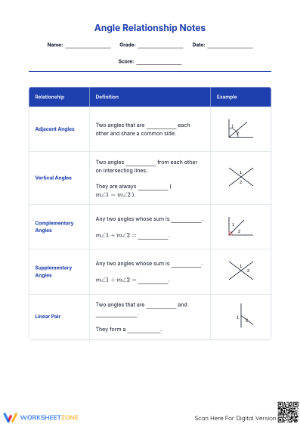
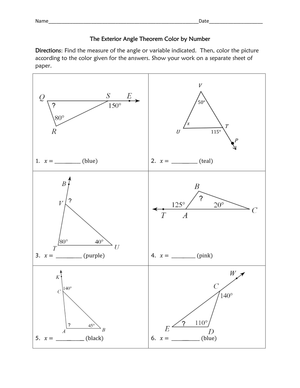
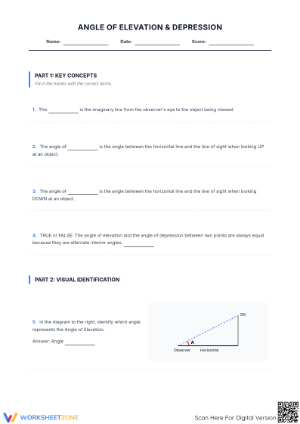
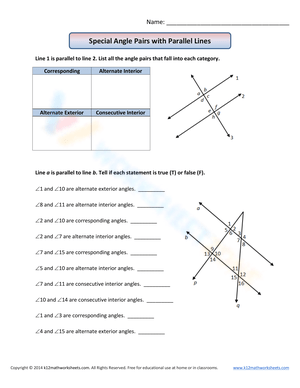
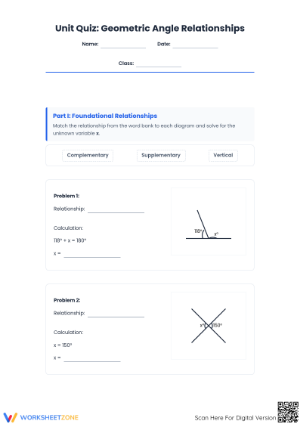
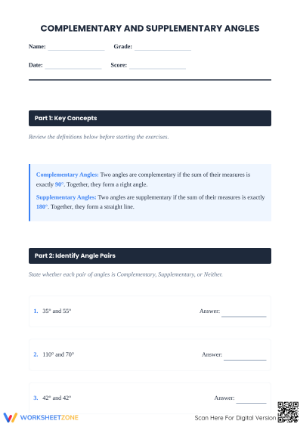
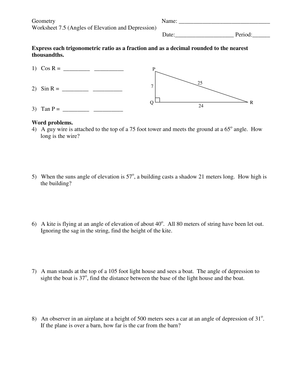
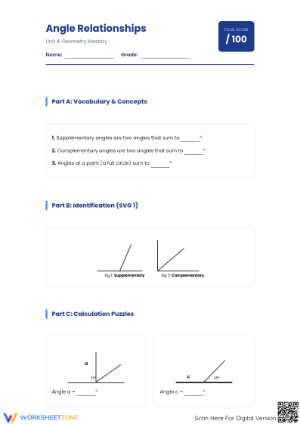
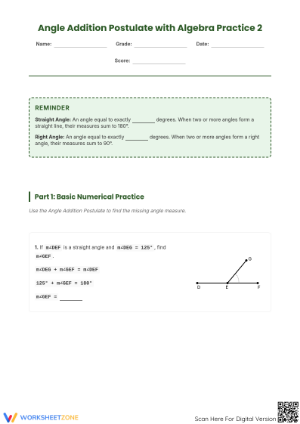
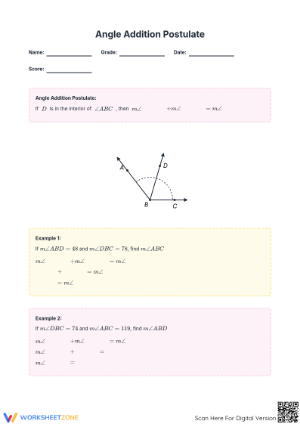
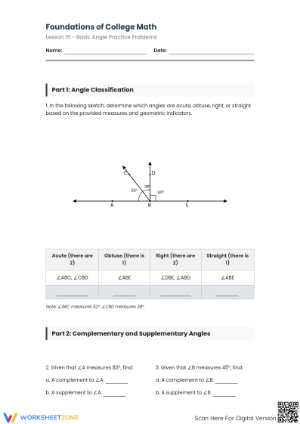
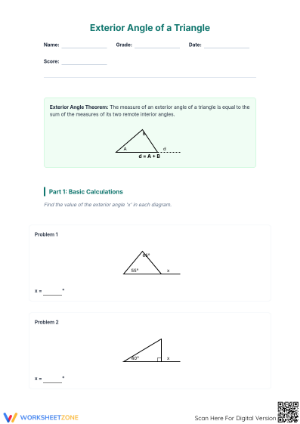
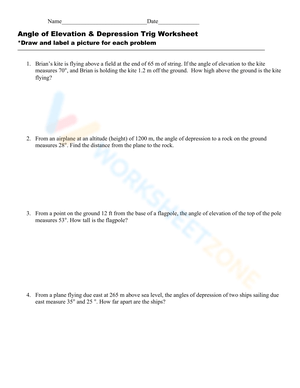
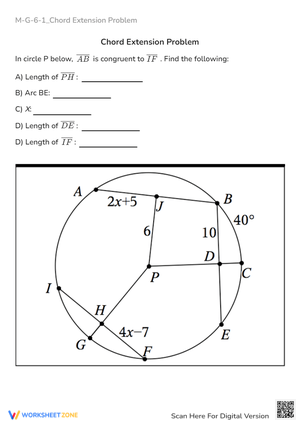
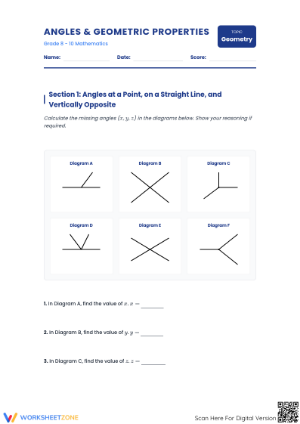
These 10th grade angles worksheets resources give geometry teachers printable practice at the specific moment in the curriculum where angle relationships stop being a measuring exercise and become a theorem application exercise. At this level, students aren't identifying types from pictures — they're setting up equations, citing justifications, and working toward formal proofs. Each worksheet includes fully labeled diagrams, because 10th graders need practice extracting setup information from figures rather than reading it from problem text.
What's Inside the Set
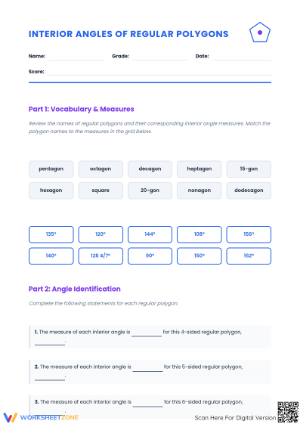
The parallel lines worksheets require students to distinguish all eight angle pair types formed when two lines are cut by a transversal — not just alternate interior and corresponding angles, which are where most classroom emphasis lands, but also co-interior and co-exterior pairs. Students identify each pair, state whether the relationship is congruence or supplementarity given that the lines are parallel, then solve for missing measures. A separate group of worksheets covers polygon angle sums using (n − 2) × 180, applied to polygons students rarely encounter in class: octagons, nonagons, and dodecagons rather than only the pentagon and hexagon examples that saturate most textbooks.
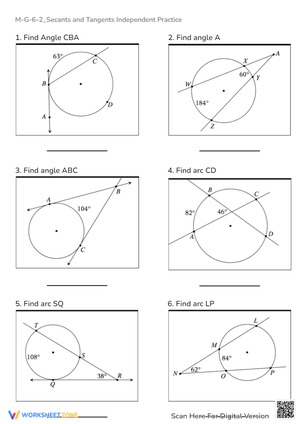
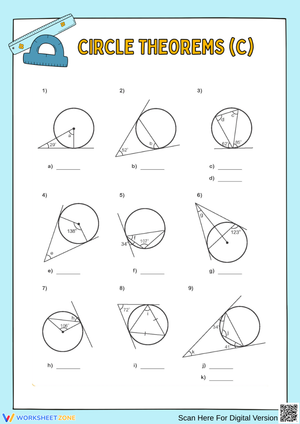
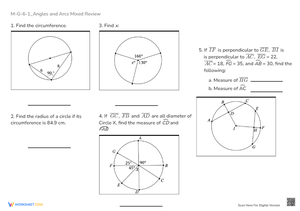
The circle angle worksheets treat each of the five standard configurations as a separate category before mixed-review problems require students to identify the type first:
- Central angles — vertex at the center, measure equal to the intercepted arc
- Inscribed angles — vertex on the circle, measure equal to half the intercepted arc
- Angles formed by two chords intersecting inside the circle
- Angles formed by two secants drawn from an exterior point
- Tangent-chord angles at the point of tangency
The algebraic angle worksheets run across all four topic areas. Angle measures appear as linear expressions — sometimes requiring distribution before solving — and students write the governing equation from the geometric relationship before doing any algebra. That sequence matters: students who calculate first and justify later consistently make classification errors that go unnoticed until the assessment.
Error Patterns Worth Anticipating Before the Lesson
The most consistent error on parallel-line problems is treating co-interior (same-side interior) angles as congruent rather than supplementary. Students who correctly distinguish alternate interior from alternate exterior angles still regularly set co-interior expressions equal to each other. The error is most visible when both expressions look symmetric on the diagram — say, 5x + 12 and 5x − 12 — because the structural similarity reinforces a false sense that the angles must match. Requiring students to write the angle relationship and its equation form (expression = expression, or sum = 180) before touching the algebra catches this before a wrong answer calculates itself in.
Circle geometry produces a different structural error: students apply the inscribed angle theorem to central angles. They see a vertex at the center of a circle and divide the intercepted arc by two, producing an answer that is exactly half the correct value. This reflex develops because inscribed angle problems appear more frequently than central angle problems in most textbooks, making "divide by two" automatic regardless of vertex position. Worksheets that place central and inscribed angle problems side by side — without sorting them by type — interrupt that reflex and require students to locate the vertex before selecting a theorem.
Fitting These Worksheets Into Your Lesson Planning
The angle identification worksheets for parallel lines work best at the start of the unit, before formal theorem instruction. A five-minute labeling task — students mark angle pairs on a diagram without calculating anything — builds the visual vocabulary that theorem names need to attach to. The algebraic worksheets are more productive mid-unit, once identification is automatic. Running computation and theorem recall as simultaneous new demands overloads working memory and produces guessing; separating the two skill demands by even a few class periods makes each one noticeably cleaner.
The circle angle worksheets are most effective when distributed across the unit one configuration at a time. Work through central angles one day, assign a worksheet for that night, then open the next lesson with inscribed angles and a new worksheet to follow. By the time students reach tangent-chord problems, spaced retrieval on the earlier configurations is already built in — which is why the mixed-review worksheet lands so differently than if it had been assigned at the start. The 10th grade angles worksheets set is sequenced to support this distribution, though each worksheet stands alone well enough that you can reorder based on your textbook. The polygon angle worksheets work well as a standalone pre-assessment review, since the formulas are discrete and most students reach competence here more quickly than on circle theorems.
Tiered Approaches for Different Levels of Readiness
Students with limited algebra fluency hit a wall when angle expressions require distribution before solving — something like finding x when (2x + 5) and (3x − 10) are supplementary. For those students, separating the geometric setup from the algebraic execution helps: write the full equation using the angle relationship first, then treat the algebra as an independent problem below it. Keeping the geometric equation visible while they work the algebra reduces the likelihood of dropping a term mid-distribution. This is a temporary structure for building fluency, not a permanent modification.
Students ready to move past computation benefit from reframing any worksheet problem as a two-column proof: given information becomes the Given row, each calculation step becomes a Statement paired with a theorem citation in the Reason column. Advanced students find this reframing genuinely challenging even when the underlying calculation was simple, so the worksheet stays relevant without requiring separate materials. Students who struggle with diagram reading often need guided annotation — marking congruent angles with tick marks, labeling parallel lines with arrows — as a first pass before attempting any calculations.
Standard Alignment
The parallel lines and algebraic angle worksheets address HSG.CO.C.9, which requires students to prove theorems about lines and angles — including the congruence of vertical angles and alternate interior angles when lines are parallel. This standard typically occupies the first unit of a 10th grade geometry sequence, so those worksheets are appropriate for early fall instruction. The circle angle worksheets address HSG.C.A.2, covering relationships among inscribed angles, radii, and chords, including the distinction between central, inscribed, and circumscribed angles. That standard falls in the second semester, usually after triangle congruence and similarity work is complete, so the full 10th grade angles worksheets collection spans roughly a semester of the course rather than a concentrated unit. The polygon angle worksheets reinforce the generalization thinking embedded across the Congruence cluster without mapping to a single discrete code.
Frequently Asked Questions
Do the worksheets include answer keys?
Yes. Each worksheet comes with a full key showing the theorem cited, the equation set up from it, and the solved value. For algebraic problems, the key shows every intermediate algebra step, which lets you identify exactly where a student's work diverged from the correct method even when their final answer happens to be right.
How are the circle configurations sequenced?
Each configuration appears on its own worksheet before the mixed-review worksheet combines them. The sequence moves from central angles through inscribed angles, intersecting chord angles, exterior secant angles, and tangent-chord angles. Assigning the mixed-review worksheet before students have worked through all five individual worksheets is the most common misuse of this part of the set — the review problems assume every theorem has already been seen in isolation.
Can these be used in an accelerated 9th grade course?
The parallel lines and polygon angle worksheets fit an accelerated 9th grade course without modification. The circle angle worksheets and the multi-step algebraic problems assume familiarity with triangle congruence reasoning, so those belong in the second half of an accelerated 9th grade year rather than at the start. The 10th grade angles worksheets files are formatted for standard letter-size printing, so there are no layout adjustments needed when pulling individual worksheets for different groups.













 Interactive Worksheet Maker
 Quiz Maker
 Word Search Maker
 Crossword Puzzle Maker
 Word Scramble Generator
 Sentence Scramble Generator
 Handwriting Worksheet Generator
 Name Tracing Generator
 Fill In The Blank Generator