


























Views
Downloads




Printable Angles of Elevation and Depression Worksheet
Paste this activity's link or code into your existing LMS (Google Classroom, Canvas, Teams, Schoology, Moodle, etc.).
Students can open and work on the activity right away, with no student login required.
You'll still be able to track student progress and results from your teacher account.
This printable trigonometry worksheet helps Grade 9 and 10 students master the calculation of angles of elevation and depression. Through a series of structured word problems and identification tasks, learners apply right-triangle trigonometry to real-world scenarios. Students will develop the spatial reasoning necessary to correctly model physical heights and distances using tangent, sine, and cosine ratios.
At a Glance
- Grade: 9–10 · Subject: Geometry
- Standard:
HSG-SRT.C.8— Use trigonometric ratios to solve right triangles in applied problems- Skill Focus: Angles of Elevation and Depression
- Format: 4 pages · 12 problems · Answer key included · PDF
- Best For: Independent practice and formative assessment
- Time: 45–60 minutes
What's Inside
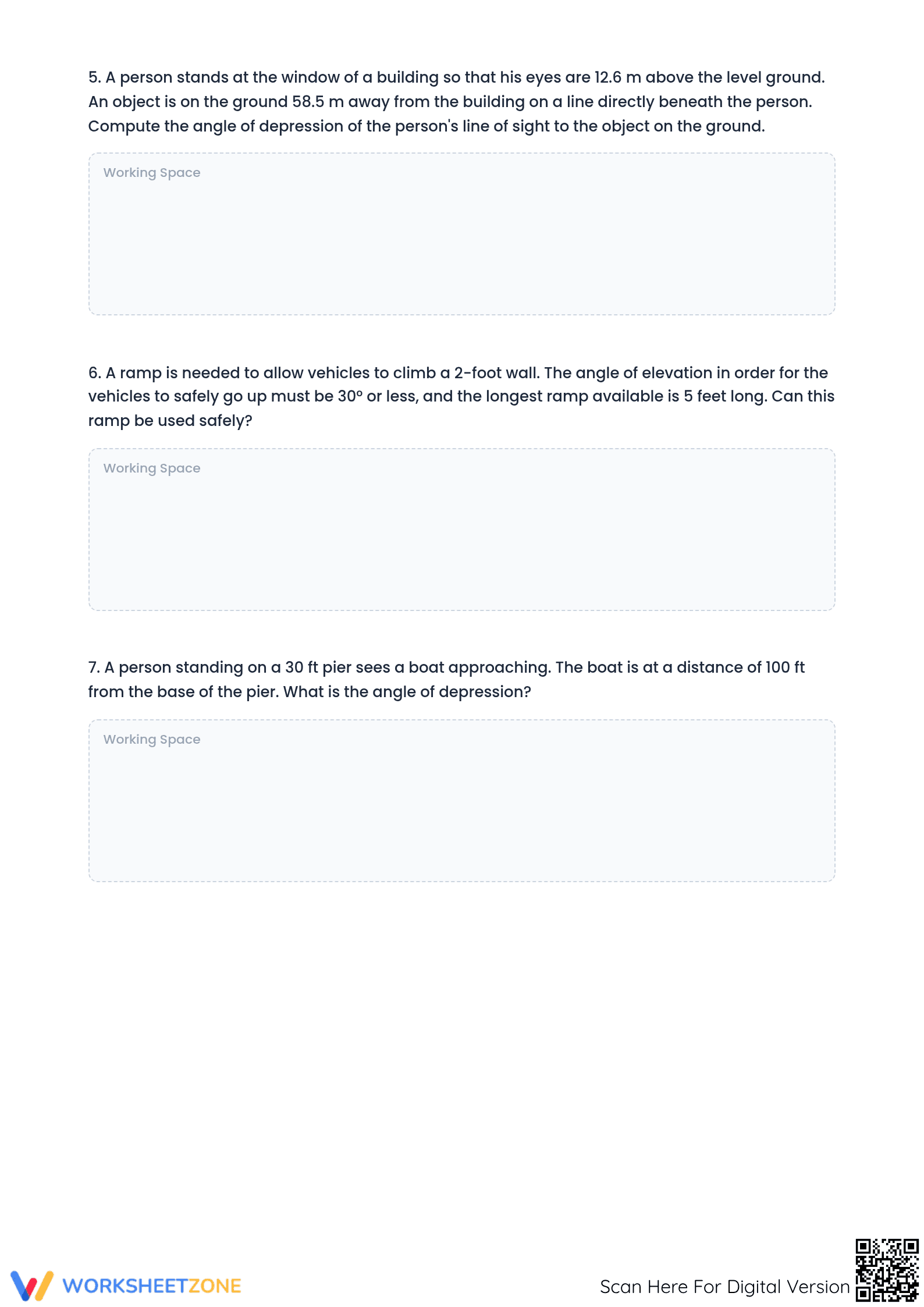
This comprehensive 4-page resource includes twelve distinct tasks designed to build geometric confidence. Part one features four diagram-based identification exercises to ensure conceptual clarity. Part two provides eight rigorous word problems covering diverse contexts such as aviation, construction, and maritime navigation. Each problem includes a dedicated working space box to encourage organized mathematical modeling and step-by-step calculations.
Zero-Prep Workflow
The zero-prep design ensures this resource is ready for immediate classroom implementation. Teachers can print and distribute the four-page packet in less than two minutes, making it an ideal choice for emergency sub plans or spontaneous review sessions. The clearly defined working spaces allow for efficient grading, while the included detailed answer key enables rapid feedback during or after the instructional period.
Standards Alignment
This resource is directly aligned to `HSG-SRT.C.8`: "Use trigonometric ratios and the Pythagorean Theorem to solve right triangles in applied problems." By requiring students to draw their own diagrams and set up trigonometric equations, the worksheet addresses the procedural and conceptual demands of the standard. This standard code can be copied directly into lesson plans, IEP goals, or district curriculum mapping tools.
How to Use It
Use this worksheet as a summative assessment following direct instruction on right-triangle trigonometry. Observe students as they translate text into diagrams to identify those struggling with spatial orientation. Alternatively, assign the word problems as a homework extension to reinforce the application of sine and cosine laws in practical contexts. Expected completion time is approximately 45 to 60 minutes.
Who It's For
This resource is tailored for high school Geometry students or Algebra 2 learners reviewing trigonometric foundations. It provides necessary scaffolds for students who need structured space to organize their work. Pair this worksheet with a right-triangle trigonometry anchor chart or a digital graphing calculator for a complete instructional experience that supports diverse learning styles in the secondary classroom.
The CCSS.MATH.CONTENT.HSG.SRT.C.8 standard requires students to apply trigonometric ratios and the Pythagorean Theorem to solve right triangles in real-world scenarios. This worksheet facilitates this mastery by providing structured practice in identifying and calculating angles of elevation and depression, which are critical components of spatial reasoning and geometric application. According to EdReports (2024), high-quality instructional materials that emphasize the application of geometric concepts to practical problems significantly improve student retention and procedural fluency. By bridging the gap between abstract trigonometric functions and concrete physical relationships, this resource supports the development of mathematical modeling skills. Students engage with diverse scenarios, from aviation to engineering, ensuring a comprehensive understanding of how vertical angles function within right-triangle trigonometry. The inclusion of dedicated working space and visual diagrams aligns with best practices for cognitive load management, allowing learners to focus on the mathematical logic required for accurate computation and problem-solving in advanced secondary mathematics.


