


























Views
Downloads

Angle Addition Postulate Notes | Essential Grade 10 Math
Paste this activity's link or code into your existing LMS (Google Classroom, Canvas, Teams, Schoology, Moodle, etc.).
Students can open and work on the activity right away, with no student login required.
You'll still be able to track student progress and results from your teacher account.
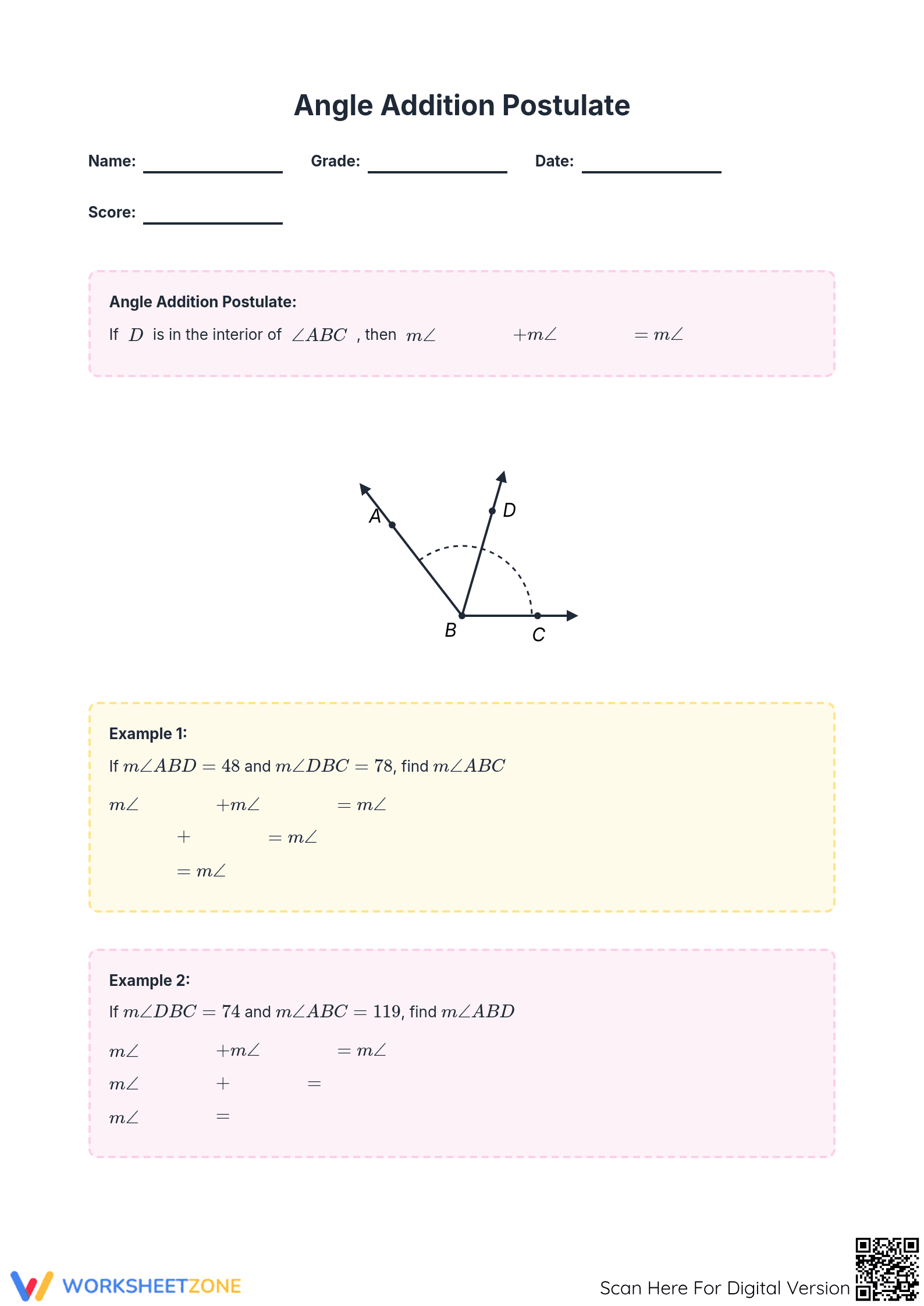
This Grade 10 Math worksheet provides a structured approach to mastering the Angle Addition Postulate. Students learn to define the relationship between adjacent angles and apply that knowledge to solve both numerical and algebraic geometric problems. By completing these guided notes, learners develop the precision required for higher-level geometric proofs and spatial reasoning.
At a Glance
- Grade: 10 · Subject: Geometry
- Standard:
HSG-CO.A.1— Use geometric definitions to solve for unknown angle measures and segments- Skill Focus: Angle Addition Postulate
- Format: 2 pages · 3 problems · Answer key included · PDF
- Best For: Introductory geometry lessons and guided notes
- Time: 20–30 minutes
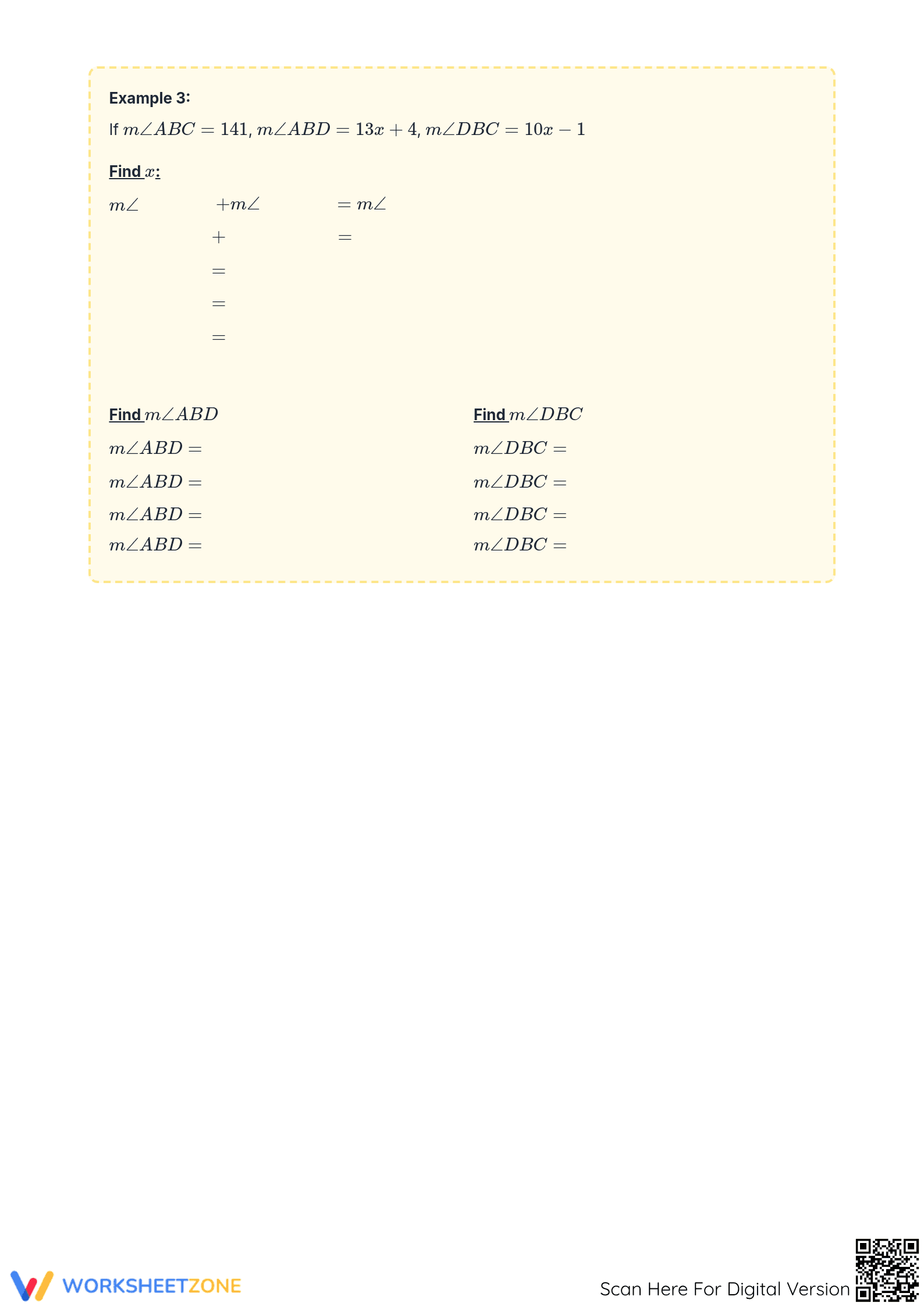
What's Inside: The resource consists of a 2-page PDF document designed for clarity and retention. Page one features a formal definition block where students fill in the postulate formula based on a provided diagram. It follows with two numerical examples: one requiring the sum of two parts and another requiring the subtraction of a part from the whole. Page two introduces algebraic complexity, challenging students to set up equations using expressions like 13x + 4 to find the value of x and subsequent angle measures.
The worksheet follows a deliberate instructional sequence. Guided Practice begins with a fill-in-the-blank definition and visual diagram to establish the conceptual foundation. Supported Practice in Examples 1 and 2 provides scaffolded equation lines where students plug in known values to find missing measures. Finally, Independent Practice in Example 3 requires students to apply algebraic substitution and multi-step equation solving to determine geometric values. This gradual-release model ensures students move from basic recognition to complex application.
Standards Alignment: The primary focus is HSG-CO.A.1, which requires students to use precise definitions of angles and segments. This worksheet specifically addresses the additive property of angle measures. Additionally, it supports HSA-REI.B.3 by integrating linear equation solving within a geometric context. Both standard codes can be copied directly into lesson plans, IEP goals, or district curriculum mapping tools.
How to Use It: This resource is ideal as a guided-notes template during the initial direct instruction of a Geometry unit. Teachers can project the worksheet and complete the first page together to model the "part + part = whole" logic. For a formative assessment, use the second page as a "check for understanding" exit ticket. Observe if students correctly set the sum of the two smaller angles equal to the total measure, which is a common point of confusion. Completion typically takes 25 minutes.
Who It's For: This worksheet is designed for high school Geometry students, particularly those in Grade 10. The clear layout and step-by-step equation lines make it an excellent resource for students with IEPs or those requiring extra scaffolding in math. It pairs naturally with a protractor activity or an anchor chart demonstrating adjacent angles.
The Angle Addition Postulate is a fundamental building block for geometric logic. According to Fisher & Frey (2014), scaffolded guided notes significantly improve student retention of mathematical definitions and procedural accuracy. This worksheet aligns with HSG-CO.A.1 by requiring students to translate visual geometric relationships into formal algebraic equations. Research indicates that students who master the transition from numerical to algebraic geometry in the 10th grade are more likely to succeed in advanced trigonometry and calculus. By providing three distinct levels of problem complexity, this resource ensures that learners move beyond rote memorization toward a functional understanding of spatial properties. The inclusion of a full 2-page answer key allows for immediate feedback, a critical component of the "I Do, We Do, You Do" instructional framework.


