


























Views
Downloads
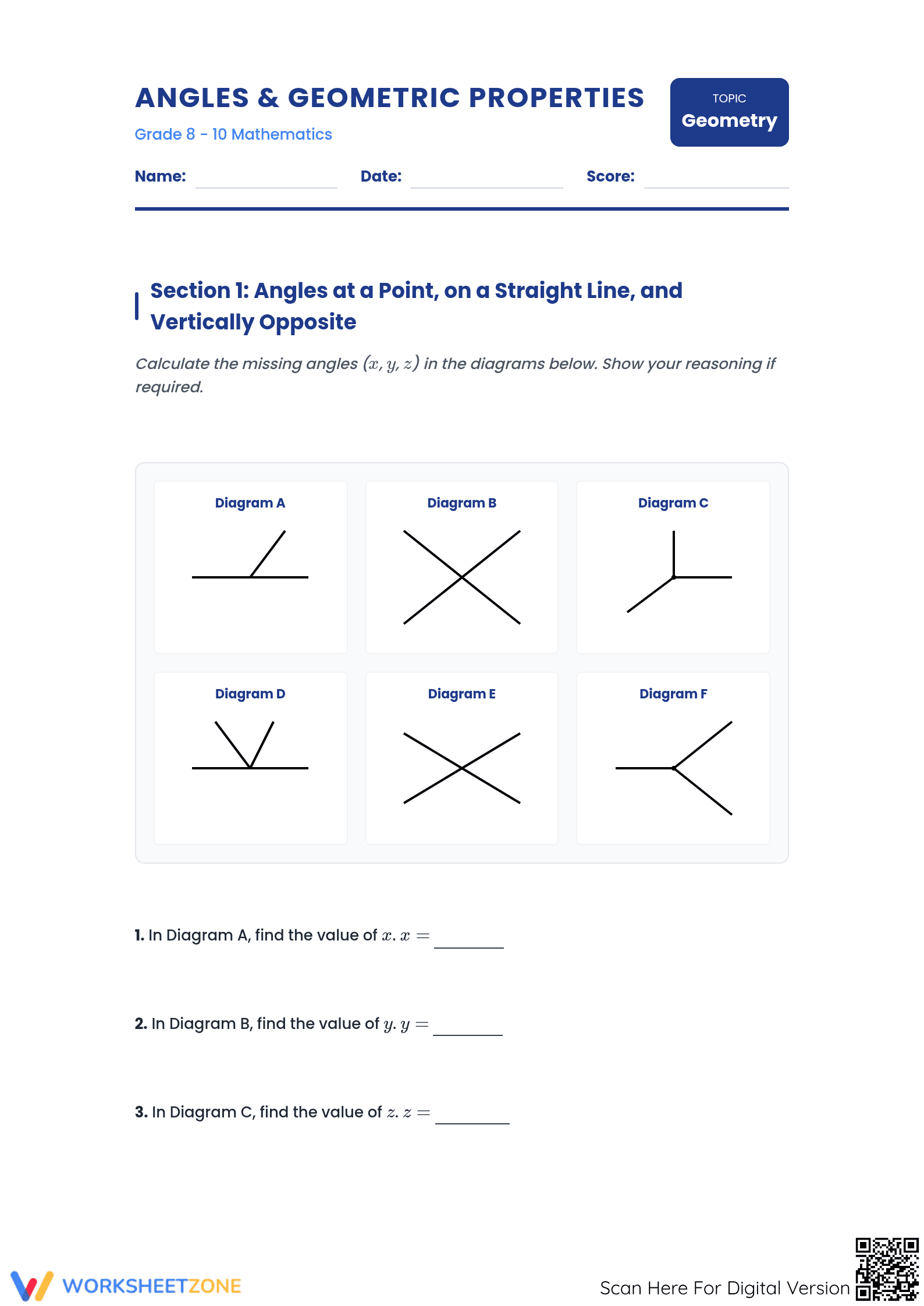
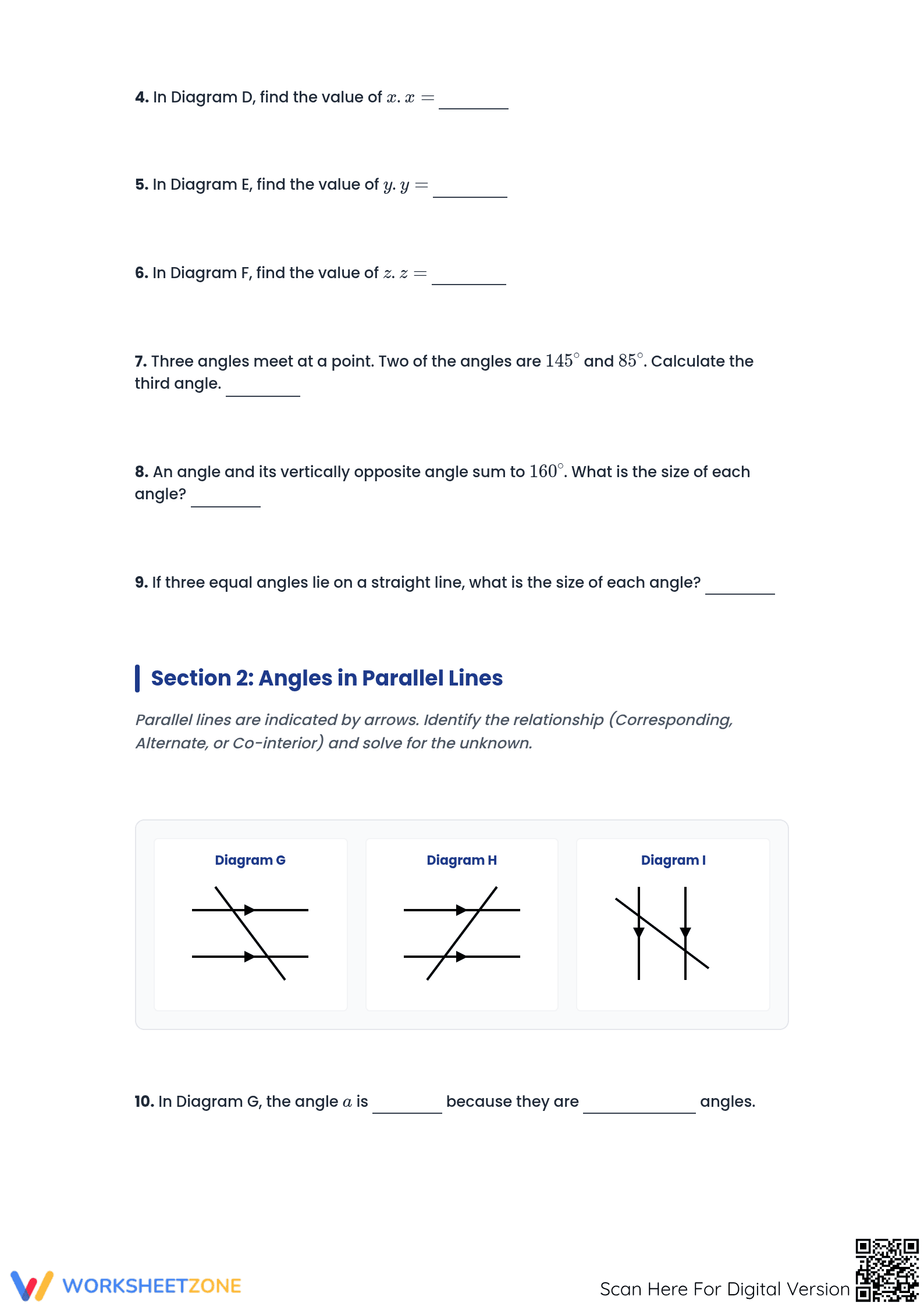
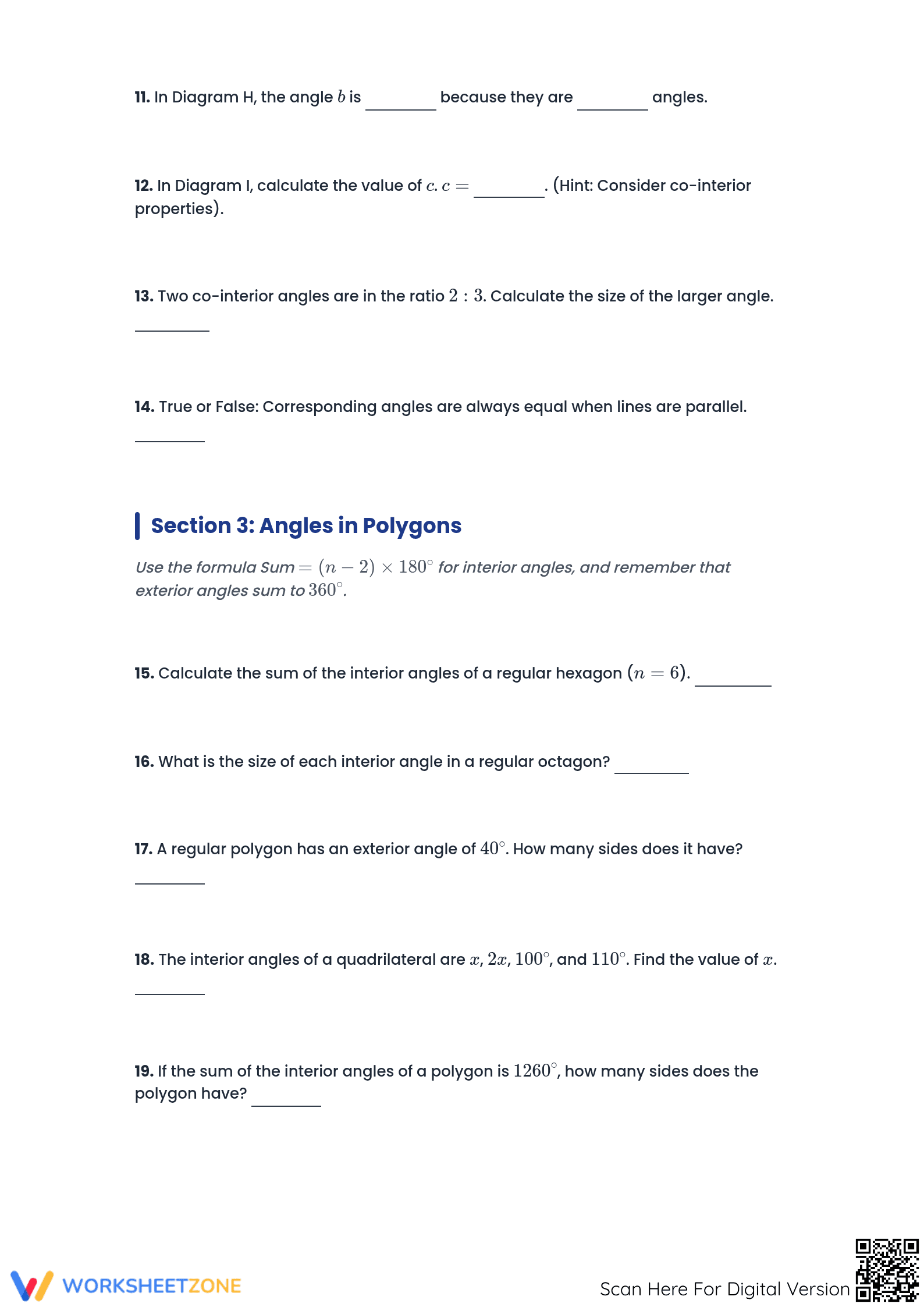
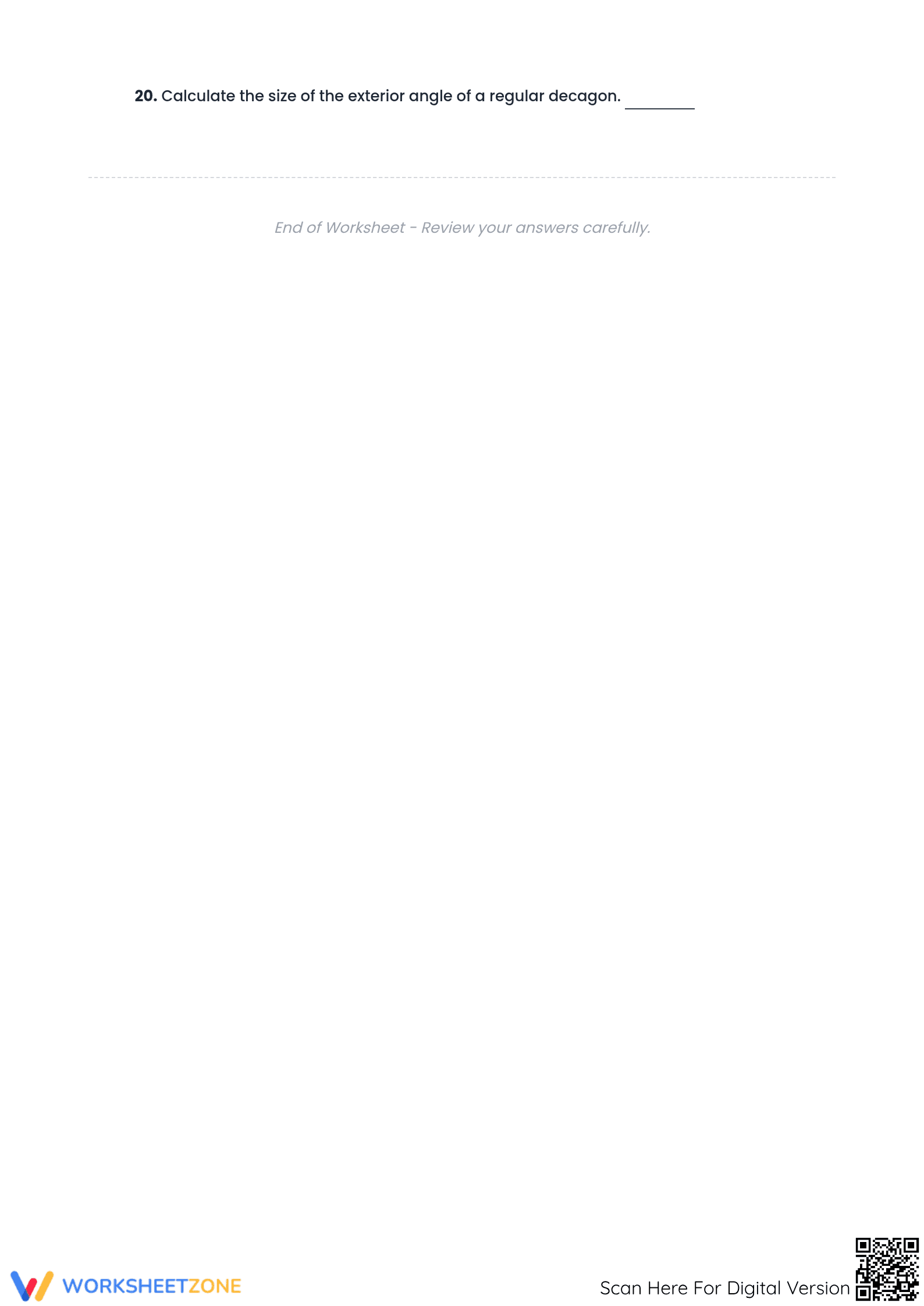

Essential Angles and Geometric Properties Worksheet
Paste this activity's link or code into your existing LMS (Google Classroom, Canvas, Teams, Schoology, Moodle, etc.).
Students can open and work on the activity right away, with no student login required.
You'll still be able to track student progress and results from your teacher account.
This comprehensive Grade 8-10 geometry worksheet provides students with 20 rigorous problems to master angle relationships across lines, transversals, and polygons. Students will calculate missing values using vertically opposite, supplementary, and interior angle properties to build geometric reasoning skills and mathematical fluency.
At a Glance
- Grade: 8-10 · Subject: Math
- Standard:
CCSS.MATH.CONTENT.8.G.A.5— Use informal arguments to establish facts about angles in parallel lines and polygons.- Skill Focus: Geometric Angle Properties
- Format: 4 pages · 20 problems · Answer key included · PDF
- Best For: Mid-unit practice or comprehensive review
- Time: 45–60 minutes
The 4-page PDF contains three distinct sections: basic line properties, parallel line transversals, and polygon angle sums. It includes visual diagrams for every problem, algebraic challenges involving ratios and variables, and a complete answer key for immediate feedback. The layout is clean and professional, ensuring students can focus on the geometric proofs and calculations without distraction.
Zero-Prep Workflow
- Print: Select the 4-page student set and the corresponding answer keys (1 minute).
- Distribute: Hand out to students for independent practice, partner work, or as a formal assessment (1 minute).
- Review: Use the provided answer key for whole-class grading or student self-correction (10 minutes).
Total teacher prep time is under 2 minutes, making this an ideal resource for sub plans or last-minute review sessions.
Standards Alignment
Primary standard CCSS.MATH.CONTENT.8.G.A.5: "Use informal arguments to establish facts about the angle sum and exterior angle of triangles, about the angles created when parallel lines are cut by a transversal, and the angle-angle criterion for similarity of triangles." This resource also supports high school geometry standards by requiring students to apply theorems about lines and angles. Both standard codes can be copied directly into lesson plans, IEP goals, or district curriculum mapping tools.
How to Use It
Use this as a summative review after teaching parallel line theorems and polygon formulas. It works well as a formative assessment during the "You Do" phase of a gradual release model. Teachers should observe students during Section 2 to ensure they correctly identify the relationship (alternate, corresponding, or co-interior) before calculating. Expect students to spend 45–60 minutes depending on their familiarity with the decagon and hexagon formulas.
Who It's For
Designed for Grade 8-10 students in Pre-Algebra or Geometry courses. It is particularly effective for students needing visual reinforcement of transversal relationships. This worksheet serves as a natural pairing for a direct instruction lesson on the interior angle sum formula (n-2) x 180.
This resource aligns with the instructional shifts identified in the RAND AIRS 2024 report, which emphasizes the importance of high-quality, standards-aligned materials in secondary mathematics. By focusing on CCSS.MATH.CONTENT.8.G.A.5, the worksheet ensures students develop the foundational geometric reasoning required for high school trigonometry. Research from Fisher & Frey (2014) suggests that structured practice with visual diagrams, like the 20 tasks provided here, significantly improves student retention of spatial relationships. The inclusion of algebraic variables within geometric contexts mirrors the rigor found in NAEP assessments, bridging the gap between basic calculation and abstract reasoning. This printable PDF serves as a reliable tool for teachers seeking to provide evidence-based practice that meets the demands of modern state frameworks while minimizing administrative preparation time.


