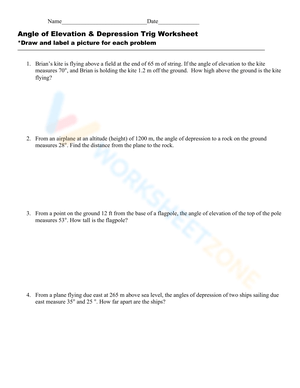
Angle of Elevation and Depression Trig Printable Worksheets for 10th Grade
These angle of elevation and depression trig printable worksheets for 10th grade close the gap between students who can recite sine, cosine, and tangent definitions and students who can actually use them to find the height of a cell tower or the distance from a ship to a cliff. Each worksheet builds the same disciplined setup routine: locate the horizontal reference line, place the angle correctly above or below it, sketch the implied right triangle, label the three sides from the reference angle's perspective, and then — only then — reach for the calculator.
What Each Worksheet Has Students Practice
The skills here sit at the intersection of reading comprehension, geometric reasoning, and algebraic calculation — which is exactly why this topic is a consistent source of difficulty in Grade 10 Geometry. Students are not just solving a triangle; they are translating a real-world scene into a mathematical model before any calculating begins. Items on each worksheet progress from recognition tasks to single-step applications to multi-step word problems that require students to extract all necessary information themselves.
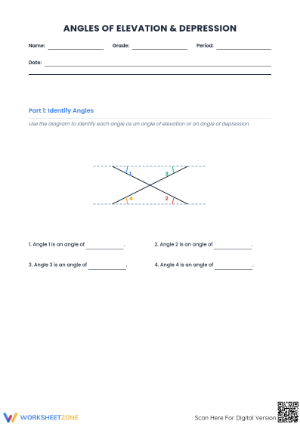
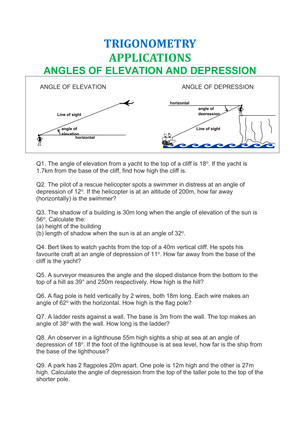
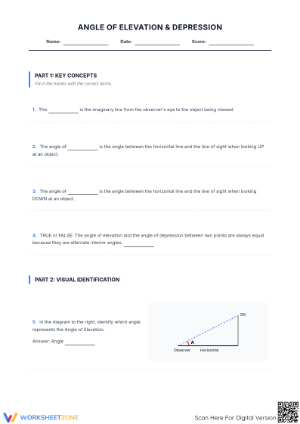
- Distinguishing an angle of elevation from an angle of depression given a diagram or a prose description
- Drawing a right triangle from a written scenario and correctly placing the horizontal reference line
- Labeling opposite, adjacent, and hypotenuse from the reference angle — not from habit or a memorized layout
- Choosing sine, cosine, or tangent based on which two sides appear in the problem
- Recognizing when an angle of depression and an angle of elevation in the same scenario are equal, because the horizontal lines are parallel and the line of sight acts as a transversal
- Attaching units to every answer and checking whether the result is geometrically reasonable
That final reasonableness check gets cut from a lot of classroom time, but these worksheets include a brief prompt at the end of word problems that asks students to verify their answer against the scene. A student who calculates a building height of 900 feet when the observer stood only 50 feet away needs to catch that mismatch before moving on — and the prompt builds the habit of looking back. These angle of elevation and depression trig printable worksheets for 10th grade treat that self-checking step as part of the problem-solving routine, not an afterthought.
Student Mistakes Worth Watching For and Correcting
The single most common setup error is measuring the angle from a vertical reference rather than a horizontal one. Students who just finished a segment on complementary angles sometimes carry that vertical-line habit into these problems and construct an entirely different triangle than the one described. Asking students to trace the horizontal line in pencil before touching anything else in the diagram addresses this directly — it turns an invisible assumption into a visible first step.
The second persistent error involves angle of depression situations. Students frequently fail to see that the angle of depression from an elevated observer equals the angle of elevation from a point on the ground below — because the two horizontal lines are parallel and the line of sight is a transversal, making these alternate interior angles. This relationship is almost always in students' notes from earlier in the course, but the connection does not transfer automatically. Worksheets that present the same scenario twice — once from the cliff looking down, once from the ground looking up — make the equality explicit rather than assumed.
A third error is subtler but just as consistent: students label the sides of the triangle from a memorized position rather than from the actual reference angle in the current problem. When the given angle is at the top of the triangle instead of the base, a student who always places the opposite side at the top and the adjacent side along the ground will invert the ratio and reach a wrong answer every time. Requiring students to circle the reference angle and write its name before labeling forces a fresh start on each item rather than a pattern match.
Fitting These Worksheets Into Your Lesson Plans
The two-item bell ringer is one of the most productive uses for this set. Putting one elevation problem and one depression problem on the board before the lesson begins activates prior knowledge and surfaces setup errors before new content arrives. Collecting those slips takes under three minutes, and sorting them tells a teacher exactly who confused the two angles, who skipped the diagram, and who chose the wrong ratio — all before direct instruction starts.
For a full lesson cycle, a structured sequence works well: teacher models one problem aloud and narrates every decision from "where is the horizontal line?" through "does this answer fit the scene?"; students work a second problem with verbal prompts; and the worksheet carries independent practice from there. Because each worksheet preserves space for setup work and labeled diagrams — not just a final numerical answer — teachers can assess reasoning during a walkabout rather than waiting to collect papers.
The day before a unit test is another natural fit. A mixed-review worksheet — some items with diagrams, some with word descriptions only — gives students an honest preview of what the test demands. Students who stumble on no-diagram items during review come to the test more prepared than those who only practiced from pre-labeled figures. Substitute teachers also find this format workable because the step-by-step setup is easy to explain and the answer key handles self-correction without additional instruction.
Adjusting These Worksheets for a Range of Learners
The most practical strategy for a mixed-ability class is to run two versions of the same problem set. Version A provides a completed diagram — triangle drawn, horizontal line marked, angle labeled — so students supply the trig equation and solved answer. Version B presents only the word description and expects students to construct the diagram themselves. Both versions assess the same standard and share an answer key; the only difference is in how much diagram support arrives with the problem.
For students who are still uncertain about ratio selection, a small reference box at the top of the worksheet — SOH-CAH-TOA with side labels illustrated — removes one retrieval demand so the lesson can focus entirely on setup. This is not a permanent fixture; it gets removed as students gain fluency, leaving diagram construction and angle identification as the only variables being targeted.
Students who finish quickly benefit from a built-in extension: reverse the known and unknown quantities in each word problem and solve again. If the original problem asks for the height of a lighthouse given the angle and horizontal distance, the extension asks for the angle given the height and distance — which requires inverse trig and a fundamentally different direction of reasoning. That reversal is often the task that separates students who know the procedure from students who understand why it works.
Standard Alignment
These worksheets address CCSS.MATH.CONTENT.HSG-SRT.C.8: "Use trigonometric ratios and the Pythagorean Theorem to solve right triangles in applied problems." In classroom terms, this standard appears in Grade 10 Geometry after students have worked with basic right-triangle ratios and before the course moves toward the Law of Sines and Cosines. The "applied problems" language in the standard is precisely what makes elevation and depression the central vehicle for meeting it — the real-world context (towers, observation points, ramps, flight paths) is what separates applied problem-solving from pure ratio identification. Teachers preparing students for state assessments should note that angle of elevation and depression trig printable worksheets for 10th grade map directly to this standard's applied-problem requirement, not just to the ratio-recall portion of HSG-SRT.
Frequently Asked Questions
Do these worksheets include answer keys?
Yes. Each worksheet comes with a full answer key showing the trig equation, the setup work, and the rounded final value. Teachers can use the key for quick grading, student self-correction after independent practice, or walking through solutions during a class discussion.
How many problems does each worksheet include?
Problem counts vary by worksheet type. Focused single-skill worksheets typically carry 6–10 items — enough repetitions to build a consistent setup routine without hitting fatigue. Mixed-review sets run longer and work well as chapter review or test-preparation tools.
Are diagrams provided, or do students draw their own?
Both types appear in the set. Some worksheets provide a labeled diagram with the angle and relevant measurements already placed; others present a word description and require students to produce the diagram from scratch. Both skills appear on assessments, so working through both formats before a test matters. These angle of elevation and depression trig printable worksheets for 10th grade include both types so teachers can sequence them by difficulty or mix them for deliberate variety within a single session.
At what point in a trigonometry unit should these worksheets be introduced?
After students are fluid with sine, cosine, and tangent in basic right-triangle problems — but not before. Introducing elevation and depression problems while ratio selection is still uncertain piles on too many simultaneous demands. Most Grade 10 teachers find the second or third week of the right-triangle trig unit is the right entry point, once students can select a ratio without pausing to check their notes on every item.
Clear All