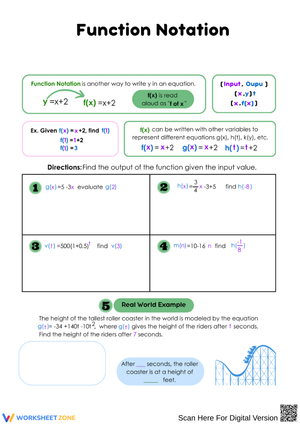
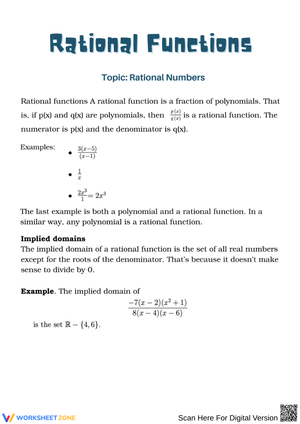
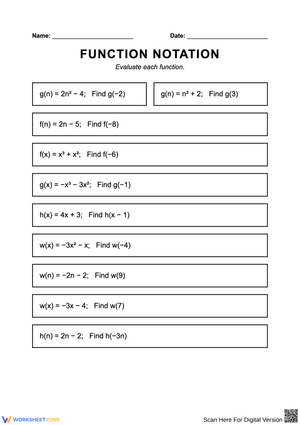
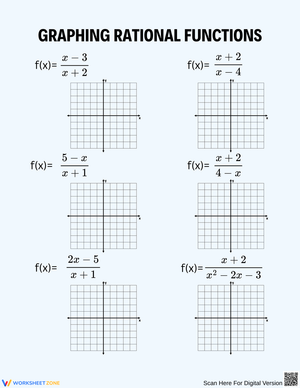
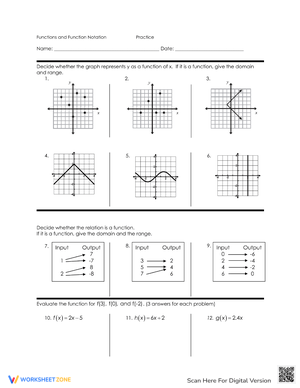
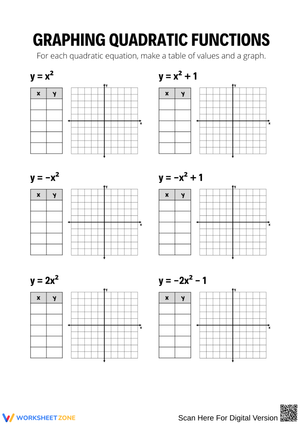
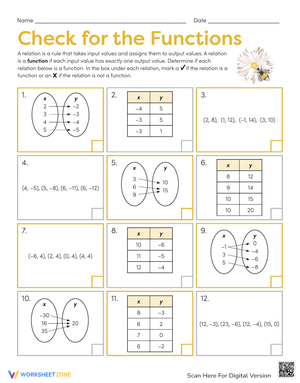
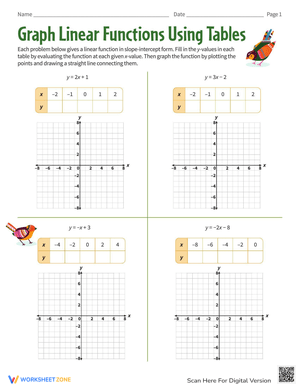
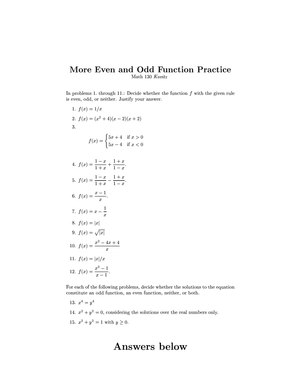
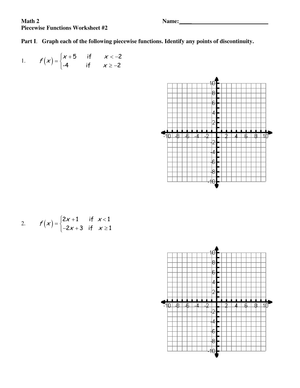
These 10th grade functions printable worksheets address the central difficulty in a Grade 10 algebra unit: students who can evaluate f(4) without trouble will often fail to recognize the same input-output relationship when it appears as a table, a graph, or a verbal description. The worksheets cover function notation, domain and range, identifying functions from multiple representations, graph interpretation, and basic comparison of function families — everything a teacher needs from the opening lesson of a functions unit through the session before the formal assessment.
What Each Worksheet Covers
The set spans the full range of Grade 10 function skills rather than clustering around a single procedure. Individual worksheets address:
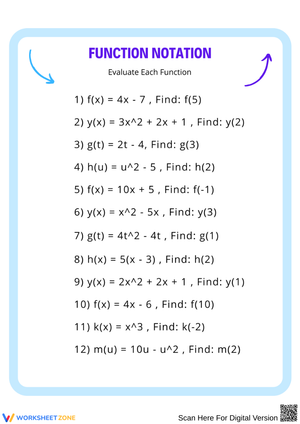
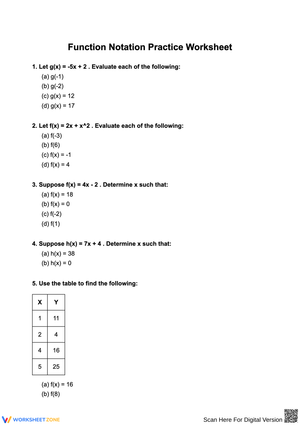
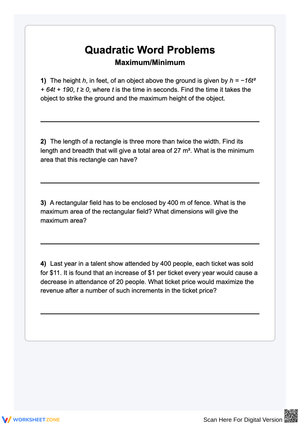
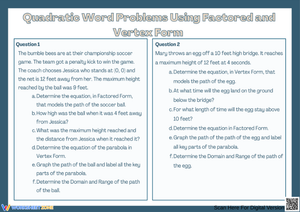
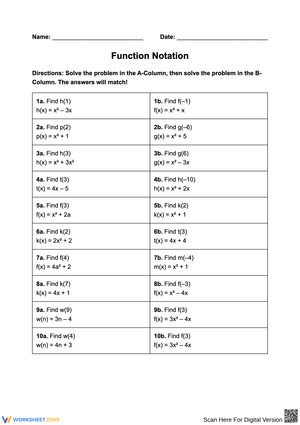
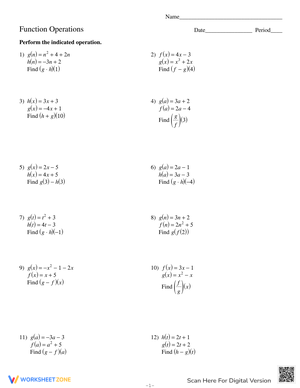
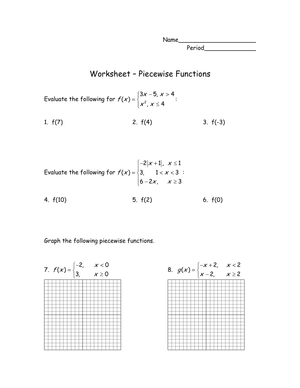
- Function notation: evaluating expressions like f(-3) and g(2x), interpreting what f(a) = 7 means in a given context, and writing a rule from a described relationship.
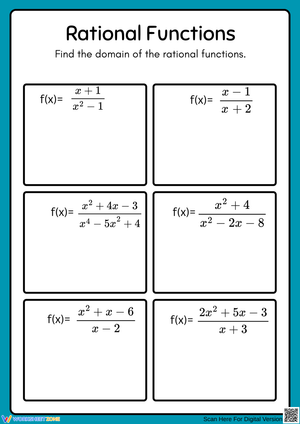
- Domain and range: reading restrictions from graphs with open and closed endpoints, identifying implied domain limits in equations like f(x) = √(x − 5), and listing domain and range from discrete tables.
- Identifying functions: applying the vertical line test, checking whether tables or sets of ordered pairs represent functions, and distinguishing relations from functions in mapping diagrams.
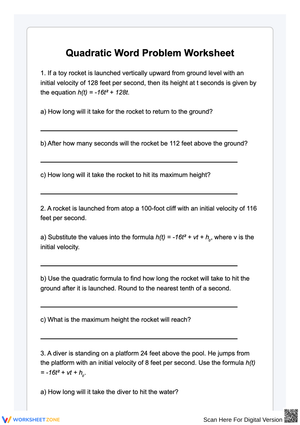
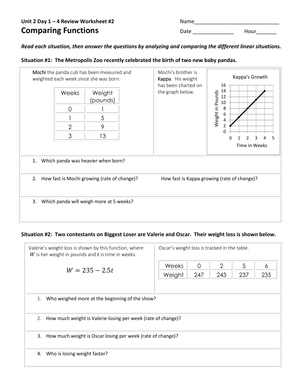
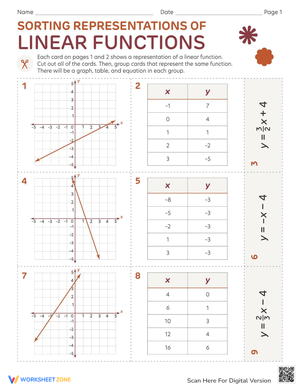
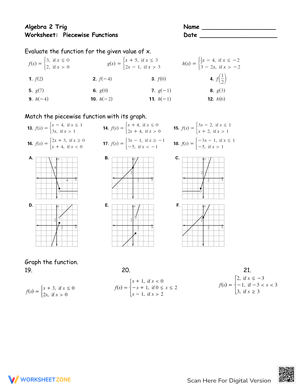
- Multiple representations: matching equations, graphs, tables, and verbal descriptions that describe the same function — moving in any direction between those forms, not just converting from equation to graph.
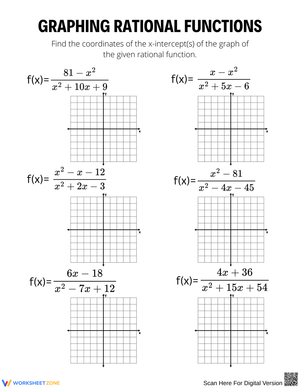
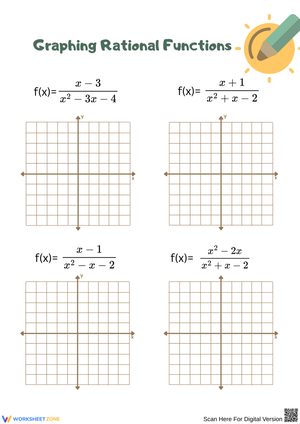
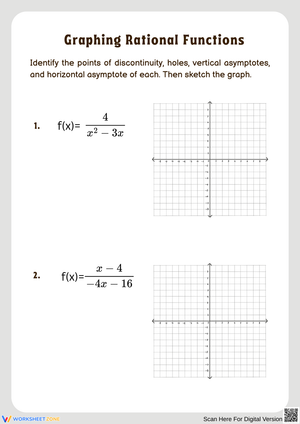
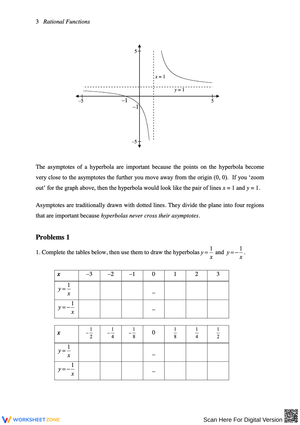
- Graph interpretation: locating intercepts, reading intervals of increase and decrease, and interpreting what specific output values mean in a real-world context.
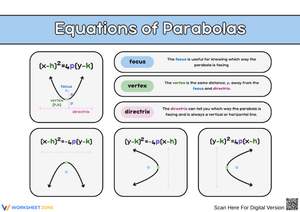
- Comparing function types: recognizing differences in shape, rate of change, and long-term behavior between linear, quadratic, and exponential functions presented side by side.
Each worksheet isolates one of these areas or combines two or three for a fuller practice session. Teachers working through a multi-week unit can pull a single worksheet to match the day's learning target rather than running through a full review every time a concept is introduced.
Predictable Student Errors Worth Catching Early
Certain mistakes appear so reliably in Grade 10 function work that experienced teachers almost anticipate them by name. The most stubborn is the f(x)-as-multiplication error: students read f(3) as "f times 3," accidentally arrive at correct numerical answers through substitution, and then collapse entirely on a problem that asks what f(a) = 5 means in a context. They have been performing a procedure correctly without building the underlying understanding. A related confusion surfaces with domain — students who accurately state "all real numbers" for a linear function apply the same answer to f(x) = 1/(x − 2), never registering the restriction at x = 2. Both errors become visible when students work through the varied problem types included in 10th grade functions printable worksheets, particularly when a single worksheet places direct substitution, domain identification, and notation interpretation side by side.
A third gap shows up in representation transfer. Students often verify that a graph passes the vertical line test and then stumble when the same relation appears as a table of ordered pairs — checking whether outputs repeat instead of inputs. That exact reversal is difficult to detect from a quiz that tests only one representation. Worksheets that present the same relationship as both a graph and a table make it straightforward to see whether a student's understanding holds across forms or only in one.
Building These Worksheets Into Your Weekly Lesson Plan
The most useful organizational move is to sort worksheets by which representation appears first in the problem, not by topic alone. Keep separate folders for worksheets that open with a graph, those that open with a table, and those that open with an equation or verbal rule. Students who look secure in one form of a function often struggle the moment the same concept leads with a different representation. That sorting makes targeted small-group practice far more efficient and helps teachers spot gaps before they become entrenched.
Early in a unit, use focused single-skill worksheets as a warm-up check: a five-item function notation page at the start of Monday's class lets a teacher scan quickly for students writing "f · 3" rather than substituting correctly. Mid-unit, mixed-representation worksheets work well as a 15-minute partner task — one student reads from the graph while the other builds the table, then both write the equation. Before an assessment, a review worksheet that cycles through notation, domain and range, graph interpretation, and function comparison gives teachers a fast picture of where reteaching is still needed. In station rotations, one station evaluates function notation, a second works through domain restrictions from graphs, and a third compares a linear function and an exponential function given in different forms. Because students record work directly on each worksheet, teachers have a written record of reasoning rather than just verbal responses — useful in any class where exit tickets and formal assessments are the only other artifacts of student thinking.
Standard Alignment
Two CCSS High School Functions standards anchor this worksheet set. HSF-IF.A.1 defines the function concept formally — exactly one output for each input — and requires students to use function notation and interpret it in context. This is the standard that surfaces the f(x)-as-multiplication confusion; fluency with notation is its specific expectation. HSF-IF.B.4 asks students to interpret key features of graphs and tables in terms of real quantities: intercepts, increasing and decreasing intervals, and relative maximums and minimums. In classroom terms, that standard appears whenever a teacher asks "what does this point on the graph actually mean?" A worksheet set that addresses both standards covers the procedural and interpretive demands of the unit without treating them as separate concerns.
Adapting the Set for Classrooms With Mixed Readiness Levels
Students in the same 10th grade class can range from those who still need to rebuild what a relation is to those who are ready to analyze function behavior across multiple types. The worksheets accommodate that range through deliberate selection rather than internal tiering.
For students who need more structured support, start with worksheets that present one representation at a time — a table only, or a graph only — and ask a single question type: "Is this a function? How do you know?" Adding a worked reference example at the top of the page and having students explain their reasoning aloud to a partner reduces the number of simultaneous demands on working memory without changing the mathematical target. For students ready for deeper work, the comparison and multi-representation worksheets ask questions that require genuine interpretation: which of these two functions grows faster after x = 3, and what in each representation shows that? Using 10th grade functions printable worksheets this way — selecting different worksheets for different groups based on readiness rather than giving every student the same page — is what actually moves students forward across a full unit.
Frequently Asked Questions
When during a functions unit should multiple-representation tasks appear?
Not at the start. Students need time with each representation individually before the work requires translation between forms. A practical sequence: spend the first week on function notation and single-representation identification, then introduce matching and comparison tasks in the second week when students have enough fluency with individual forms to sustain the transfer. Introducing mixed-representation worksheets on day two typically produces frustration rather than insight.
Do these worksheets work for students who are still developing foundational algebra skills?
The notation-focused and function-identification worksheets work for students who can substitute values, read graphs at a basic level, and recognize input-output pairs. Students who have not yet built those foundations will need additional direct instruction before practice worksheets become productive. For those students, pairing the worksheet with a reference card covering the relevant notation convention is a workable bridge.
What is the most efficient way to use these worksheets for assessment preparation?
A single review worksheet that spans notation, domain and range, graph interpretation, and function comparison covers the core assessment targets in one sitting. The most efficient follow-up is to address only the items where several students made the same error — a focused whole-class discussion of one or two key mistakes is faster and more durable than revisiting the entire unit. This is where 10th grade functions printable worksheets deliver the most classroom value: they generate a written record of student thinking that makes those targeted conversations possible, rather than leaving teachers to reconstruct errors from memory.













 Interactive Worksheet Maker
 Quiz Maker
 Word Search Maker
 Crossword Puzzle Maker
 Word Scramble Generator
 Sentence Scramble Generator
 Handwriting Worksheet Generator
 Name Tracing Generator
 Fill In The Blank Generator