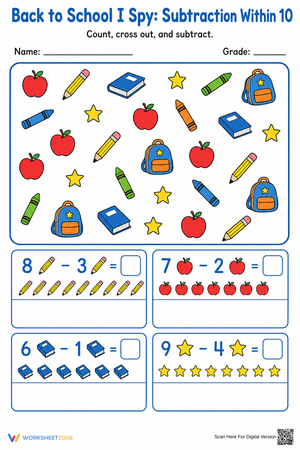
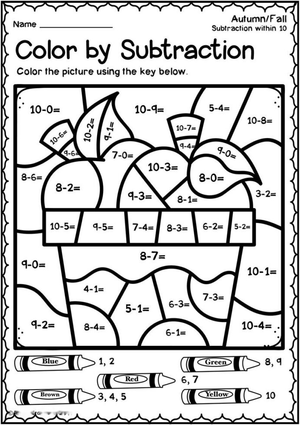
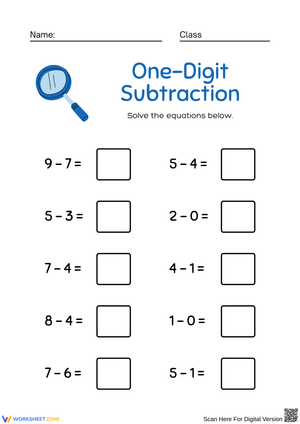
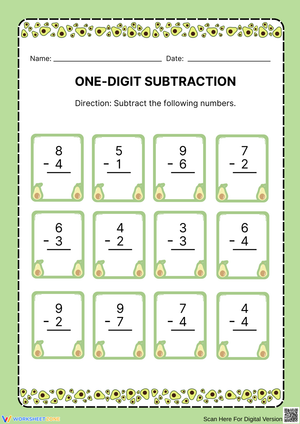
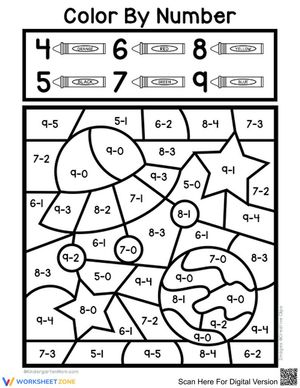
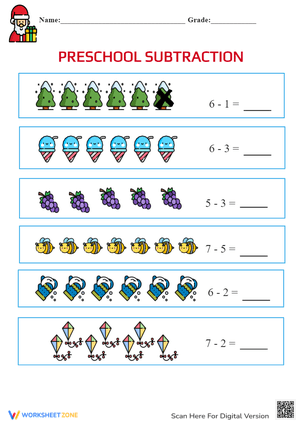
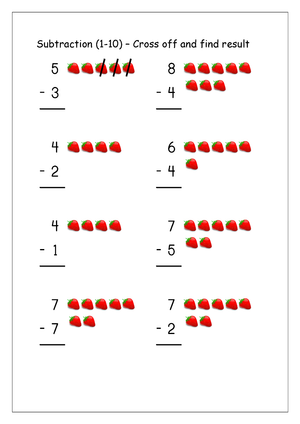
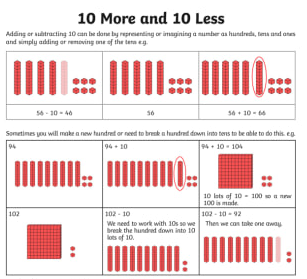
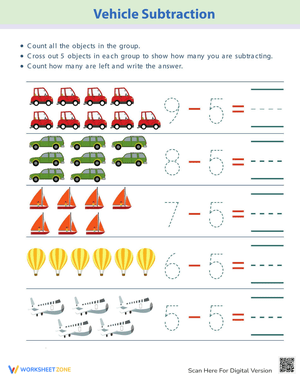
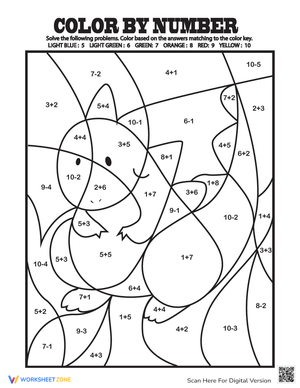
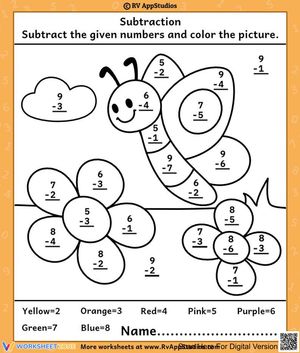
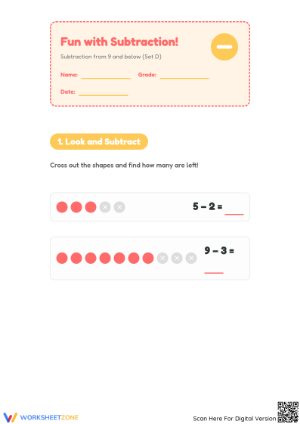
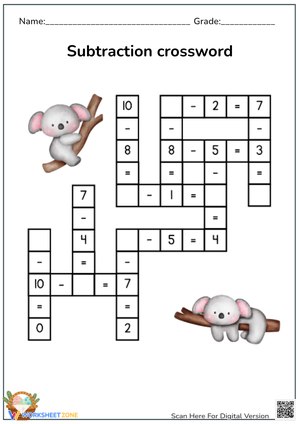
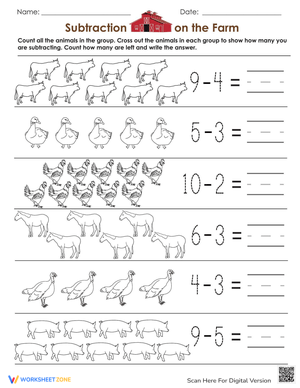
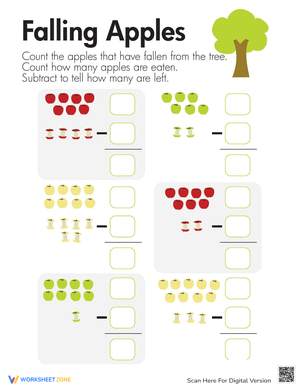
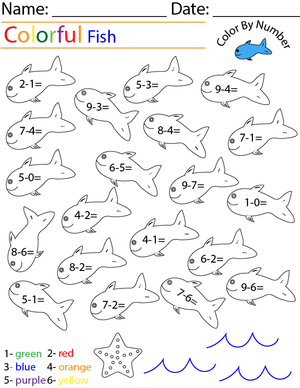
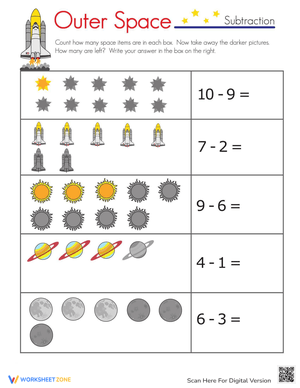
These 1st grade subtraction within 10 worksheets give teachers a specific, varied practice set built around the developmental arc first graders actually follow — from concrete counting toward internalized fact fluency. The set spans ten-frame models, number line tasks, bare equations in horizontal and vertical formats, and short word problems, giving teachers distinct formats to sequence across the unit rather than repeating the same structure day after day.
What These Worksheets Ask Students to Do
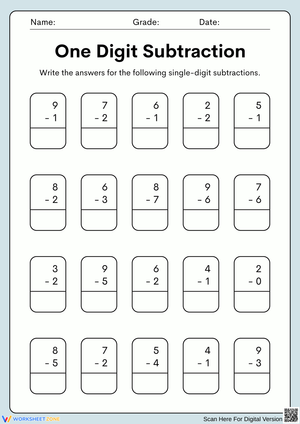
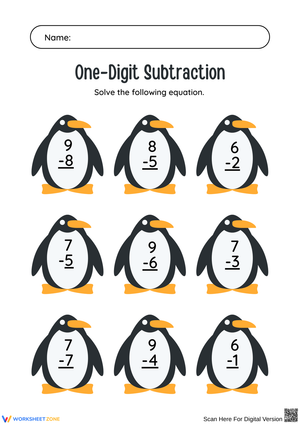
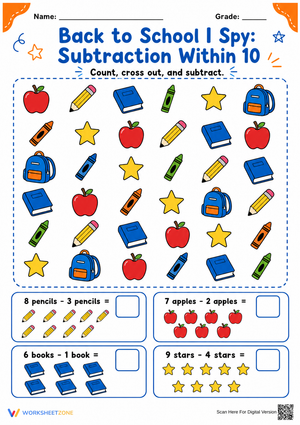
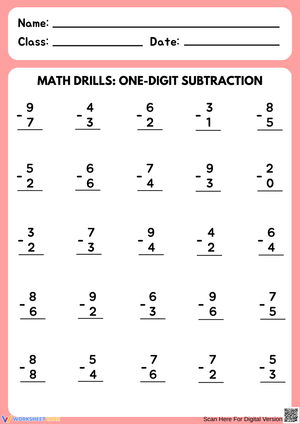
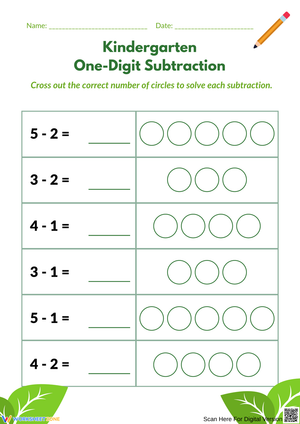
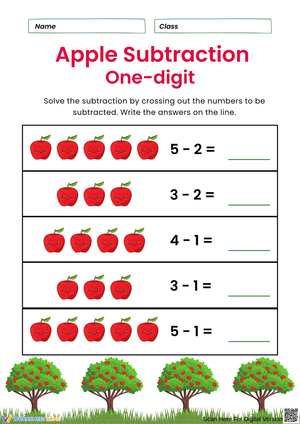
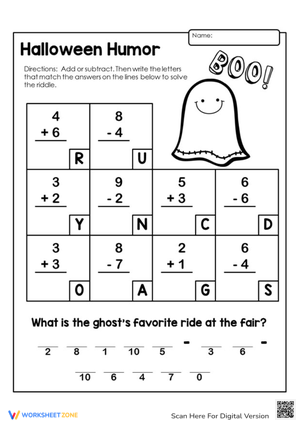
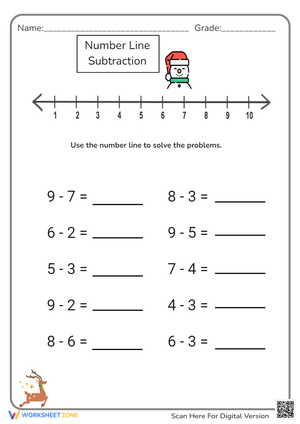
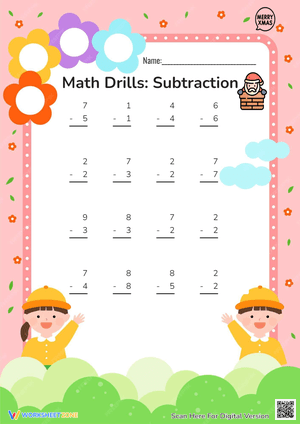
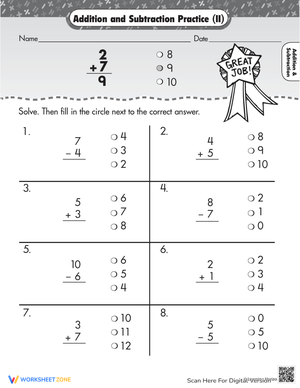
Ten-frame worksheets ask students to shade remaining dots after crossing out a given quantity, which externalizes the "taking away" action before it becomes mental. Number line worksheets ask students to mark a starting value and draw backward hops — students who physically move left on a number line understand that subtraction moves toward smaller values in a way that bare equation practice doesn't always convey. Equation worksheets appear in both horizontal and vertical arrangements, because the vertical format trips up first graders who learned to read left to right and apply that habit to math problems. Word problems use single-sentence prompts with quantities under 10, written at a reading level where decoding doesn't compete with the arithmetic.
Why Pairing Visual Models With Equation Practice Builds Durable Fluency
At the start of first grade, most students compute by reconstructing — they count all, or count back, using fingers or drawn marks. Fluency means shifting from reconstruction to recognition: seeing 8 − 3 and retrieving 5 without rebuilding the problem. That shift requires two things: repeated exposure to the same fact, and multiple representations of that fact so the student doesn't only recognize it in one format. Ten-frames build spatial memory — a student who sees 10 dots with 4 removed doesn't count; they recognize a familiar arrangement. Number lines build ordinal reasoning. When the same subtraction fact appears across both visual formats and then as a bare equation, students have three retrieval pathways, which is what makes the knowledge hold when the format changes on a quiz or the problem appears mid-word-problem instead of in isolation.
Student Mistakes Worth Watching For in This Unit
Direction reversal is the most consistent error in subtraction within 10. Students who see 8 − 3 presented vertically sometimes compute 3 − 8 instead, reversing the order because they begin with whichever number appears first in their visual scan from the top. This is especially common in the first two weeks of vertical-format practice. A second pattern surfaces around zero: students who solve 7 − 3 confidently will pause at 7 − 0 or 5 − 5 and write 0 for both, reasoning either that "nothing happened" or that "both numbers disappeared." The most efficient correction is to group all zero problems on a single day and ask students to prove each answer using a ten-frame — showing that 7 − 0 leaves all seven dots intact resolves the misconception faster than marking wrong answers repeatedly across multiple sessions.
Working These Worksheets Into Your Weekly Routine
Ten-frame worksheets work well as Wednesday morning work following Tuesday's direct instruction — a consolidation task students can settle into while attendance is taken and the room organizes itself. Number line worksheets fit better inside the math block itself, either as independent practice or in a partner format where one student marks the hops and the other records the equation. These 1st grade subtraction within 10 worksheets hold up well in laminated math center rotations; students complete them with dry-erase markers, erase, and rotate to the next problem, which conserves paper and keeps the center reusable across the week without reprinting.
Small-group time is where the diagnostic value of these worksheets becomes clearest. Pulling three students who are consistently reversing subtraction direction and working through six equations together — watching each student mark their starting number before drawing hops — gives corrective feedback that silent independent practice cannot replicate. For students who finish any worksheet quickly and accurately, asking them to write a second equation using the same three numbers (if 7 − 3 = 4, then also 7 − 4 = 3) extends the work into fact-family thinking without requiring a separate resource.
Standard Alignment
These 1st grade subtraction within 10 worksheets address CCSS.MATH.CONTENT.1.OA.C.6, which requires students to demonstrate fluency for addition and subtraction within 10. Fluency under this standard means accuracy paired with the kind of retrieval speed that doesn't require reconstructing the problem from scratch on every attempt — students should eventually solve 9 − 4 without rebuilding it each time. The standard sits downstream of K.OA.A.2 (adding and subtracting within 10 with objects and drawings) and upstream of 2.NBT.B.7 (adding and subtracting within 1,000 using place-value strategies). Meeting 1.OA.C.6 well means students enter second grade without basic-fact retrieval competing with the new cognitive demands of regrouping.
Adjusting Practice Across Ability Levels in the Same Classroom
For students still anchored to finger-counting, pair the ten-frame worksheets with physical counters: students build the problem with manipulatives first, then mark the worksheet to match what they constructed. This bridges tactile and visual representations without demanding abstract recall before students are ready for it. Students in the middle of the fluency progression — accurate but slow — benefit most from the number line format, which gives them a reliable procedure to trust while faster retrieval is still developing. For students who have already internalized most facts within 10, word problem worksheets can be extended: ask them to underline the key quantity words, write the subtraction equation, then write the related addition equation that confirms the answer. This surfaces fact-family thinking without requiring a separate set of materials or a pull-out resource.
Frequently Asked Questions
Do these worksheets need to be used in a specific order?
Start with ten-frame worksheets before number line worksheets. Ten-frames connect directly to counting objects — a skill students already have — while number lines require ordinal understanding that takes several weeks of first grade to consolidate. Introduce word problems after students can solve bare equations with minimal hesitation, so reading comprehension and arithmetic aren't competing in the same problem at the same time.
A student gets every problem right but takes two to three minutes per equation. What does that tell me?
Accuracy without speed means the student has a working procedure but hasn't internalized the fact — they're reconstructing it each time rather than retrieving it. These students benefit from repeated passes through the same worksheet over several days (spaced retrieval practice) rather than exposure to new problem sets. Adding more variety before the facts are locked in can actually slow the shift from reconstruction to recognition.
Can these be sent home for homework without confusing parents?
Ten-frame and number line worksheets travel home well because the visual structure gives families enough context to follow the work without requiring an explanation of classroom methods. The one format that occasionally generates parent questions is the part-part-whole diagram; attaching a one-sentence note — "this box shows which two parts combine to make the whole number at the top" — prevents most of the homework-time friction these tend to produce.
Are these suitable for formative assessment purposes?
The 1st grade subtraction within 10 worksheets in this set are practice tools, not controlled assessments. They yield useful formative information — you can see which problems a student skips, erases twice, or answers incorrectly in a consistent pattern — but error patterns on practice work don't substitute for a structured assessment where timing and conditions are controlled. Use these worksheets to identify who needs small-group time before a unit check, not as the check itself.













 Interactive Worksheet Maker
 Quiz Maker
 Word Search Maker
 Crossword Puzzle Maker
 Word Scramble Generator
 Sentence Scramble Generator
 Handwriting Worksheet Generator
 Name Tracing Generator
 Fill In The Blank Generator