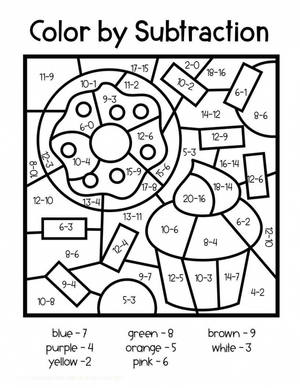
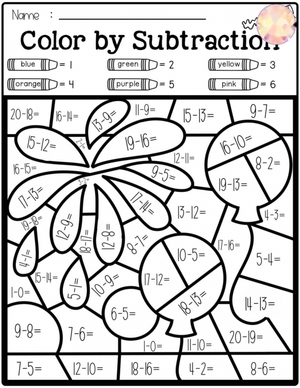
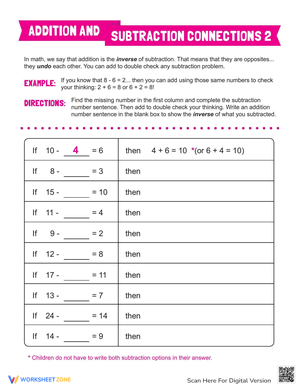
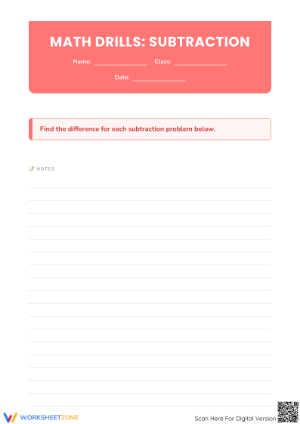
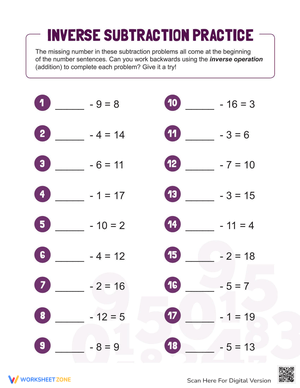
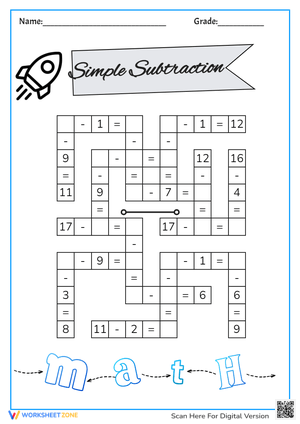
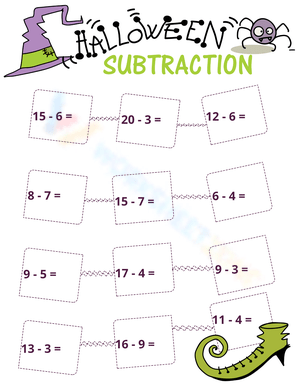
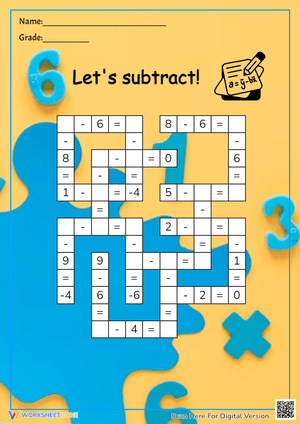
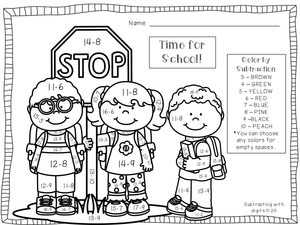
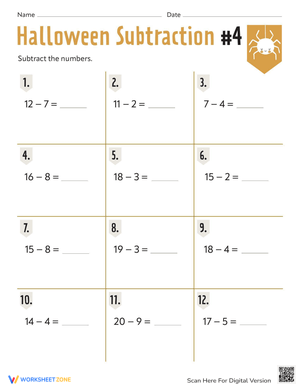
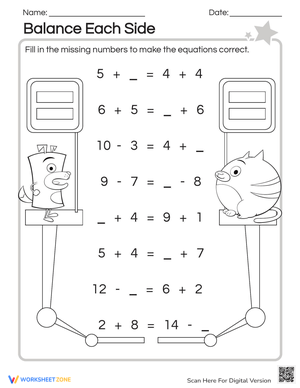
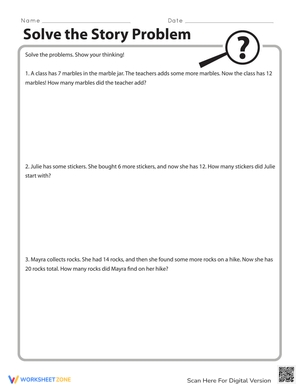
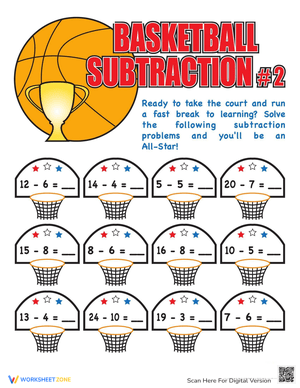
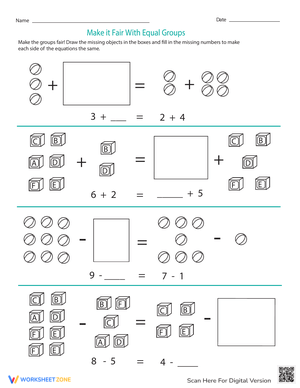
These subtraction within 20 printable worksheets for 1st grade give teachers a focused set of practice tools built around the strategies first graders actually need — counting back, making ten, and recognizing fact families — rather than around speed drills alone. Each worksheet targets a narrow skill, which makes the set easy to fold into math centers, morning warm-ups, or small-group pull-outs without adding planning overhead.
The Specific Skills Each Worksheet Targets
The set covers the full range of subtraction work first graders encounter on their way toward fluency. Visual models are built directly into most worksheets rather than added as hints — students cross out dots on a ten frame, hop along a number line, or fill in a part-part-whole mat as the actual work, not as an optional layer on top of it.
- Counting back 1, 2, or 3 on a number line, with and without labeled tick marks
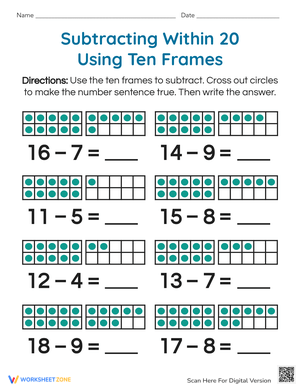
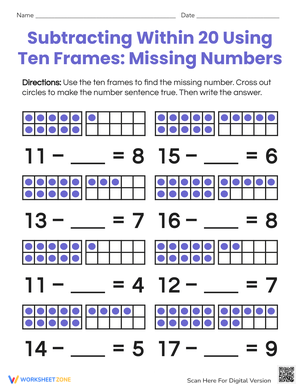
- Using ten frames to cross out and find differences, including problems that cross the ten boundary
- Applying the making-ten strategy to equations like 13 − 5 and 16 − 8, with double ten frames drawn in
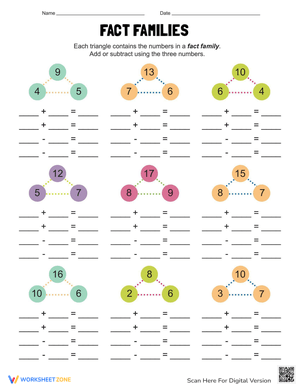
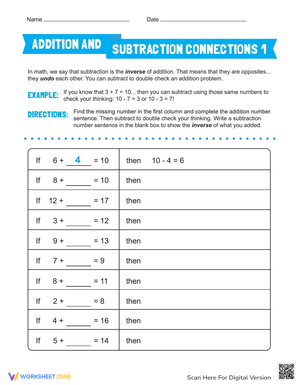
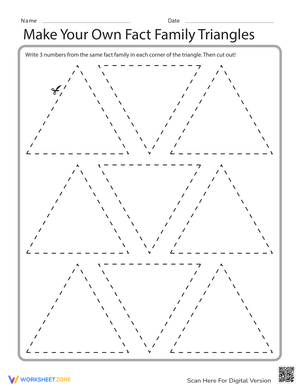
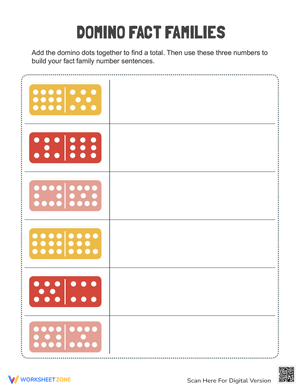
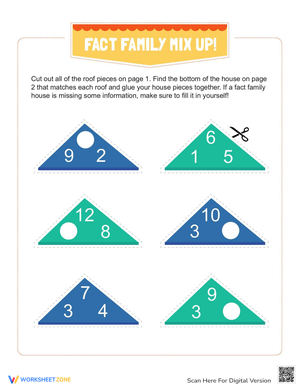
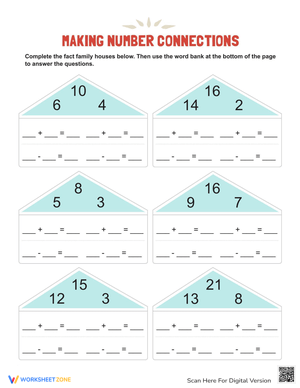
- Completing fact family triangles to reinforce the inverse relationship between addition and subtraction
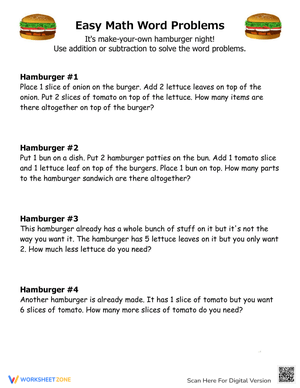
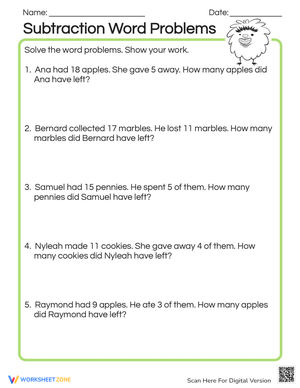
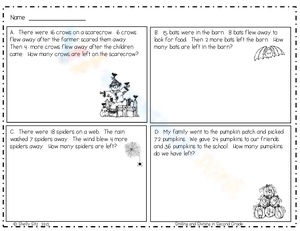
- Solving simple word problems using part-part-whole diagrams to organize the given information
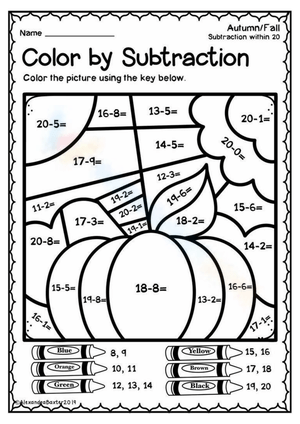
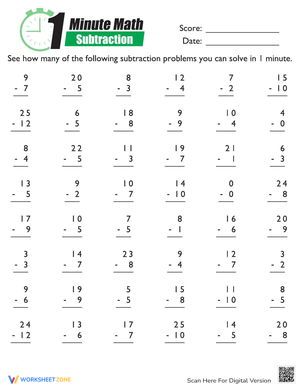
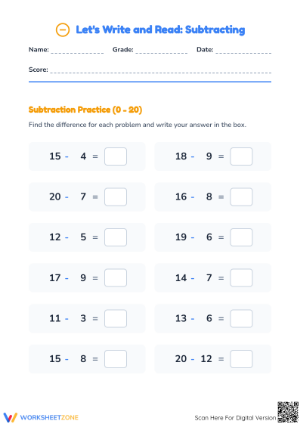
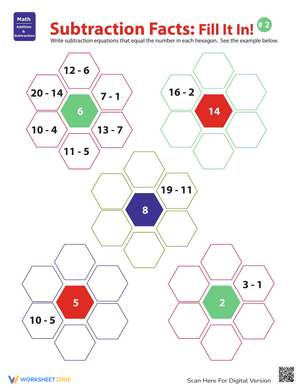
- Mixed-format review equations written both horizontally and vertically
Mistakes Students Make That These Worksheets Help You Catch
The error that surfaces most consistently in first-grade subtraction work is miscounting on the number line. When a student solves 15 − 6, they frequently treat the starting number as hop one — counting 14 as the first move instead of beginning the count from 15 — which lands them at 10 instead of 9. That single procedural slip accounts for a large share of what teachers log as careless mistakes, but it signals a real conceptual confusion about what the starting point represents. Worksheets that ask students to draw and label each hop make the error visible before it gets buried in a column of answers.
A second pattern appears with the making-ten strategy. Given 13 − 7, a student who has been told to "get to ten first" will sometimes decompose 13 into 10 + 3 when they should be decomposing 7 into 3 + 4. They have the strategy direction backwards — breaking the wrong number. Ten-frame worksheets that show both numbers side by side let students see the operation rather than reconstruct it from memory each time.
Why Representational Models Matter at This Grade Level
First grade is the developmental window for crossing from concrete manipulatives — counting bears, linking cubes — toward abstract symbolic equations, and that crossing requires a representational bridge. The middle tier of the Concrete-Representational-Abstract (CRA) progression is where ten frames and number lines live: students operate on drawn pictures of quantities rather than physical objects, but they are not yet asked to hold everything in working memory without support. Skipping this tier and moving straight to naked equations is the most common reason first graders stall on subtraction facts — the cognitive demand is too high without a visual anchor.
This is exactly where subtraction within 20 printable worksheets for 1st grade built around drawn models earn their place in instruction. The representational work here is not decoration; it is the mechanism by which students internalize strategies well enough to eventually stop needing the pictures at all.
Fitting These Worksheets Into Your Instructional Week
Math centers are the most natural home for these worksheets during a regular instructional week. A student can complete a ten-frame subtraction worksheet independently once the format is familiar, which keeps the center running without teacher guidance and frees the teacher for small-group work. Laminating one copy per format and supplying dry-erase markers lets a center run for several days without reprinting.
The transition right after morning meeting — or the eight minutes before dismissal — is often lost time. A single counting-back worksheet placed on desks before students arrive fills that window without requiring any instructions, because the format is already known. Scanning completed sheets takes under two minutes and tells you exactly which students are still miscounting from the starting number, which is genuinely useful formative data before a lesson rather than after one.
The narrow skill focus per worksheet is its most useful feature for intervention work. The full set of subtraction within 20 printable worksheets for 1st grade gives a teacher enough variety to match a specific worksheet to a specific gap — handing the making-ten ten-frame practice to one small group and the fact-family triangles to another, rather than routing everyone through the same general review.
Standard Alignment
Standard 1.OA.C.6 requires first graders to add and subtract within 20, demonstrating fluency for addition and subtraction within 10. The word "fluency" in that standard carries a specific CCSS meaning: accuracy, efficiency, and flexibility — not timed-test speed. A student who solves 18 − 9 by thinking "that's a near-doubles fact" is demonstrating a fundamentally different kind of fluency than one who laboriously counts back nine hops, even when both arrive at the correct answer. The worksheets here give students repeated exposure to multiple strategies so that flexible selection becomes habitual rather than effortful.
1.OA.C.6 sits within the Operations and Algebraic Thinking domain, designated a major cluster for Grade 1 in the CCSS focus documents. That classification means it belongs at the center of instructional time — not as enrichment or early-finisher material — which justifies building consistent weekly practice around it.
Adjusting Practice for Different Points on the Learning Curve
Students who are still counting-all from one need ten-frame worksheets that have dots already drawn in — crossing out a picture is cognitively lighter than simultaneously holding a count in working memory and tracking on fingers. Move those students toward counting-on worksheets once they stop losing their place mid-problem, which is a reliable signal that they have stopped treating each number as a fresh count-from-one.
For students who have internalized counting back and are ready for more, the subtraction within 20 printable worksheets for 1st grade that feature fact family triangles and missing-addend formats — 15 − ___ = 8 — demand more flexible reasoning than standard difference equations without requiring new materials. Students at or above grade level often have the most to gain from this work, because it surfaces the algebraic structure underneath arithmetic at exactly the age when that structure is becoming visible to them.
Students with fine motor challenges do better on worksheets that ask them to circle, cross out, or mark rather than write numerals. Ten-frame formats accommodate this naturally; equation-only formats generally do not.
Frequently Asked Questions
Can these worksheets run as math centers without additional materials?
Most formats work as standalone paper-and-pencil activities — students cross out, circle, or write answers directly on the worksheet. For repeated center use, laminating a copy and providing dry-erase markers removes the reprinting burden. Pairing counting-back worksheets with a physical number line posted nearby benefits students still building the mental image, but no manipulative is required for the majority of formats.
At what point in first grade should students be working on subtraction above 10?
Most scope-and-sequence documents introduce subtraction within 10 in the first half of the year and extend to within 20 in the second half, once counting-back and making-ten strategies are stable. The making-ten strategy is the real gatekeeper: a student who can decompose a subtrahend to reach 10 and then subtract the remainder is ready to work with numbers above 10. Moving there before that strategy is secure tends to produce counting-all behavior rather than strategic thinking, which means more practice time spent reinforcing the wrong habit.
How do I decide which worksheet to assign a student who is struggling?
Watch the student solve two or three problems aloud. If they lose count mid-sequence on a number line, the ten-frame worksheets with dots already drawn in reduce the procedural steps and isolate the conceptual issue. If they can count back accurately but fall apart when problems cross the ten boundary — 13 − 7, 15 − 8 — the double ten-frame making-ten worksheets are the right next move. The error pattern identifies which strategy needs more time; having a set with narrow, distinct skill focuses means there is always a specific worksheet to match it.













 Interactive Worksheet Maker
 Quiz Maker
 Word Search Maker
 Crossword Puzzle Maker
 Word Scramble Generator
 Sentence Scramble Generator
 Handwriting Worksheet Generator
 Name Tracing Generator
 Fill In The Blank Generator