1st Grade Comparing Weight Printable Worksheets
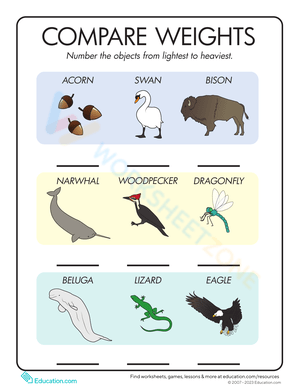
1st grade comparing weight printable worksheets tackle the moment every first-grade teacher recognizes — a child stares at a picture of a watermelon next to a marble and confidently circles the watermelon as heavier, then moves on without a second thought. These worksheets address that exact gap: students practice comparing two objects and describing the relationship using the words heavier, lighter, and about the same before formal measurement tools or standard units ever enter the picture. What teachers get is a focused set of visual comparison tasks matched to where first graders are developmentally.
The Specific Skills These Worksheets Build
Each worksheet targets one or two of the core comparison tasks that Grade 1 measurement instruction demands. The range across the set includes:
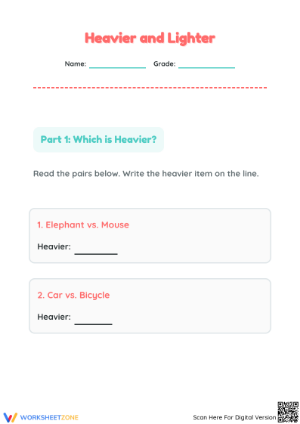
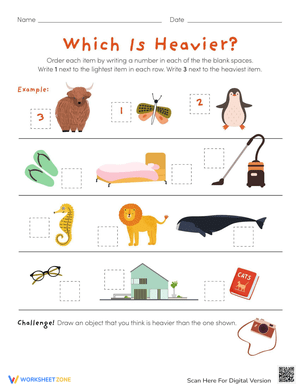
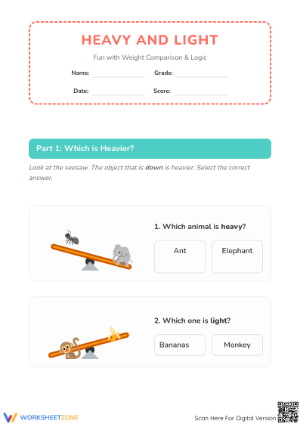
- Identifying the heavier or lighter object from a picture pair featuring familiar items — shoes, apples, feathers, books, boulders
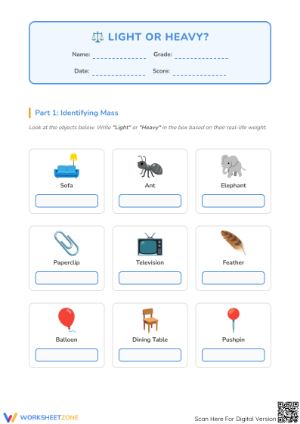
- Sorting pictures into heavy and light categories using cut-and-paste formats
- Completing sentence frames such as "The ___ is heavier than the ___" to bind vocabulary to reasoning
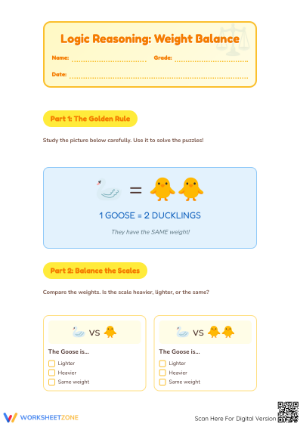
- Matching objects to a drawn balance scale to indicate which side would tip down
- Short story problems built around classroom or home objects, answered with a circled comparison word rather than a number
The picture-heavy format is strategic, not decorative. Reducing the reading load lets students whose literacy is still developing do real mathematical thinking. A page with five clear object pairs often produces sharper reasoning than a text-dense page with only two problems.
Frequent Student Errors Worth Watching For and Correcting
The dominant error pattern in weight comparison is the size proxy: students substitute visual size for weight and treat the two as interchangeable. A child who correctly identifies a large rock as heavier than a small button will often get tripped up when shown a large empty cardboard box next to a small glass jar full of pennies. The box looks more imposing, so the box wins — in the student's mind. That reasoning persists until it's disrupted by physical experience, and no printed page alone will dislodge it.
A second pattern is vocabulary slippage. Students may circle the correct object but use the word "bigger" to explain their choice. That's evidence the concept is partially there — the selection is right — but the mathematical language hasn't connected yet. Listen during pair-shares and oral explanations, not just during answer review. A student who says "that one is more heavy" has something different going on than a student who says "that one's big." Both need a response, but not the same one.
Sentence frames and labeled diagrams help address slippage directly, but the most reliable fix is pairing any worksheet with at least one physical comparison that surprises students. A large foam block and a small steel bolt work well. Once students feel the mismatch in their hands, the vocabulary starts to anchor to the correct concept rather than to appearance.
How to Work These Worksheets Into Your Lesson Plan
The most dependable sequence: brief hands-on exploration first, worksheet second. Give students five minutes at the start of a math block to hold two objects — one in each hand — and predict which is heavier, then confirm with a balance scale or a second student's verdict. After that physical anchor, the worksheet functions as structured practice that records the same thinking rather than introducing it cold. 1st grade comparing weight printable worksheets are significantly less effective when they serve as the first contact a student has with the concept — they work as consolidation, not introduction.
Within the week, consider this distribution: Monday introduces the concept with real objects and a vocabulary chart; Tuesday's worksheet focuses only on heavier; Wednesday's focuses only on lighter; Thursday's mixes both terms and adds a sentence frame; Friday's is a four-question exit check. That rhythm gives each worksheet a distinct instructional purpose rather than treating the set as interchangeable pages to fill time.
Math centers offer a second strong context. Set a basket of small classroom objects next to a printed worksheet and ask students to pick two items from the basket, predict which is heavier, and then circle their prediction on the page. That loop — predict, check, record — produces more durable understanding than circling pictures in isolation.
Standard Alignment
Weight comparison in the early grades traces to CCSS.MATH.CONTENT.K.MD.A.2, which asks students to directly compare two objects sharing a measurable attribute and describe which has "more of" or "less of" that attribute. Comparing weight is a direct application: students decide which object is heavier or lighter and say so using precise language. Grade 1 instruction revisits this standard as vocabulary consolidation and as a bridge toward the measurement-and-data work in 1.MD, where students begin to quantify length rather than just compare it. In classroom terms, that placement means comparing weight belongs at the opening of a Grade 1 measurement unit — familiar enough to feel accessible, but demanding enough in language that using heavier and lighter accurately inside complete comparative sentences gives students real work to do.
Adapting the Worksheets for a Range of Learners
1st grade comparing weight printable worksheets work across ability levels when teachers are deliberate about which features to keep and which to add. For students who need the most support, use pages with one direction, large clear images, and a single target word — either heavier or lighter, not both at once. Keeping the cognitive demand narrow lets those students practice the concept without the additional load of switching between two vocabulary terms mid-page.
On-level students handle mixed pages well: heavier and lighter questions on the same worksheet, with two or three sentence frames to complete. The frames push students to generate the language rather than just recognize the correct picture — a meaningful distinction when you're checking whether vocabulary has actually landed.
For students ready for extension, add an explanation prompt after one or two problems — "Why do you think this one is heavier?" — without the sentence frame as support. Students at this level don't need standard units to reason well; they just need space to connect prior knowledge to the comparison in front of them. A student who writes "the rock is heavier because it's packed tight and the balloon is full of air" is reasoning about material properties, which is exactly where this topic eventually leads. For multilingual learners, front-load the key terms before worksheet time using gestures and real objects, and keep printed directions short and consistent so students learn the direction format once and apply it across each worksheet without decoding new instructions each time.
Frequently Asked Questions
At what point in the year do these worksheets belong?
Most Grade 1 measurement units run in the second semester, once number sense is established and students have enough language to make comparative statements. Comparing weight fits naturally alongside comparing length — both skills ask students to make relational claims rather than assign numerical values. Introduce the worksheets after at least one full hands-on lesson with real objects, not as the opening move of the unit.
How many problems per worksheet is appropriate for first graders?
Four to eight problems fits most first graders well for an independent practice task. Fewer than four doesn't give enough repetition for the vocabulary to stick; more than eight starts to fatigue students who are still building pencil stamina. The exception is cut-and-sort formats, where six to ten pictures is reasonable because the physical act of sorting breaks up the monotony of a long page.
My students keep saying "bigger" instead of "heavier" — how do I fix it?
This is one of the most consistent vocabulary problems in this unit. The fastest fix is a physical counterexample: bring in a large empty bottle and a small rock, let students hold both, and ask them which word fits now. Once students feel the mismatch, they become more careful with language. On 1st grade comparing weight printable worksheets, sentence frames that require students to write heavier or lighter by name reinforce correct word choice in writing even when oral language is still catching up.
Can these worksheets be sent home as homework?
They can, with one caveat: the vocabulary support that exists in the classroom — the anchor chart, the balance scale, the class discussion — won't be there at home. Send home a small reference card with the comparison words alongside simple pictures. Better yet, include a note suggesting the family compare two household objects before the child starts the page. That five-minute activity recreates the hands-on anchor that makes the worksheet meaningful rather than just a paper to complete.
Clear All