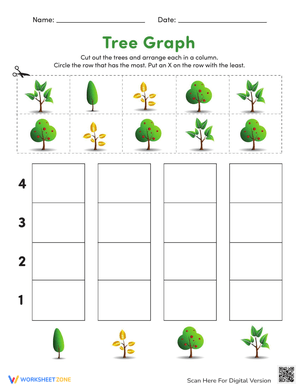
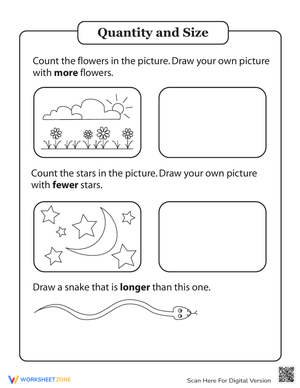
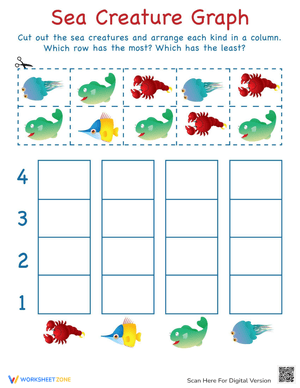
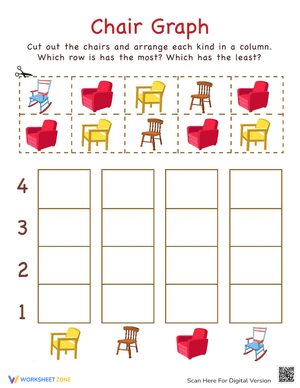
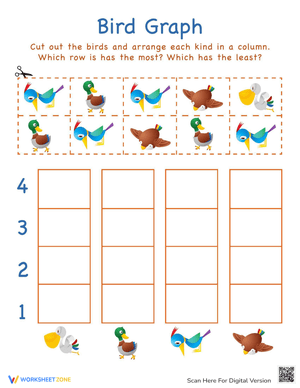
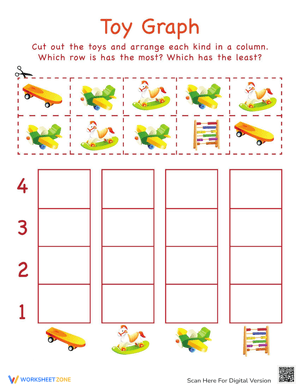
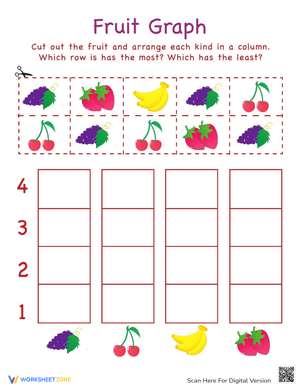
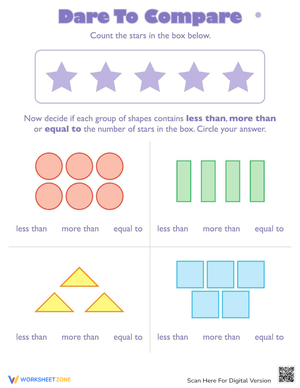
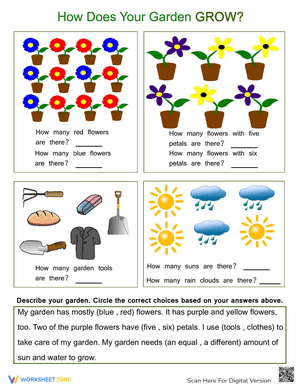
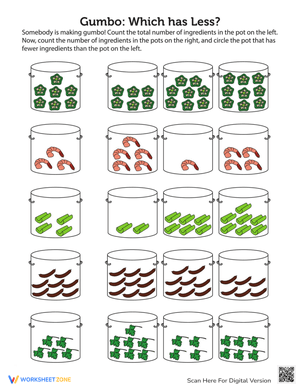
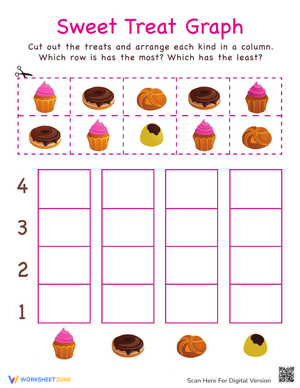
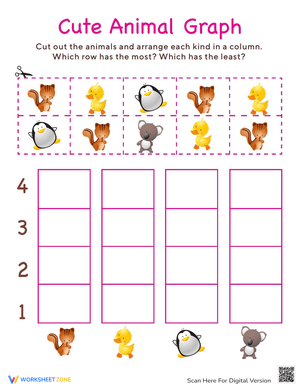
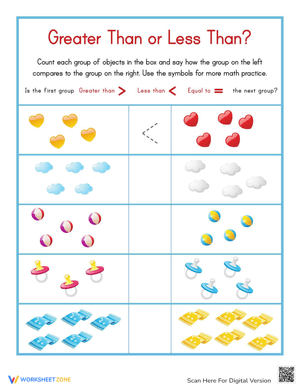
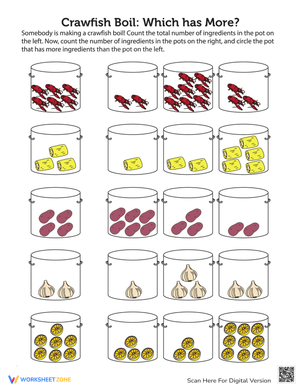
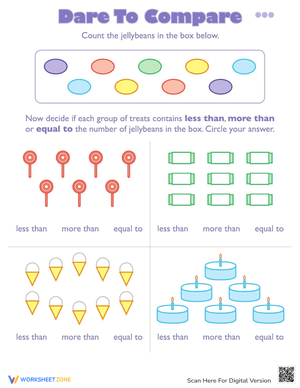
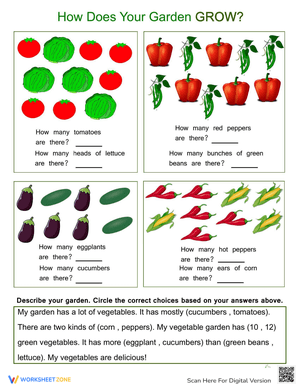
These comparing amount printable worksheets for 1st grade address one of the trickier conceptual pivots in early math: a child who can count confidently to 100 often cannot yet explain why a tall, narrow vase holds less water than a short, wide bowl. The set covers capacity, weight, and length through visual exercises where students mark, circle, underline, and write comparison words rather than count discrete objects.
What the Worksheets Ask Students to Do
Each worksheet in this collection of comparing amount printable worksheets for 1st grade targets one measurement domain, and the exercise types shift depending on what that domain demands. Capacity worksheets show two or three containers side by side — milk jugs, soup bowls, juice boxes — and students circle the one that holds more, then write holds more or holds less beneath each image. Weight worksheets center on balance scale illustrations: the scale tips visibly to one side, and students identify which object is heavier, then record their answer in the blank. Length worksheets ask students to order three objects from shortest to longest, annotating each with a number from 1 to 3 — the same task structure used in 1.MD.A.1-aligned assessments.
Several worksheets also build measurement vocabulary directly into the exercise format. Students trace or write the following comparison terms while looking at the image that illustrates each one:
- heavier / lighter
- holds more / holds less
- longer / shorter
That pairing is deliberate: when a student writes heavier while looking at a scale tipped by a watermelon, the word attaches to something concrete rather than landing as an isolated spelling task.
Why Grade 1 Is the Right Place for This Skill
First-grade measurement standards ask students to compare directly — not yet to measure with rulers or standard units, which enters the curriculum in second grade. That distinction matters for instruction: the 1.MD cluster is about recognizing measurable attributes and making direct comparisons using precise vocabulary. Students at this stage are ready to observe and compare what they can see and hold, but they haven't yet developed the abstraction required to assign numerical measurement values. These worksheets sit in that specific developmental window, giving students repeated direct comparison practice before 2.MD requires them to assign units and use rulers.
The underlying challenge is that first graders often conflate visible size with measured amount. A tall container reads as "more" before a student has internalized that height and volume are independent attributes. Early exercises in the set use exaggerated contrast — a bathtub beside a teaspoon — and reduce that visual gap progressively, training students to look past the most obvious dimension before making a comparison judgment.
Where Student Work Tends to Break Down
Balance scale exercises produce a consistent error: students mark the higher side of the scale as heavier, because "up" reads intuitively as "more." The correct logic — the lower side is heavier, because gravity pulls it down — is counterintuitive for most six-year-olds and worth naming explicitly before the first balance scale worksheet. A thirty-second demonstration with a physical scale, or a see-saw analogy, prevents the majority of these errors before they become habitual.
In length comparisons, errors cluster around alignment. When two objects aren't drawn with matching left endpoints, students tend to compare from the right side instead, reaching wrong answers through internally consistent reasoning. Naming the rule before the worksheet — "we always line up the starting end before we compare" — takes about ninety seconds and eliminates most of this confusion. Students who've internalized the rule self-correct; students who haven't will miss it consistently, regardless of how many exercises they complete.
Capacity comparisons surface a third pattern: students rank containers by height rather than volume. A tall, thin beaker beside a short, wide pitcher reliably misleads a large portion of the class on first encounter. A brief physical pour — watching rice or water transfer between the two container types before the worksheet — resolves this more effectively than reteaching from the front of the room.
Planning These Worksheets Into Your Teaching Week
The sequence that works best is sensory first, paper second. Before students touch a capacity worksheet, set up a five-minute pouring station with the same container types illustrated on the page. Students fill, pour, and observe. Then they sit down and complete the comparing amount printable worksheets for 1st grade while that physical memory is still active. Students who have already poured the rice know what "holds more" means when they see it on the page — this sequence consistently produces fewer errors than leading with the paper task.
For daily integration, the length and weight worksheets slot naturally into the first ten minutes of math block as a warm-up review, into small-group center rotations while the teacher works with a targeted group, or as an exit check at the end of a measurement lesson. The balance scale worksheets work especially well as Monday re-entry tasks: they require enough visual focus to snap students back into math thinking without demanding new learning on a day when attention is still scattered from the weekend.
Standard Alignment
The length-ordering worksheets align directly with 1.MD.A.1, which requires first graders to order three objects by length and compare the lengths of two objects indirectly using a third. The numbered-labeling format — annotate objects 1, 2, 3 from shortest to longest — mirrors the task structure used in 1.MD.A.1-aligned assessments, so students completing these exercises also gain familiarity with the question format itself. Capacity and weight exercises address the broader first-grade measurement cluster: identifying measurable attributes and making direct comparisons with precise vocabulary. These skills carry forward into 2.MD, where students shift from visual comparison to measuring with standard units.
Tiering the Exercises Across Ability Levels
Students who need additional support do best starting with worksheets that present only two objects with a pronounced size differential — a full bathtub beside a tablespoon, or a dictionary beside a pencil. The goal at that entry point is vocabulary acquisition and basic decision-making, not fine visual discrimination. Once they can reliably identify and label in those clear-cut cases, they move to three-object ordering tasks and comparisons with a reduced visual gap.
Students ready for extension benefit from worksheets where the contrast is intentionally subtle and from tasks that require a written explanation. Asking a student to write "the bowl holds more because it is wider even though the jar is taller" pushes into attribute-based reasoning that anticipates second-grade measurement work. Those students also make effective leaders at the sensory station — explaining the pour to a classmate requires them to articulate their reasoning aloud, which surfaces gaps that completed worksheets alone would not reveal.
Frequently Asked Questions
In what order should I teach the three comparison domains?
Start with length. It has the most direct visual cues and connects to what students already know from ordering numbers on a number line. Move to weight next — balance scale images make sense quickly once students understand that the lower side is heavier. Introduce capacity last; it requires the most abstract reasoning and benefits most from physical experience before the paper tasks. Each domain can anchor a one-week center cluster before rotating to the next.
Can parents reasonably support these worksheets at home?
Yes. The visual format — images with labeled blanks rather than word problems — makes homework use practical without requiring parents to understand the curriculum context. A one-sentence note defining the key terms (heavier, holds more, longer) gives families enough grounding to ask "which picture shows more?" and guide their child through the exercise. The answer choices are embedded in the illustrations, so the task is clear even without a teacher present.
How many exposures does it typically take to reach accuracy in each domain?
Three to five worksheets per domain handles most students working at grade level, but capacity often requires more. Students who have had physical experience with pouring reach accuracy faster than those who have not — sometimes the difference is two worksheets versus six or seven spread across multiple weeks of spaced practice. This is exactly where the comparing amount printable worksheets for 1st grade set's variety in container images matters: if students see the same images repeated across exercises, they answer from memory rather than reasoning, and the formative value of the task disappears.
Do the length worksheets address indirect comparison specifically?
Yes. The more advanced length worksheets introduce indirect comparison, where students use a reference strip to compare two objects they cannot place side by side. That format aligns with the second component of 1.MD.A.1 and is worth introducing with a brief physical demonstration — most first graders don't intuitively understand why the reference strip must match one object's length before it can be used to compare against the other. A ninety-second demo with a piece of string and two classroom objects makes the logic clear before students attempt it on paper.













 Interactive Worksheet Maker
 Quiz Maker
 Word Search Maker
 Crossword Puzzle Maker
 Word Scramble Generator
 Sentence Scramble Generator
 Handwriting Worksheet Generator
 Name Tracing Generator
 Fill In The Blank Generator