


























Views
Downloads
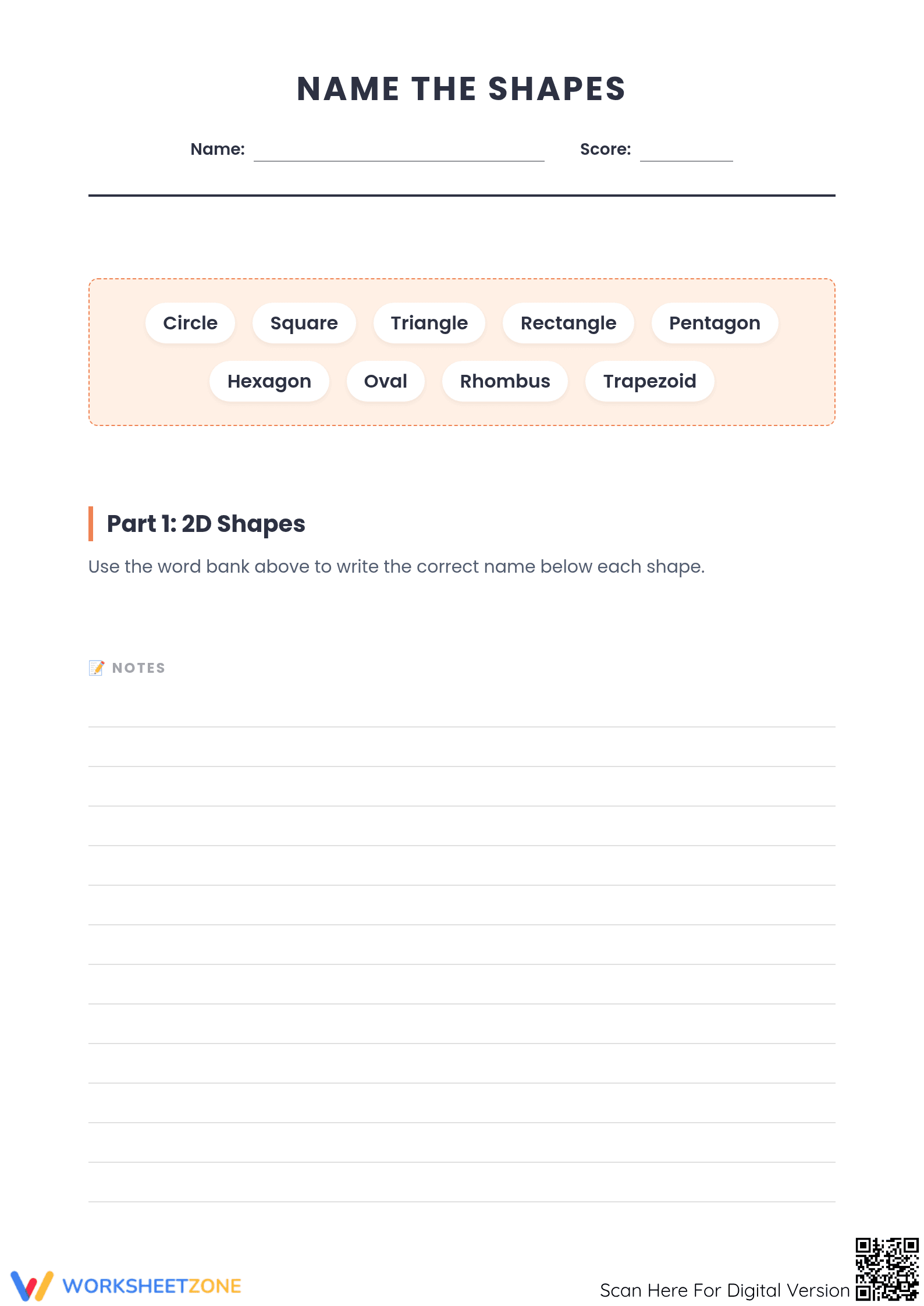


Printable 2D Shapes Worksheet: Name the Shapes | Grade 1
Paste this activity's link or code into your existing LMS (Google Classroom, Canvas, Teams, Schoology, Moodle, etc.).
Students can open and work on the activity right away, with no student login required.
You'll still be able to track student progress and results from your teacher account.
This 2D shapes worksheet helps Grade 1 students master geometry by identifying and naming nine fundamental shapes. By utilizing a clear word bank and descriptive riddles, learners build a strong foundation in spatial reasoning and geometric terminology. It is an essential tool for reinforcing shape recognition through both visual identification and property-based analysis.
At a Glance
- Grade: 1 · Subject: Math
- Standard:
CCSS.MATH.CONTENT.1.G.A.1— Identify shapes and distinguish between defining attributes like sides and corners- Skill Focus: 2D Shape Identification
- Format: 2 pages · 11 problems · Answer key included · PDF
- Best For: Independent geometry practice or morning work
- Time: 15–20 minutes
The two-page PDF includes a focused identification section with nine geometric shapes, including polygons like pentagons and hexagons, supported by a clear word bank. Page two introduces descriptive logic through multiple-choice questions that challenge students to identify shapes based on side counts and angles. A comprehensive answer key ensures quick checking, while the included notes section allows for student observations.
Zero-Prep Workflow
- Print: Select the two-page PDF and hit print for your class (30 seconds).
- Distribute: Hand out the sheets; the word bank provides all necessary scaffolds (30 seconds).
- Review: Use the included answer key for immediate formative feedback (60 seconds).
Total teacher prep time is under 2 minutes, making this an ideal solution for sub plans, last-minute math centers, or homework assignments.
Standards Alignment
The primary focus is `CCSS.MATH.CONTENT.1.G.A.1`, which requires students to distinguish between defining attributes (like number of sides or corners) and non-defining attributes. This worksheet specifically targets naming and identifying shapes based on these structural properties. Supporting standards include CCSS.MATH.CONTENT.K.G.B.4. Both standard codes can be copied directly into lesson plans, IEP goals, or district curriculum mapping tools.
How to Use It
Assign this worksheet during the independent practice phase of a geometry lesson to verify that students can transition from recognizing shapes to naming them accurately. It also serves as a robust formative assessment; observe if students correctly use the word bank or struggle with similar shapes like the rhombus and rectangle. Expected completion time range is 15–20 minutes.
Who It's For
This resource is designed for Grade 1 and Grade 2 students beginning their geometry journey. It provides necessary scaffolding for English Language Learners through the visual word bank while offering a slight extension challenge in the property-based multiple-choice section. It pairs naturally with an attributes of shapes anchor chart or pattern blocks.
According to a RAND AIRS 2024 analysis, providing structured scaffolds like word banks significantly reduces cognitive load during early elementary math tasks, allowing students to focus on high-level attribute identification. This Grade 1 geometry resource aligns with evidence-based practices for identifying 2D shapes, ensuring learners move beyond simple rote memorization toward a conceptual understanding of geometric properties. The inclusion of diverse polygons such as trapezoids and hexagons supports the CCSS.MATH.CONTENT.1.G.A.1 requirement for analyzing defining attributes. By integrating both visual and descriptive cues, the worksheet provides a multi-modal approach to geometry that mirrors the instructional recommendations found in recent EdReports findings for high-quality elementary curriculum materials. This ensures that the practice is not only engaging but technically accurate for standards-based reporting. The clear layout and focused task set encourage student persistence and mastery of foundational math skills.


