


























Views
Downloads

Printable 2D Shapes Worksheet | Grade 2 Geometry Ready
Paste this activity's link or code into your existing LMS (Google Classroom, Canvas, Teams, Schoology, Moodle, etc.).
Students can open and work on the activity right away, with no student login required.
You'll still be able to track student progress and results from your teacher account.
This comprehensive 2D shapes worksheet helps elementary students master geometry fundamentals through identification and attribute analysis. Students progress from simple naming tasks to identifying sides and vertices, culminating in real-world application. By connecting abstract geometry to familiar objects, this resource ensures learners develop a robust spatial vocabulary and a firm grasp of essential mathematical properties.
At a Glance
- Grade: 2 · Subject: Math
- Standard:
CCSS.MATH.CONTENT.2.G.A.1— Recognize and draw shapes with specific attributes like sides and angles.- Skill Focus: 2D Shape Identification and Properties
- Format: 3 pages · 26 problems · Answer key included · PDF
- Best For: Geometry unit practice or formative assessment
- Time: 20–30 minutes
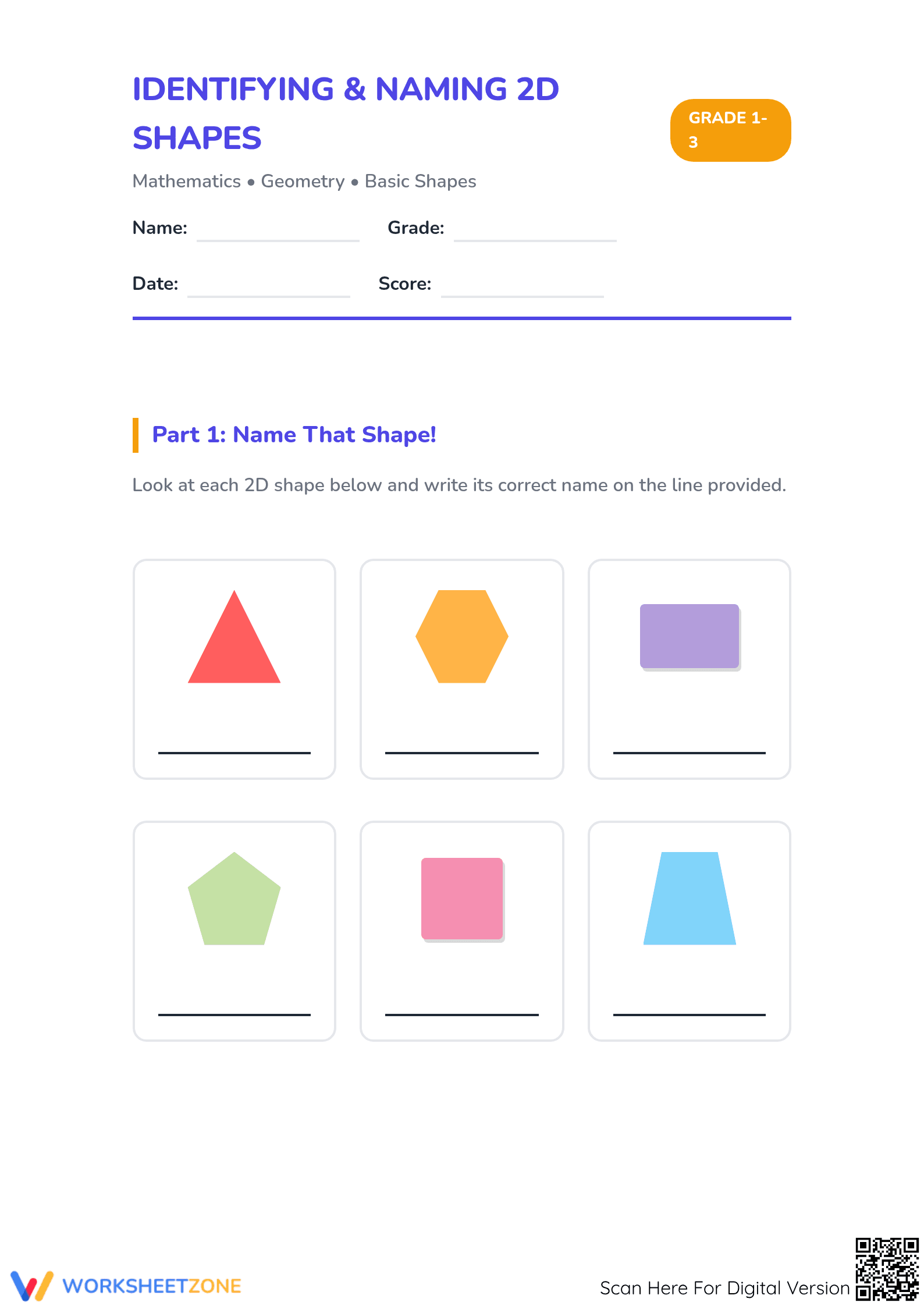
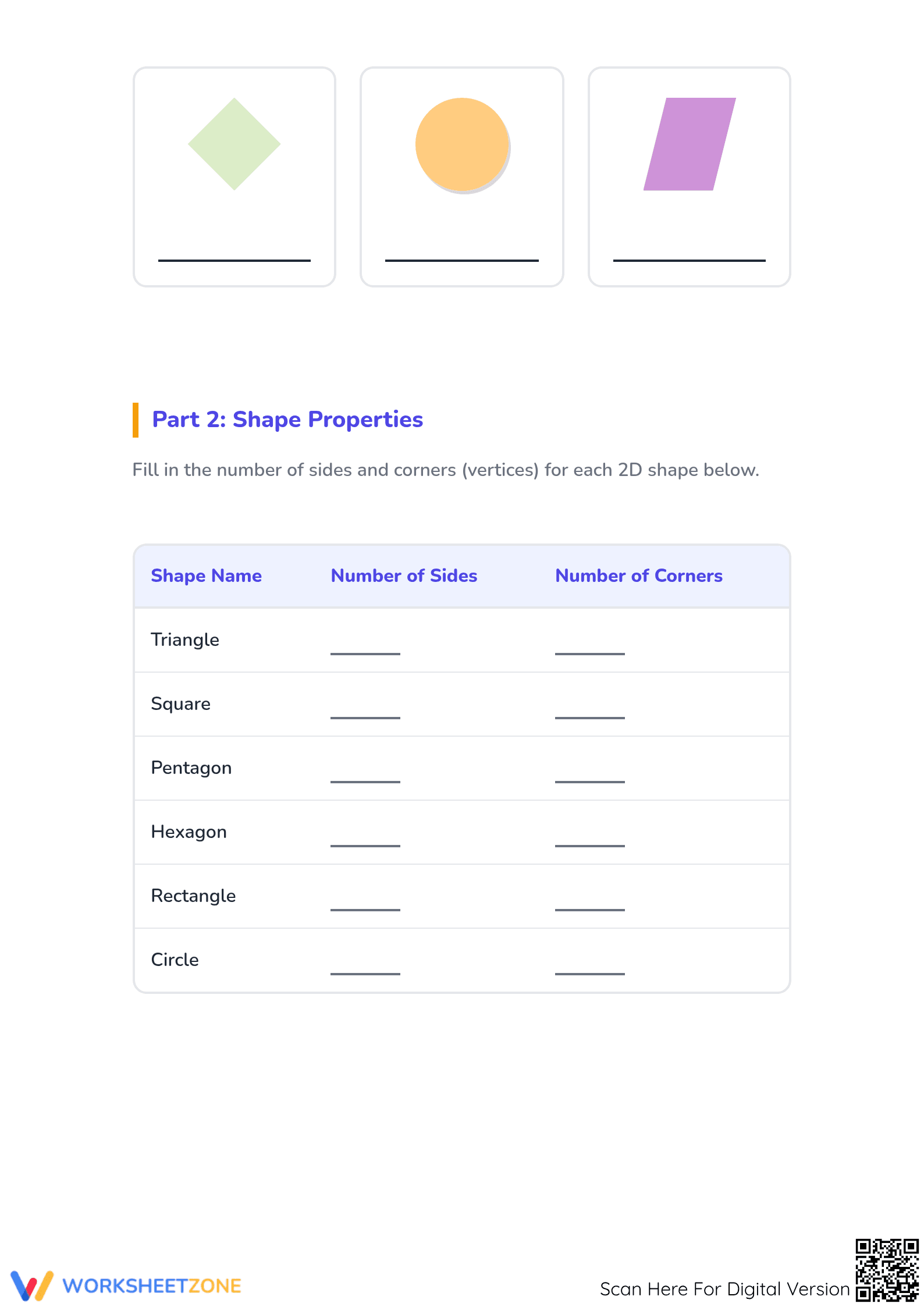
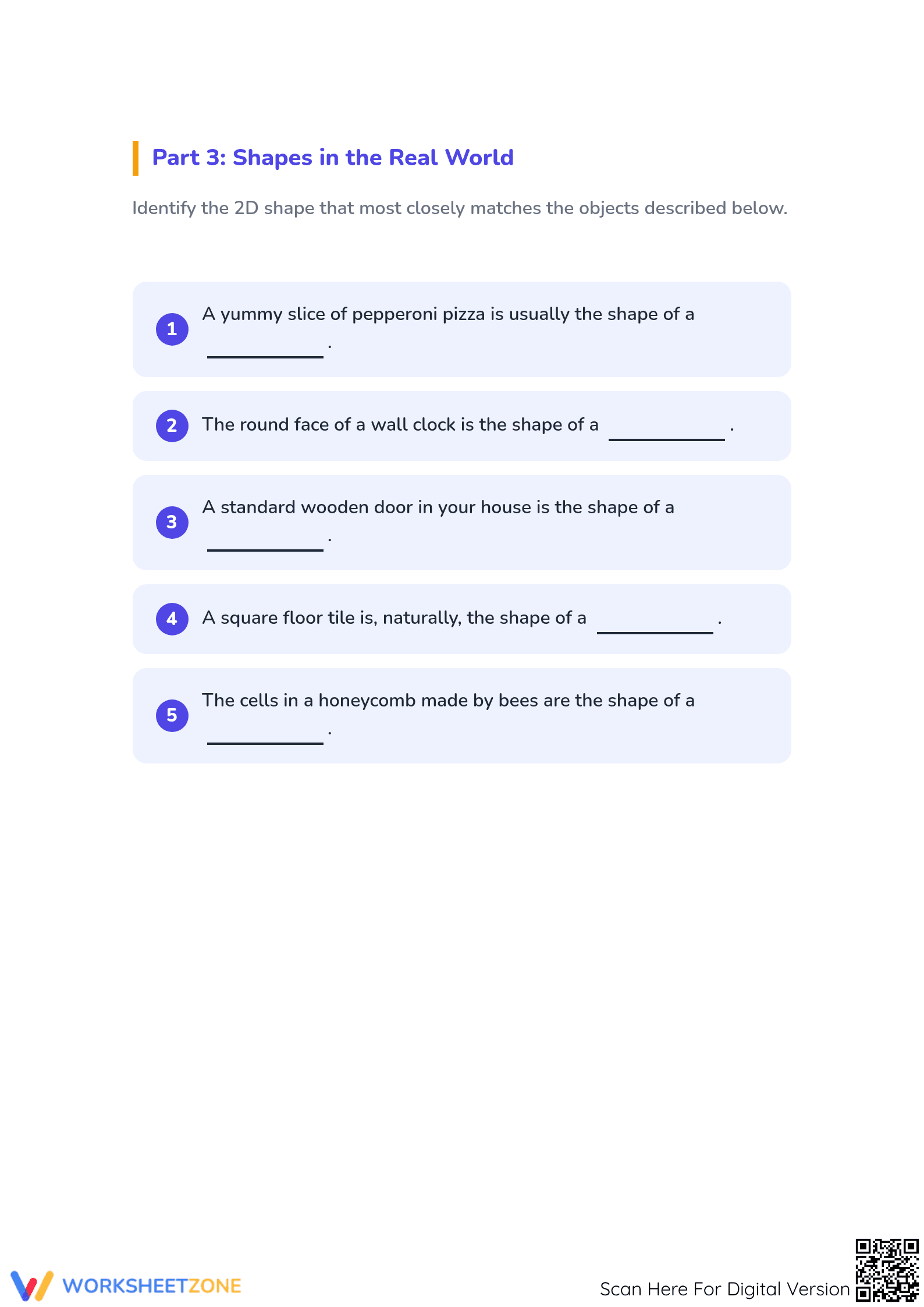
Three pages of practice cover identification, property analysis, and application. The first section presents nine visual prompts including triangles, hexagons, and trapezoids. The second page features a data table for recording sides and corners for six core shapes. Finally, five real-world problems connect geometry to familiar objects like clocks, wooden doors, and honeycomb cells.
Skill Progression
- Guided Identification: Students focus on nomenclature across nine distinct visual examples of 2D shapes to build recognition confidence.
- Supported Property Analysis: A structured table scaffolds the identification of vertices and sides for six primary shapes, moving toward attribute-based classification.
- Independent Application: Five context-based problems challenge students to generalize geometric concepts to the physical environment without visual aids.
This structured approach follows the gradual-release model, ensuring students build foundational confidence before tackling higher-order application tasks.
Standards Alignment
The primary focus is CCSS.MATH.CONTENT.2.G.A.1, which requires students to recognize and draw shapes having specified attributes, such as a given number of angles or equal faces. It also supports CCSS.MATH.CONTENT.1.G.A.1 through its emphasis on distinguishing between defining and non-defining attributes. Both standard codes can be copied directly into lesson plans, IEP goals, or district curriculum mapping tools.
How to Use It
Use this resource during the "independent practice" phase of a geometry lesson to monitor student understanding of shape attributes. It also serves as an effective homework assignment to reinforce vocabulary after direct instruction. While students work, observe if they are counting sides or vertices to identify shapes; this formative data helps determine if they require physical manipulatives for further scaffolding.
Who It's For
This worksheet is designed for second-grade students but is highly effective for first-grade enrichment or third-grade review. It supports diverse learners through clear visual layouts and a structured table format. For students requiring extra help, consider pairing this with a shape anchor chart or pattern blocks to provide a tactile reference during the property analysis section.
The CCSS.MATH.CONTENT.2.G.A.1 standard emphasizes the transition from intuitive recognition to analytical property-based identification. This worksheet facilitates this shift by requiring students to name shapes and systematically count defining attributes like vertices. Research from the NAEP highlights that early mastery of geometric properties is a strong predictor of success in later spatial reasoning and advanced mathematics. By integrating real-world connections, the resource addresses the need for students to perceive geometry as a functional part of their environment. The inclusion of twenty-six tasks provides sufficient repetition for mastery while maintaining engagement through varied formats. Educators can utilize this tool to generate reliable data on student proficiency, ensuring all learners meet foundational math expectations. This evidence-based approach aligns with best practices for elementary mathematics instruction and supports the development of critical thinking skills through applied geometry.


