How Many Cubes worksheets for 1st Grade: Counting Practice That Builds Number Sense
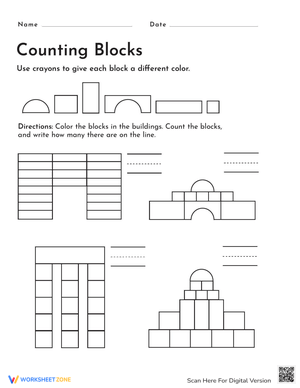
These how many cubes worksheets for 1st grade move students through a specific and important transition: from physically handling linking cubes to interpreting drawn representations of the same quantities. That shift — concrete manipulative to pictorial image — is where a lot of Grade 1 counting instruction lives, and the worksheets in this set are built to support it directly. Teachers get print-ready pages covering one-to-one counting, early place value with tens and ones, color-and-count tasks, and cut-and-paste matching activities.
What Each Worksheet Targets
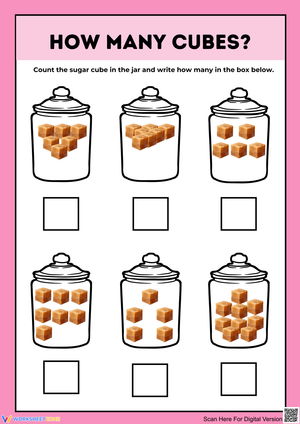
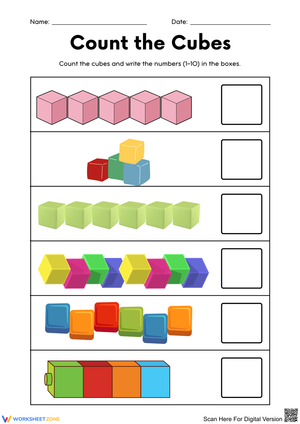
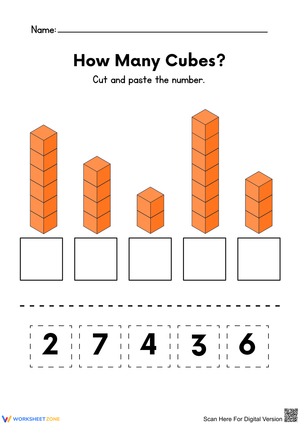
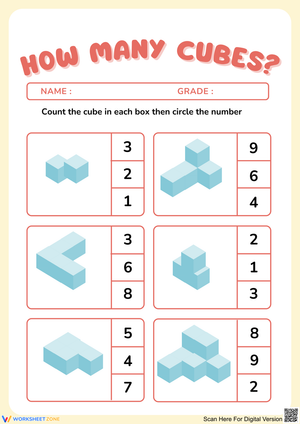
The counting worksheets in the set focus on quantities from 1 to 20, presenting cubes in rows, loose clusters, and stacked towers depending on the skill being practiced. Students count each cube and record the total in a response box — a stripped-down format that keeps attention on the count itself rather than on reading complex directions. For students still building one-to-one correspondence, that simplicity matters more than it might look.
Several worksheets shift the task to number production: a row of blank cubes appears with an instruction to color a specific quantity, say, 11 out of 15. This reverses the standard count-and-write routine and requires students to hold a target number while tracking what they've already colored — a different and harder cognitive move. The cut-and-paste matching worksheets ask students to connect a numeral card to the correct group of cubes, which functions both as practice and as a quick informal check on whether a child reliably maps symbol to quantity. The tens-and-ones pages show a rod of 10 alongside loose unit cubes and ask students to write the two-digit total, offering an early foothold in place value before the numbers get abstract.
Standard Alignment
These worksheets align primarily with CCSS.MATH.CONTENT.1.NBT.B.2, which requires Grade 1 students to understand that the two digits of a two-digit number represent amounts of tens and ones. The single-cube counting pages support the counting and cardinality work that leads into NBT, particularly the expectation that students count to 120 with fluency and understand the value of each position. In most pacing guides, teachers introduce cube arrangements up to 20 in the first quarter, then move to tens-and-ones representations in the second or third quarter once students count 20-object sets without error. The cut-and-paste matching format provides the numeral-to-quantity connection that bridges those two phases.
Frequent Student Errors Worth Watching For
The most consistent error in early cube-counting work is recounting a cube that was already counted — students lose their place in a scattered arrangement and sweep back over cubes they've already tallied. This shows up most often when cubes are illustrated in an irregular cluster rather than a tidy row. One reliable fix during guided practice: have students touch and say each number aloud, then physically cross out each cube with a pencil as they go. The crossing-out step is the part most students skip unless directly taught, and it's the part that prevents the error.
On the tens-and-ones worksheets, a different error appears. Students who can correctly count a rod of 10 as "ten" will often recount it cube-by-cube when asked for the total, writing 14 as "1 and 4 more" but then counting all 14 cubes individually to verify. That's not wrong, exactly, but it signals the student hasn't yet trusted the rod as a unit — which is the whole concept the worksheet is trying to build. When you see this pattern in student work, it's worth pausing before moving further into place value instruction.
Smart Ways to Work These Worksheets Into Your Week
The most efficient use of these worksheets is in the first five to eight minutes of the math block, before whole-group instruction begins. Projecting a single cube arrangement while students settle in lets you do a choral count together, then students complete their own copy independently. That sequence — model aloud, then produce independently — mirrors a gradual release structure without requiring a long setup.
At a math center, pairing the worksheet with a cup of physical linking cubes changes the task meaningfully. Students build the arrangement shown on the worksheet with real cubes, confirm the count, then write the number. That concrete-to-representational loop is exactly what the CRA (Concrete-Representational-Abstract) progression calls for, and scheduling it this way honors the sequence rather than jumping students directly to pictorial work. Reserve the tens-and-ones worksheets for the center rotation where an adult or trained peer partner can prompt students to treat the rod as a unit rather than re-counting it.
Cut-and-paste pages work well in small-group rotations mid-unit and make straightforward exit assessments — a finished page tells you in a glance whether a student matched numerals to quantities correctly across the whole set.
Adjusting the Worksheets for a Range of Learners
For students who are still building confidence with quantities under 10, print the worksheet at 120–130% on a photocopier. The larger cube images are easier to track and cross out, which reduces the recounting error described above. Limit these students to pages with totals under 10 and give them a physical cube to place on each illustrated cube as they count — that one-to-one physical correspondence slows down the count in a useful way.
Students ready for a challenge can work with pages that show quantities up to 50 using grouped tens rods. Ask them to record both the total count and a written equation showing tens and ones (e.g., 3 tens + 2 ones = 32). That written decomposition is a preview of the place value notation they'll formalize later in first grade and revisit heavily in second. The color-and-count worksheets also extend naturally: instead of coloring a given number, students can write their own number, color that many cubes, and trade pages with a partner to verify.
Frequently Asked Questions
Do these worksheets require any special materials to use?
No materials beyond pencils and crayons are needed for most worksheets. The cut-and-paste pages require scissors and a glue stick. If you're using these at a math center alongside physical linking cubes, a small cup of cubes per student adds the concrete verification step — but the worksheets function on their own without manipulatives.
When should I introduce the tens-and-ones cube worksheets in the Grade 1 sequence?
Wait until students count a set of 20 objects without error and can write the corresponding numerals reliably. For most Grade 1 classrooms following a standard pacing guide, that readiness appears in the second or third quarter. Introducing tens-and-ones cube pages too early — before one-to-one correspondence with quantities to 20 is solid — tends to produce the re-counting-the-rod error described above and sets up a conceptual gap that's harder to close later.
How do I handle students who struggle with 3D cube illustrations?
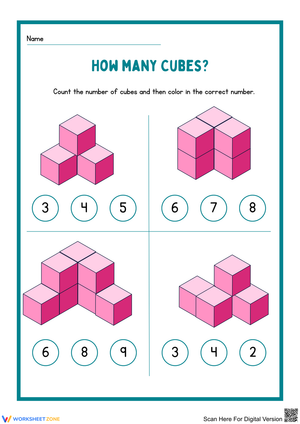
Choose worksheets where cubes are drawn as flat squares rather than shaded isometric blocks. If you're working with a page that uses 3D-style drawings, have students place a small pencil dot on each cube face as they count rather than trying to track by eye. The mark-as-you-go strategy works for most students who are miscounting due to visual ambiguity rather than conceptual gaps in counting.
Clear All