


























Views
Downloads
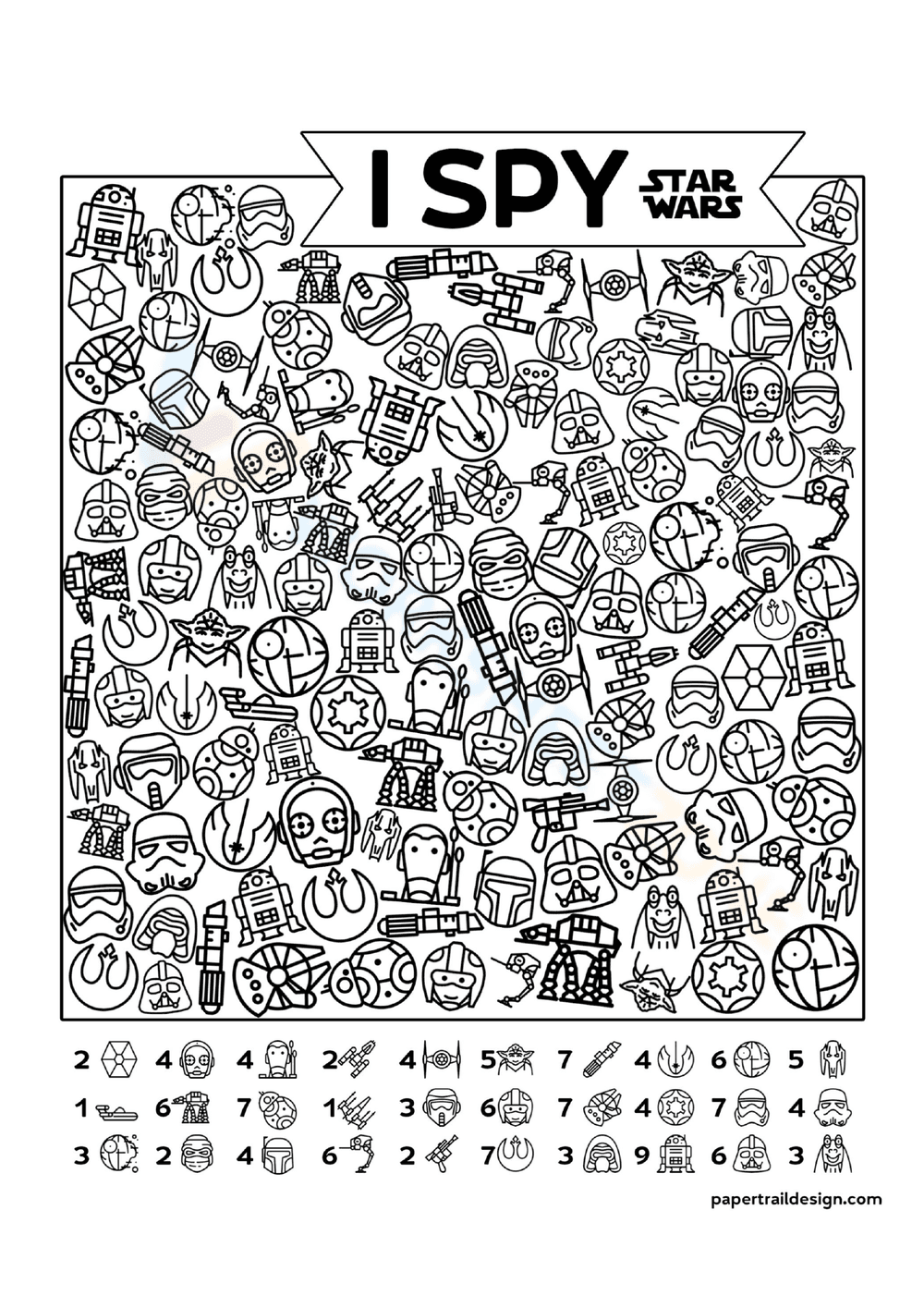

Printable Star Wars I Spy Worksheet | Grade 1-5 Math
Paste this activity's link or code into your existing LMS (Google Classroom, Canvas, Teams, Schoology, Moodle, etc.).
Students can open and work on the activity right away, with no student login required.
You'll still be able to track student progress and results from your teacher account.
This engaging Star Wars I Spy worksheet helps students practice visual discrimination and counting in a fun format. By searching for iconic characters, learners build focus and reinforce one-to-one correspondence, making math practice an exciting adventure for early finishers.
At a Glance
- Grade: 1-5 · Subject: Math
- Standard:
CCSS.MATH.CONTENT.1.OA.C.5— Relate counting to basic math operations- Skill Focus: Visual discrimination and counting
- Format: 1 page · 20 problems · Answer key included · PDF
- Best For: Morning work or early finishers
- Time: 10–15 minutes
This single-page printable features a densely packed visual search area filled with sci-fi characters and starships. At the bottom, a clear checklist provides the exact target number for each of the 20 unique items students need to locate. These built-in target numbers act as a self-checking mechanism, allowing students to verify their counts independently.
This resource is designed for immediate classroom implementation with zero prep required.
- Print (1 minute): Download the PDF and print a class set. The black-and-white line art ensures crisp copies while saving ink.
- Distribute (1 minute): Hand out the worksheets with pencils or crayons. No special manipulatives are necessary.
- Review (3 minutes): Students can compare findings with peers or use the target numbers to confirm they found every item.
Total teacher preparation time is under two minutes, making this an ideal addition to any sub plan.
This activity aligns with CCSS.MATH.CONTENT.1.OA.C.5 by encouraging students to relate counting to addition strategies as they group visual items. It also supports cognitive development in visual scanning. Both standard codes can be copied directly into lesson plans, IEP goals, or district curriculum mapping tools.
This worksheet is perfect for morning work, providing a calm activity as students settle in. It also serves as an excellent fast finisher reward, keeping students engaged while others complete primary assignments. For a quick formative assessment, teachers can observe how students track their counting—such as crossing off items—to gauge organizational strategies. Expected completion time ranges from 10 to 15 minutes.
This resource is ideal for elementary students in grades 1 through 5 who benefit from gamified learning. The visual nature provides natural differentiation for English Language Learners (ELLs) and students who struggle with text-heavy math, relying entirely on visual matching. It pairs wonderfully with a data collection unit, where students graph their results.
Integrating visual search tasks into early mathematics instruction significantly enhances students' foundational counting skills, visual tracking, and cognitive focus. Aligned with CCSS.MATH.CONTENT.1.OA.C.5, this activity requires learners to relate counting to basic math operations by systematically locating, grouping, and tallying specific visual targets across a busy page. According to Fisher & Frey (2014), incorporating highly engaging, culturally relevant themes—such as popular space fantasy characters—into routine practice helps sustain student attention and promotes independent problem-solving stamina. Activities like this I Spy game require sustained visual discrimination, which is a critical precursor to more advanced geometric and spatial reasoning tasks in later grades. By providing a structured yet entertaining format, educators can effectively reinforce one-to-one correspondence and organizational strategies without the cognitive fatigue often associated with traditional rote counting drills. This targeted approach ensures that essential math practice remains both rigorous and highly accessible for diverse learners.


