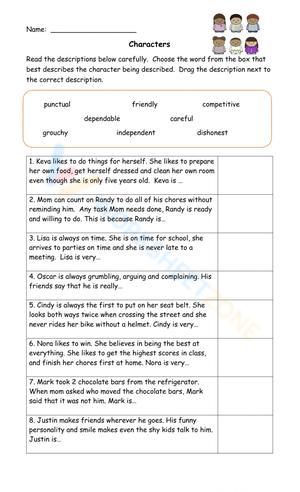
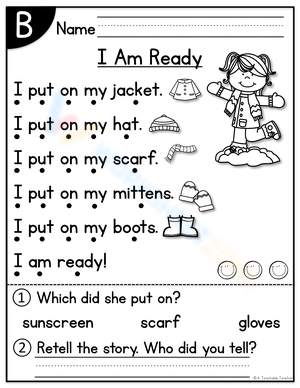
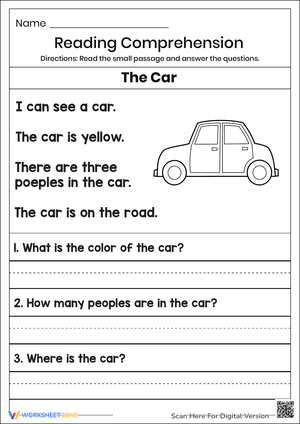
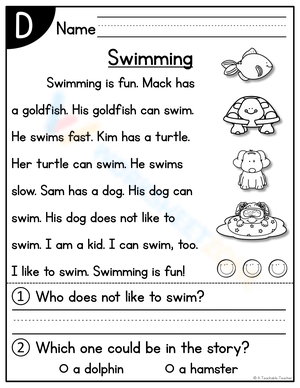
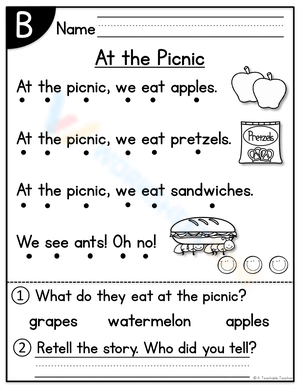
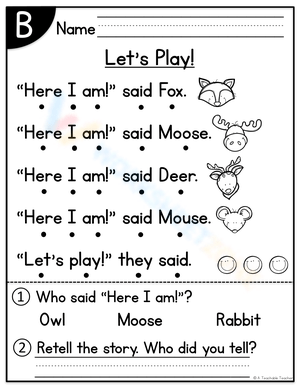
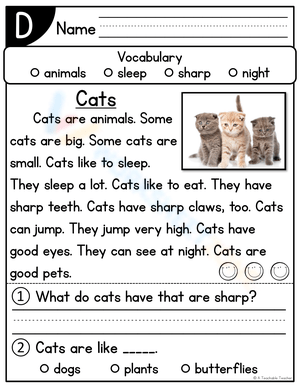
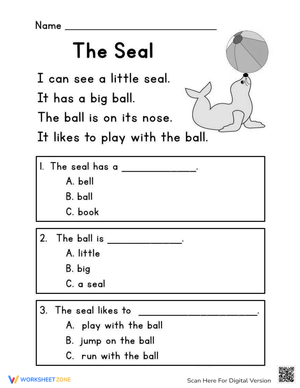
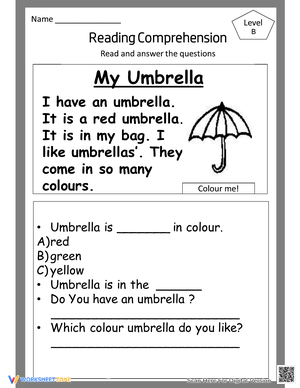
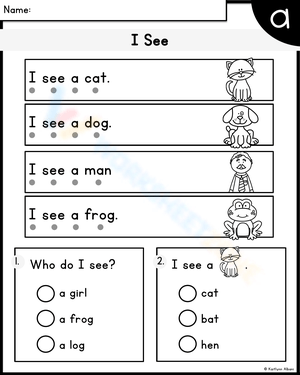
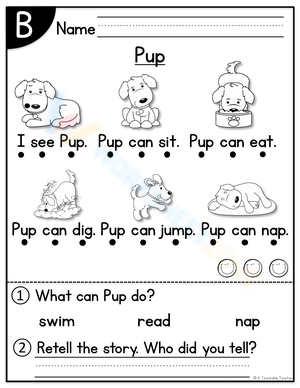
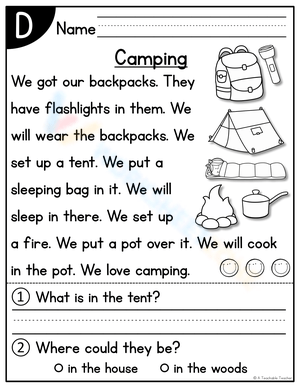
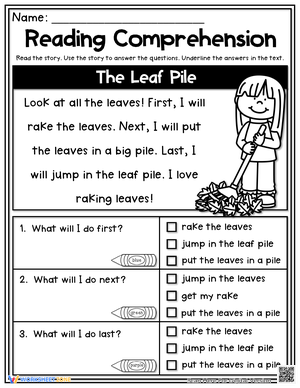
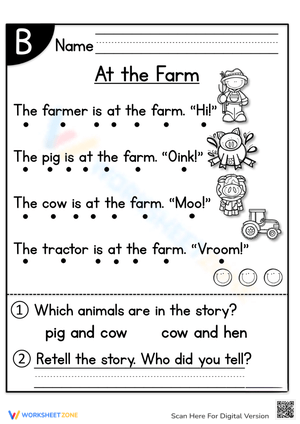
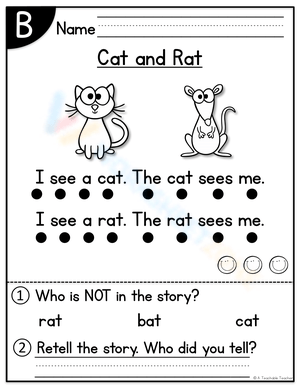
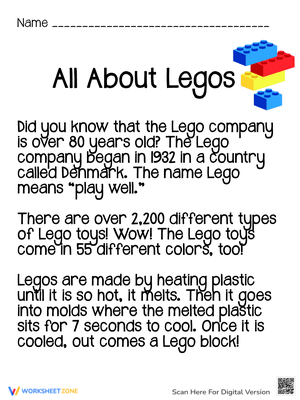
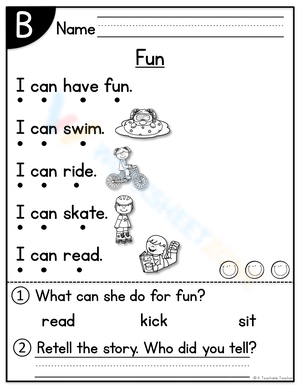
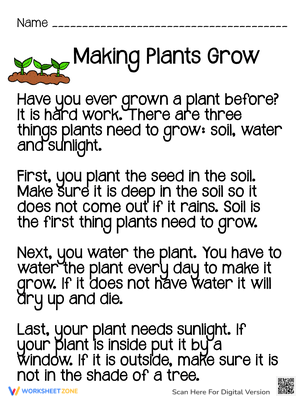
These leveled reading worksheets for 1st grade give teachers a practical answer to one of guided reading's core logistical problems: having the right text in hand for every group, every day. The set spans F&P Levels D through I, covering the full developmental arc of first-grade reading from early emergent readers who rely on picture cues to transitional readers handling multisyllabic words and basic inferences. Every worksheet pairs a reading passage with comprehension questions, so teachers collect formative data from the same task students use to practice.
Concepts Covered Across the Set
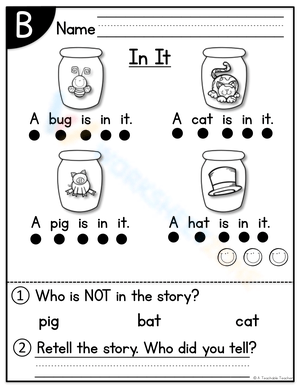
When browsing for leveled reading worksheets for 1st grade, it helps to understand what the level indicators actually signal about passage structure — not just a letter on a header, but specific text characteristics that determine what readers must do. Level D and E worksheets are built around short-vowel CVC words, high-frequency Dolch and Fry sight words, and repetitive sentence frames that let students use syntactic patterns to confirm their decoding. By Level G, vowel teams appear in context — ea, oa, ai — and students must cross-check visual cues against sentence meaning. Levels H and I introduce two-syllable words, -tion endings, and multi-paragraph structures where students must track information across more than one chunk of text before answering questions.
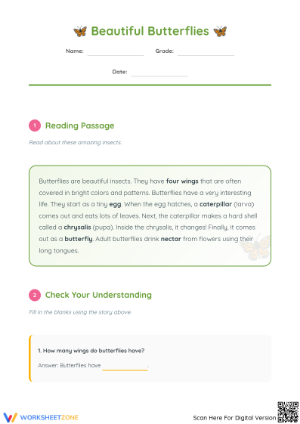
Both fiction and informational passages appear throughout the set. Informational worksheets at the upper levels include basic text features — a bolded vocabulary term, a simple caption, or a labeled diagram. These features aren't decorative; the comprehension questions require students to use them, building habits that matter considerably in second grade when informational reading demands increase.
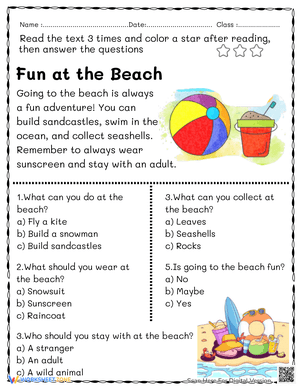
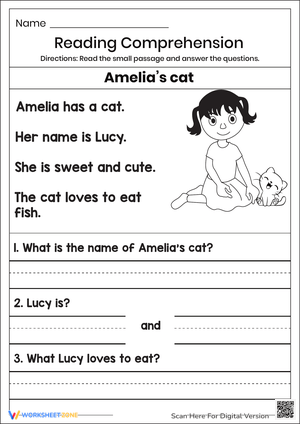
Comprehension questions follow a deliberate sequence on every worksheet: literal recall first, a detail requiring rereading second, a basic inference or author's purpose third. That ordering is intentional. First graders who rush through comprehension tasks almost always skip the rereading step. Starting with the most accessible question builds momentum before the harder one appears.
Why Text-to-Reader Matching Matters More at This Grade Than Almost Any Other
First grade is the developmental window where phonological awareness, letter-sound knowledge, and sight word recognition begin consolidating into automatic decoding. Until that consolidation happens, a text that's too difficult produces a predictable outcome: students decode with surface accuracy while understanding almost nothing, because every unit of working memory is absorbed by the word-by-word effort. The comprehension questions expose this clearly. A student who reads "The bear walked into the meadow" without a single oral error will sometimes circle the wrong answer to "Where did the bear go?" — not from carelessness, but because meaning-making was crowded out entirely during decoding. Texts matched to a student's current decoding ability free up enough cognitive capacity for comprehension to actually occur. That's the entire argument for leveled materials, visible in a single classroom moment.
Common Errors Worth Watching For and Correcting
The most predictable error pattern at Levels D through F is visual substitution at the first and last letter: students read "when" for "went," "horse" for "house," or "there" for "three" because the letter skeleton matches and they're not cross-checking with sentence meaning. This error is nearly invisible when teachers review only written comprehension responses — a student who substituted three words might still answer a recall question correctly by guessing from context. The substitution surfaces during oral reading, which is why listening to students read the passage aloud, rather than assigning it silently, is essential in guided reading groups. The written score tells you what the student got wrong; the oral read tells you why.
At Levels G and H, the error shifts to vowel team inconsistency. A student who reads "seat" correctly as a sight word will mispronounce "heat" and "beat" in the same passage, reverting to the short-vowel sound because they're treating each word as a new decoding event rather than applying a pattern across the text. These worksheets surface that inconsistency within a single reading session, so teachers can address it immediately rather than waiting for a phonics lesson to catch up to the error.
Fitting These Worksheets Into the Teaching Week
Guided reading small groups are the primary setting. In a 20-minute session, students read the passage independently while the teacher listens to individuals in rotation, marking errors on a personal clipboard copy. The group then discusses the comprehension questions aloud before writing individual responses. That sequence — silent read, oral check, written response — produces three separate data points from a single worksheet without adding time to the lesson. The teacher's marked copy becomes the running record of the session and feeds directly into the next round of grouping decisions.
For literacy stations, assign students a worksheet one to two levels below their instructional level. The station's purpose isn't growth; it's fluency. Students build reading automaticity on texts they can navigate confidently, and that automaticity transfers to instructional-level reading. A student who labors through Level G in small group reads Level E at the station and finishes feeling like a capable reader — which matters for first graders who have already started identifying themselves as struggling.
Leveled reading worksheets for 1st grade also hold up well as end-of-week review materials. Returning to a passage from earlier in the week as a Friday station task takes under 10 minutes, and second reads are consistently faster and more accurate than first reads. Students who answer the comprehension questions correctly on the second attempt are telling their teacher something specific: they needed time, not intervention. That distinction changes the instructional response entirely.
Standard Alignment
These worksheets address CCSS.ELA-LITERACY.RF.1.3 (Phonics and Word Recognition) and RF.1.4 (Read with Sufficient Accuracy and Fluency to Support Comprehension) through passage design, and they target RL.1.1 and RI.1.1 through comprehension questions asking students to locate and explain key details in text. In instructional terms, RF.1.4 is the standard that makes the leveled-text format necessary: it explicitly frames fluency as a vehicle for comprehension, not an end in itself. Fluency practice disconnected from a real text — isolated word lists, flashcard drills — doesn't fully address what RF.1.4 requires. Reading a leveled passage and answering questions about it addresses both the fluency and comprehension standards in a single, contained task. Teachers in Texas (TEKS) and Virginia (SOL) will find the passage progression and question types map closely to those states' first-grade reading expectations without modification.
Adjusting the Worksheets for a Range of Readers in the Same Room
Students reading well below Level D by late in the year benefit from a word bank added to the comprehension section. These students often demonstrate genuine understanding when a passage is read to them or read with support, but the writing task collapses because encoding the response words exceeds what they can manage independently. A word bank removes the encoding obstacle without simplifying the comprehension thinking — the data collected is cleaner because it separates the skill being assessed from the unrelated skill that was interfering.
Students reading above Level I well before year's end benefit from reframing the comprehension questions as written responses with a text-evidence requirement. Instead of circling or filling in a short answer, they write two sentences: one stating their answer and one identifying where in the passage they found support. This moves them toward the analytical thinking embedded in RL.1.3 and RI.1.8 without requiring a different worksheet entirely — a minimal format adjustment with a meaningful increase in cognitive demand.
For English language learners managing both decoding and vocabulary as simultaneous challenges, adding a brief picture glossary for three or four key passage words reduces vocabulary detours without removing the phonics practice. EL students already carrying heavier cognitive demands than the passage was designed to impose get the most out of the decoding work when the vocabulary load is deliberately lightened at the words that matter most.
Frequently Asked Questions
How do I figure out which level to start a student on at the beginning of the year?
Administer a brief benchmark read in the first week of school: select a Level E passage, listen to the student read aloud for one minute, and calculate accuracy as words read correctly divided by total words attempted. Accuracy between 90 and 94 percent signals an instructional match. Below 90 percent, drop to Level D. At 95 percent or above with strong comprehension responses, move up. Don't anchor to last year's assessment — summer loss is real in early literacy, and many students drop half a level between May and September. The benchmark tells you where students actually are on the day you need to teach them.
Can these worksheets substitute for a running record?
No. Leveled reading worksheets for 1st grade capture comprehension outcomes and provide a written record of student thinking, but they don't document the behavioral picture a running record captures — the self-corrections, the re-reads, the abandon-and-replace strategies that reveal whether a student monitors meaning while decoding. Use the worksheets to track comprehension over time and inform grouping decisions. Use running records when you need to understand the process behind a student's reading, not just the results.
Students notice when their passage looks different from a classmate's. How do I handle that?
Print all levels on the same paper stock and use identical header formatting across every worksheet in the set. When the materials look visually indistinguishable — same font, same layout, same general appearance — most first graders stop making comparisons. For the students who ask directly, the answer is simple and honest: everyone is working on the reading they need right now. At this age, that framing is usually enough.












 Interactive Worksheet Maker
 Quiz Maker
 Word Search Maker
 Crossword Puzzle Maker
 Word Scramble Generator
 Sentence Scramble Generator
 Handwriting Worksheet Generator
 Name Tracing Generator
 Fill In The Blank Generator