ea worksheets for 1st grade
These ea worksheets for 1st grade give teachers a structured, printable set of phonics resources built around one of the trickiest vowel team patterns first graders encounter: the "ea" spelling of the long /e/ sound. Each worksheet targets a specific decoding or encoding task — word-picture matching, fill-in-the-blank, word sorts, sentence unscrambling — so teachers can assign them selectively depending on where their students are in the learning sequence.
What's Inside the Set
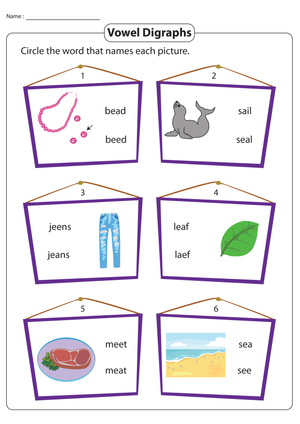
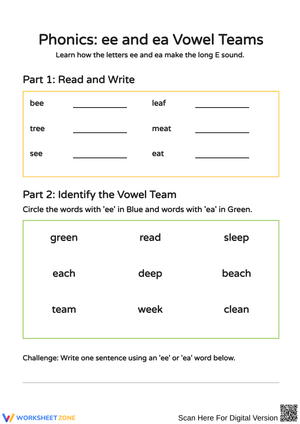
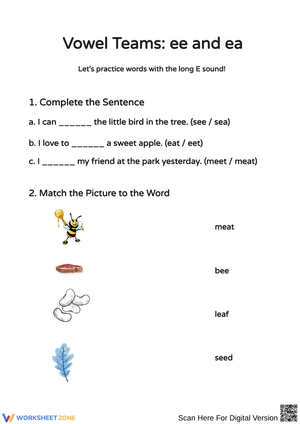
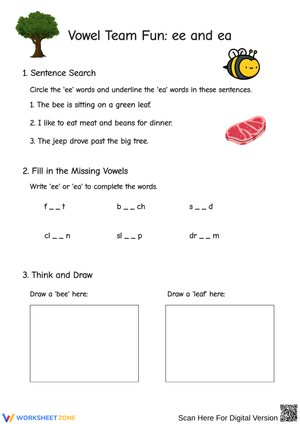
The worksheets move students through the "ea" pattern at increasing levels of demand. Early worksheets ask students to identify and circle the "ea" team inside short, familiar words — sea, leaf, meat, each, beach. These are the words first graders meet in leveled readers, and seeing them isolated on a page helps students notice the pattern rather than just memorizing the whole word as a shape. Later worksheets ask students to produce the spelling themselves: fill-in-the-blank frames like m_ _t and r_ _d force attention to the vowel team rather than the consonants around it. Sentence-level tasks appear at the end of the progression, where students unscramble word sets such as The / team / can / run and write the result — keeping phonics work connected to actual reading and writing rather than pure isolation drills.
Standard Alignment
These worksheets address CCSS.ELA-LITERACY.RF.1.3.C, which requires first graders to know common vowel team conventions for representing long vowel sounds. In classroom terms, this standard sits between the short vowel and final-e work of kindergarten and the more complex vowel pattern instruction that continues in second grade. "ea" is one of the first vowel teams most first-grade phonics sequences introduce precisely because it appears in such a high density of early reader vocabulary — meeting this standard isn't a box-checking exercise; it's unlocking a significant slice of the words students are already trying to read.
Frequent Student Errors Worth Watching For
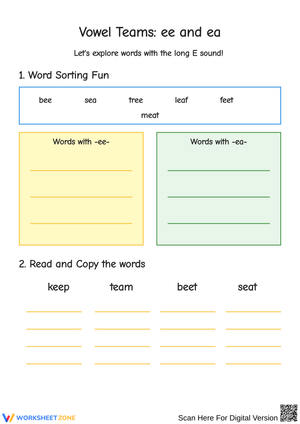
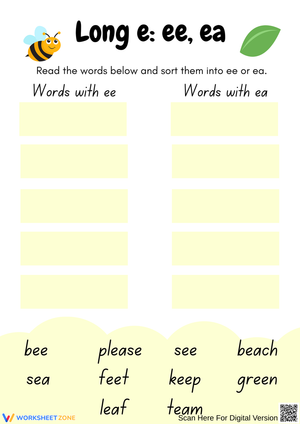
The most predictable error in first grade isn't failing to recognize "ea" — it's substituting "ee" for it. Both teams make the long /e/ sound, and students who have already internalized words like tree and feet will default to that spelling when writing beach or dream. You'll see this in writing journal entries before you see it on worksheets, because worksheets often constrain the choice. When a student writes beech or teem independently, that's the cue to pull out a sorting worksheet and make the two patterns visible side by side.
A second error pattern appears on the fill-in-the-blank tasks: students who know the word read by sight will sometimes fill in the blank correctly without attending to the vowel team at all — they're retrieving the whole word from memory, not applying the phonics rule. A quick probe is to give them an unfamiliar "ea" word, like veal or reap, and see whether they can decode it. If they can't, they're still operating on memorization, and the word-level isolation tasks need more time before sentence work makes sense.
How to Build These Worksheets Into Your Lesson Plans
Most teachers introduce "ea" during whole-group phonics instruction using an anchor chart or whiteboard work, then send students to centers where the worksheets provide independent reinforcement. The word-picture matching worksheet fits naturally into a twenty-minute literacy center block — students finish at different paces, and those who finish early can flip the paper and write three "ea" sentences on the back. The sorting worksheet works well during small-group time, where a teacher can watch students categorize and catch the "ee" confusion in real time rather than after the fact.
One placement worth considering: use the sentence-unscramble worksheet on a Monday morning after the pattern has been introduced the previous week. Spaced retrieval — coming back to a skill after a gap — strengthens retention more than massed practice on the same day as instruction. Five minutes at the start of Monday's phonics block, before new instruction begins, is enough. Students who sail through it are ready for longer "ea" words; students who stall need the matching or fill-in-the-blank worksheets revisited before moving forward.
Why This Vowel Team Belongs in First Grade Phonics
By mid-first grade, most students have stable short vowel knowledge and are beginning to encounter words their decoding strategies can't fully handle. "ea" words appear constantly in early reader texts — read, each, clean, mean — and a student who hasn't been explicitly taught the vowel team pattern will either guess from context or stall. Explicit instruction at this point isn't premature; it's responsive to the actual texts first graders are reading.
The orthographic mapping process — the mechanism by which students permanently store a word's spelling, pronunciation, and meaning in long-term memory — depends on students being able to analyze the phoneme-grapheme connections inside a word. A student who sees leaf and knows that "ea" says /e/ maps the word fully and retrieves it automatically on the next encounter. A student who memorizes leaf as a shape stores it without that phoneme-grapheme anchor, which makes spelling it later far less reliable. These worksheets support the analytical step that makes orthographic mapping stick.
Adjusting the Worksheets for a Range of Learners
Students who are still working on short vowel stability need the matching and circling tasks before anything requiring production. Using the worksheets with large-print versions and limiting each task to six to eight words reduces cognitive load and keeps the focus on the target pattern rather than task management. For these students, reading the words aloud while completing the worksheet — either to themselves or to a teacher — reinforces the sound-symbol link in a way that silent written practice alone does not.
Students who decode "ea" words accurately but inconsistently in writing are ready for the more demanding fill-in and sentence tasks. Extending the challenge is straightforward: ask them to sort a mixed list of "ea" and "ee" words, or give them a short paragraph with blanks where they must choose between the two spellings. Students who have genuinely mastered the pattern can work on two-syllable "ea" words — season, reader, dreamlike — which appear in the more advanced worksheets in the set and preview the morphology work coming in second grade.
Frequently Asked Questions
Both "ea" and "ee" make the long /e/ sound. How do I help students know which to write?
Direct instruction on this distinction belongs after students can reliably decode "ea" words, not before. Once they can read them accurately, use a side-by-side sort: "ea" words on one side anchored to a picture of a leaf, "ee" words on the other anchored to a picture of a tree. When a student freezes during writing and asks whether beach uses "ea" or "ee," pointing to the visual anchor on the wall is more efficient than explaining the rule again — and it builds the habit of using a reference rather than guessing. Over enough exposure in reading and writing, the correct spelling becomes a visual memory, not a rule retrieval.
What about "ea" words that don't say the long /e/ sound, like "bread" or "head"?
Introduce those exceptions after the long /e/ pattern is solid — typically late first grade or early second. Raising exceptions too early creates genuine confusion: first graders are still building the primary rule, and presenting bread alongside beach during initial instruction increases cognitive load without increasing understanding. When exceptions do come up organically in a read-aloud or student writing, acknowledge them briefly ("that's a tricky "ea" — it says /ĕ/ in that word, and we'll learn more of those later") and move on.
Can these worksheets work for students receiving intervention below grade level?
Yes, with sequencing adjustments. Intervention students often need the picture-matching and circling tasks extended further than the core classroom sequence allows — three or four sessions on identifying and naming "ea" words before any production work begins. The worksheets are flexible enough to support that slower progression. What they don't replace is the teacher's explicit phoneme-grapheme modeling; for students in intervention, the worksheet reinforces instruction rather than substituting for it.
Clear All