Printable ee and ea Worksheets for Grade 1 Phonics
These ee and ea printable worksheets for 1st grade target one of the trickier decision points in early phonics instruction: the moment students realize that two different letter pairs can make the exact same long /e/ sound. The set covers word sorts, sentence-level practice, and short reading passages — enough variety to carry these vowel teams from initial introduction through independent application.
What Each Worksheet Builds
Each worksheet isolates the long /e/ vowel team patterns without mixing in unrelated phonics content, which matters more than it sounds. When first graders are trying to lock in a spelling rule, having competing patterns in the same activity creates interference — it splits attention between two things that both need full concentration. Keeping the focus tight lets students develop genuine pattern recognition rather than a vague sense of the sound.
The activities students work through across the set include:
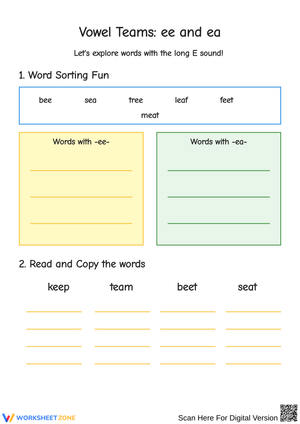
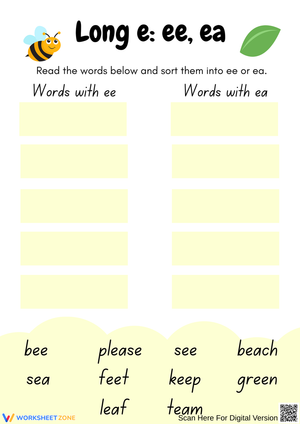
- Cut-and-paste word sorts that separate "ee" words from "ea" words in labeled columns — tree, feet, sleep on one side; leaf, team, beach on the other
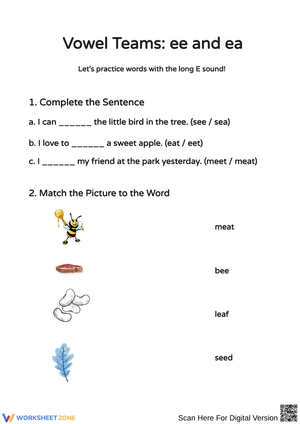
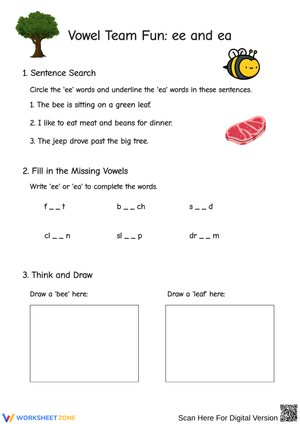
- Fill-in-the-blank sentences where students select the correct vowel team spelling based on context, choosing between pairs like meet and meat
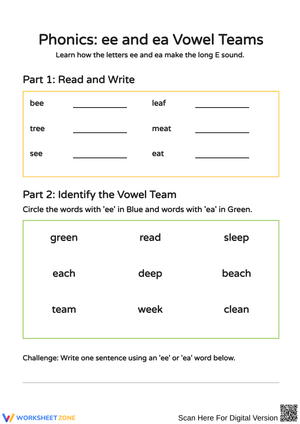
- Short phonics passages loaded with target words, where students underline or highlight each vowel team before reading the text aloud
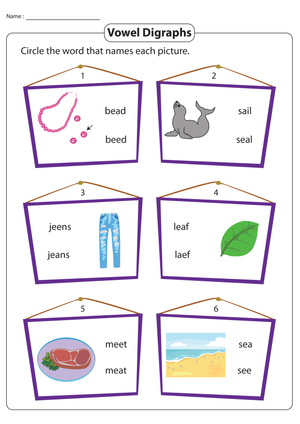
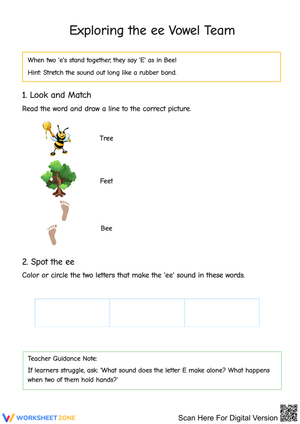
- Picture-word matching tasks that anchor spelling patterns to concrete images — a drawing of a bee, a leaf, a seed
- Trace-and-write practice for the most common "ee" and "ea" words students encounter in leveled readers at this stage
Word choices across the set draw from vocabulary first graders actually meet in early reader books. There is no point spending practice time on words a student will not see for another two grade levels.
Common Errors Worth Watching For and Correcting
The most persistent error is not choosing the wrong vowel team — it is choosing one team exclusively and applying it everywhere. A student who has internalized "ee" will spell beach as beech, meat as meet, clean as cleen. That student knows the long /e/ sound. What they lack is orthographic discrimination — the understanding that both patterns exist and each one has its own territory in English spelling. The word sorts address this directly by presenting both patterns side by side every time, which forces active comparison rather than default recall of whichever pattern feels familiar.
The reverse appears too: students who learned "ea" first sometimes write trea for tree or grean for green. Both directions of the error look like the same problem from a distance — using the wrong team — but the fix differs depending on which pattern is dominant for that student. A quick look at their completed word sort tells you which way the confusion runs.
A second, less obvious error surfaces in the fill-in sentences. Some students decode the context clue correctly but still default to vowel-consonant-e spelling — writing mete instead of meat or meet — because CVCe also produces long /e/. That confusion signals the student needs explicit conversation about which spelling fits which words, not just more undifferentiated practice.
Getting the Most From These Worksheets in Your Weekly Lesson Plans
The word sorts work best early in the week, at the introduction phase. Run the sort together on Monday — project it, do the first three words as a class think-aloud, then release students to complete the rest independently. The cut-and-paste format means students handle the words physically before committing them to columns, which slows the impulsive guessing that derails a lot of early phonics work.
The connected text passages belong mid-week, after students have some exposure to the patterns in isolation. Asking a first grader to mark every "ee" and "ea" word in a passage before reading it aloud serves a specific purpose: it makes the orthographic patterns visible in context, which pushes the reading of those words from effortful decoding toward automatic recognition. By Thursday or Friday, the fill-in sentences and trace-and-write tasks work as consolidation review because students can complete them with less teacher involvement — and that lower-support moment gives you a clearer read on who has truly locked in the skill versus who is still guessing.
For small-group time, the picture-word matching worksheets are the most efficient entry point. A group of four students can each work one while you watch who hesitates, who self-corrects, and who reaches for a word without glancing at the picture anchor at all. That last student is likely ready to move forward.
Standard Alignment
The ee and ea printable worksheets for 1st grade address CCSS.ELA-LITERACY.RF.1.3.C, which requires first graders to know common vowel team conventions for representing long vowel sounds. In classroom terms, this standard sits right at the hinge between short-vowel CVC work and the more complex multisyllabic decoding students will tackle in second grade. The "ee" and "ea" patterns are among the earliest vowel teams introduced in most systematic phonics progressions, which makes this set most useful from mid-year through the end of first grade — after students have stabilized short vowels and are ready to add the next layer of spelling knowledge.
Adjusting the Worksheets for a Range of Learners
For students who are still shaky on the idea that two letters together can produce one sound, start with the picture-word matching tasks and work through them orally before asking for written responses. The image removes decoding pressure and lets the student focus entirely on identifying the spelling pattern — saying the word, naming the vowel letters, then selecting from the options provided. That step-by-step process works better than moving directly to fill-in sentences, which demand reading and spelling at the same time.
Students who move through the word sorts quickly need a writing extension. Instead of sorting given words, they generate their own "ee" and "ea" words and sort those. Some can also work through the connected text passages with an added prompt: write a sentence using one target word from the passage without looking back at it. That retrieval demand — producing a spelling from memory rather than selecting it from a field of choices — is much closer to what real writing requires. The ee and ea printable worksheets for 1st grade include enough format variety that teachers can assign selectively by group without preparing separate materials for each level.
Frequently Asked Questions
Does the "when two vowels go walking" rule apply to these patterns?
It applies reliably to "ee" — both letters are identical, the sound is always long /e/, and there are no exceptions a first grader will encounter. With "ea," the rule holds for the most common reading (long /e/ as in leaf, beach, team), but the pattern has genuine exceptions: bread and head use "ea" for short /e/, and steak uses it for long /a/. For first grade, teach the long /e/ reading as the default and label exceptions "rule breakers" when they surface naturally in reading. Front-loading the exceptions creates confusion before students have consolidated the main pattern.
At what point in the year should I introduce these worksheets?
Most first graders are ready for vowel teams after they have stable control of short vowels and CVC blending — for students on grade level, that typically means mid-year or later. If your phonics sequence is systematic, "ee" often appears before "ea" because the spelling is more uniform. These worksheets work best as consolidation practice after each pattern has been explicitly taught, not as first-exposure material.
Can I send these home without explaining the phonics rule to parents?
For the word sorts and picture-word matching tasks, yes — both have enough visual structure that a caregiver can support the work without phonics training. The fill-in sentences are self-explanatory once students have had classroom instruction on the patterns. One practical note on the cut-and-paste sorts: confirm there are scissors and glue available at home before sending them, or assign the version where students draw lines to match words to columns instead.
How do these worksheets fit alongside decodable readers that use long /e/ words?
The ee and ea printable worksheets for 1st grade work alongside decodable readers, not in place of them. Use a word sort or matching worksheet to pre-teach the target patterns before students open the reader — that five-minute warm-up reduces decoding effort in the text and frees more cognitive attention for meaning. After reading, a fill-in sentence or trace-and-write task anchors the same words in a new context. That transfer step — seeing a word in print, then producing it independently — does more for long-term retention than rereading the same passage a third time.
Clear All