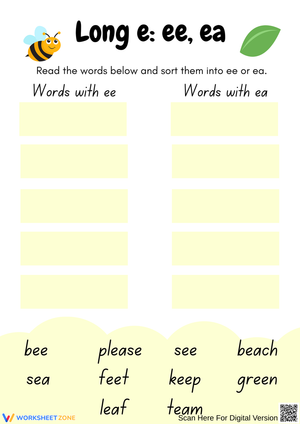
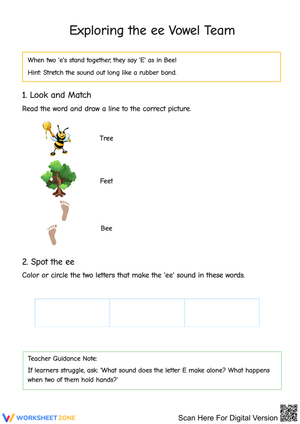
These 1st grade ee printable worksheets give early readers structured, repeated contact with the ee vowel team — the long /e/ digraph that shows up in words like feet, green, and sleep before most students have finished their first chapter books. Each worksheet isolates a specific skill within this pattern, so teachers can slot them into whole-group lessons, phonics centers, or small-group work without retrofitting the activity to fit a purpose it wasn't built for.
The Specific Skills Targeted
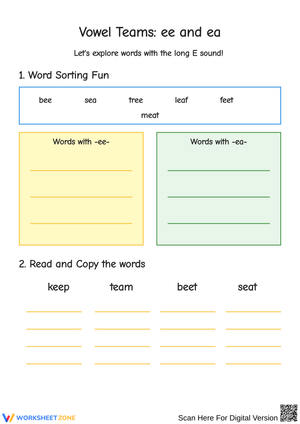
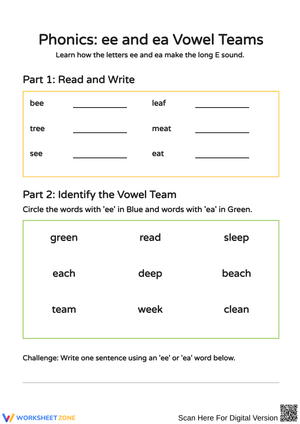
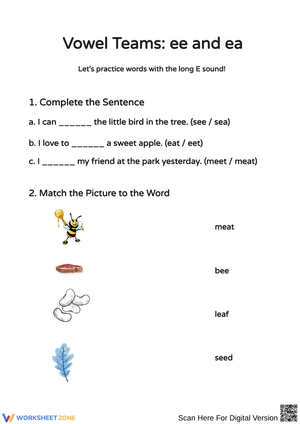
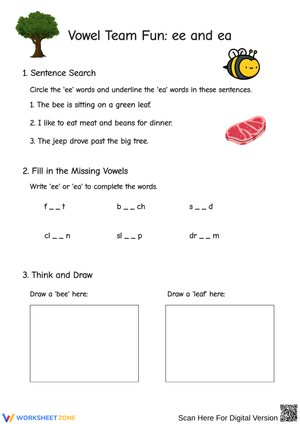
The worksheets address the ee digraph across five distinct task types, each one doing different cognitive work. Word-mapping sheets ask students to segment an ee word into individual phonemes, record each sound in a labeled box, and then blend the word back together — a sequence that builds both decoding and encoding in a single exercise. Cut-and-paste sorting tasks have students categorize picture and word cards under ee and non-ee headers, which develops the categorical thinking that underlies later vowel-team comparisons. Decodable sentence strips load short, readable sentences with ee words; after reading, students underline every digraph they can find. Color-by-word printables tie a color to each target word — students read the word, identify its designated color, and fill in the matching region of an illustration, pairing phonics work with fine-motor practice. Phonics mazes round out the set: students trace a route through a word grid by following only the ee words and avoiding distractors, which functions as a low-stakes review activity that students tend to treat like a game.
Standard Alignment
These worksheets align with CCSS.ELA-LITERACY.RF.1.3.C, which requires first-grade students to know common vowel team conventions for representing long vowel sounds. In classroom terms, this standard sits inside the larger RF.1.3 strand on phonics and word recognition — it's the point in the year when students are expected to move beyond single-letter sound-spelling correspondences and begin working with digraphs and vowel teams as units. The ee digraph is typically addressed in the second or third quarter of first grade, after CVC and CVCe patterns are established, and these worksheets are sequenced to match that instructional placement.
Frequent Student Errors Worth Watching For
The most common problem in early ee work is not misreading the digraph in isolation — it's failing to apply the pattern under load. A student who correctly reads bee on a flashcard will often decode it as /b/-/ɛ/ (short e) when it appears mid-sentence, because attention is split between tracking syntax and applying a phonics rule simultaneously. This is a working memory issue, not a gap in phonics knowledge, and it signals that the student needs more practice reading ee words inside connected text rather than in lists.
A second error pattern appears during encoding. Students who can read sleep will sometimes write slep or sleap when spelling from dictation — they remember that the long /e/ sound needs a second vowel but haven't yet locked in which digraph produces it. Elbow-partner dictation rounds after worksheet completion, where one student dictates three ee words while the partner records them on a whiteboard, surface this confusion quickly and give the teacher a clear picture of who has consolidated the spelling pattern and who hasn't.
How to Build These Worksheets Into Your Lesson Plans
The word-mapping and fill-in-the-blank worksheets work well as guided practice immediately after a whole-group introduction. Spend five to seven minutes on an anchor chart — list eight to ten target words, circle the ee in each one with a bright marker, and model blending two or three words by stretching phonemes before snapping them together. Then distribute the mapping worksheet and walk the room while students work, prompting anyone who stalls to tap each sound box before writing. Corrective feedback during this window matters: a misconception left unaddressed for even a day starts to calcify in first grade.
The cut-and-paste and color-by-word worksheets are better suited to center rotations or the independent block. Because the tasks are visually self-guiding, students need minimal redirection, which frees the teacher to run a small-group pull. The phonics mazes fit naturally into the eight or ten minutes before a transition — lunch, specials, end of day — when there isn't enough time to launch a new activity but too much to leave unstructured. Students pick up a maze, work independently, and the room stays productive without any additional setup.
Adjusting the Worksheets for a Range of Learners
Emerging readers should focus on three-phoneme ee words — bee, see, fee — where the segmentation task is short enough not to overwhelm working memory. On the word-mapping sheets, pre-print the initial consonant in the first sound box so these students can concentrate their effort on the digraph itself rather than getting stuck before they reach it. On-level readers work through the standard word list, which includes four-phoneme words like feed and week. Advanced readers extend by writing one or two original sentences after completing the worksheet, using at least two ee words each — a sentence frame ("I can see a ___") lowers the barrier for students who freeze in front of a blank line without reducing the encoding demand.
For students receiving intervention support, the cut-and-paste sorting worksheet pairs well with a tactile reinforcement step: before cutting and placing the cards, students build each ee word on a magnetic letter board, then transfer it to the paper. The physical construction of the word adds a motor-memory layer that print-only practice skips.
Frequently Asked Questions
Do these worksheets work for students who already know short vowel sounds but haven't been introduced to digraphs yet?
Yes — the word-mapping format is particularly useful for that transition. Students who are secure with CVC words already know how to segment three phonemes into sound boxes; the mapping worksheet simply extends that familiar routine to include a two-letter spelling for a single sound. Starting there prevents the digraph from feeling like a completely new concept rather than an extension of skills already in place.
How do the ee worksheets connect to upcoming vowel-team lessons?
Once students are solid on ee, they're ready to meet ea as a second spelling for the same long /e/ sound. A brief comment during the ee unit — "this sound has more than one spelling we'll learn" — sets the expectation without front-loading information students aren't ready to sort. The sorting worksheet format transfers directly to ea instruction: the same cut-and-paste structure works with ee versus ea headers, asking students to categorize by spelling while recognizing that both say /e/.
How many worksheets does a student typically need before the ee pattern is consolidated?
There's no universal number, but the patterns we see in first-grade student work suggest that most on-level readers need five to eight distributed practice sessions — meaning spread across several days, not completed in a single sitting — before ee words appear automatically in their writing. Spaced retrieval outperforms massed practice for phonics patterns at this age. Using one or two worksheets per session across a week produces better retention than completing the full set in a single phonics block.












 Interactive Worksheet Maker
 Quiz Maker
 Word Search Maker
 Crossword Puzzle Maker
 Word Scramble Generator
 Sentence Scramble Generator
 Handwriting Worksheet Generator
 Name Tracing Generator
 Fill In The Blank Generator