These long u worksheets for 1st grade cover the three spelling patterns students encounter most often in early phonics — u_e, ue, and ew — and give teachers focused practice that moves from sound recognition through independent spelling without requiring extra prep. Each worksheet targets the same sound through a different task type, so the set builds familiarity across formats rather than repeating the same activity across the week.
What's Inside the Set
Each worksheet approaches the long u sound from a different angle so students accumulate varied encounters with the same phonics target. The five task types across the worksheets are:
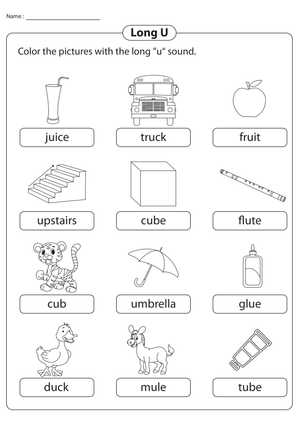
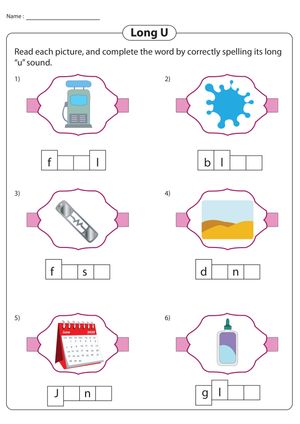
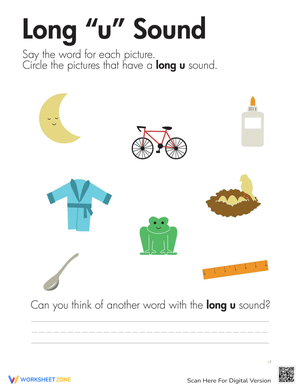
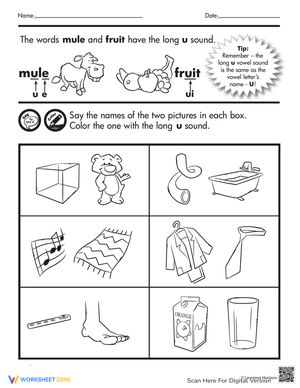
- Picture-to-word matching — students connect familiar images to printed words before reading them cold
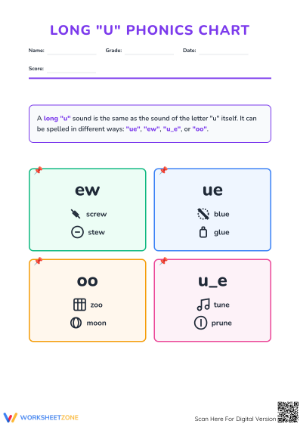
- Word sorting by spelling pattern — students group words under u_e, ue, and ew column headers
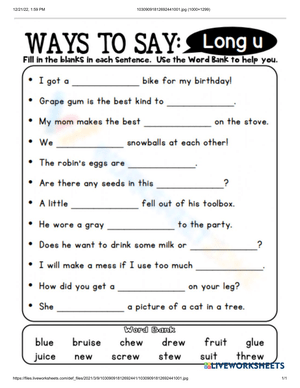
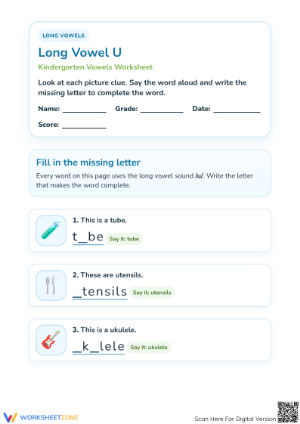
- Fill-in-the-blank completion — students supply the missing vowel pattern inside a partially written word
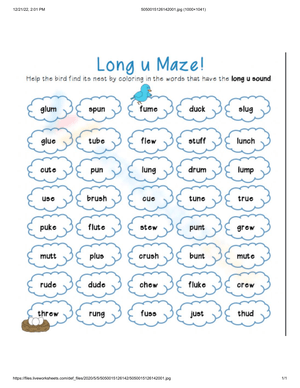
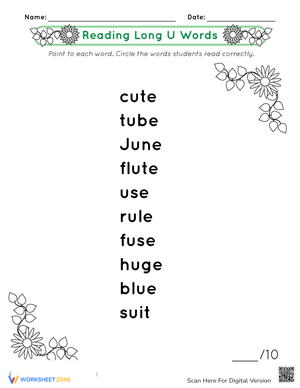
- Sentence reading with underlining — students locate the long u word inside a short sentence and mark it
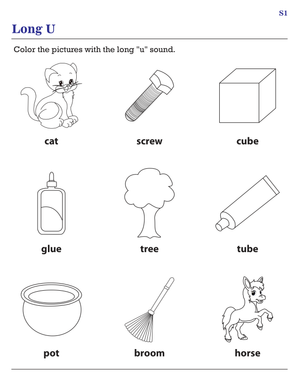
- Short-u versus long-u comparison — students sort or label word pairs such as cube and cub, mule and mud
A set of long u worksheets for 1st grade organized this way gives teachers enough variety to place different worksheets into morning work, centers, and homework without the practice feeling repetitive. Each worksheet also keeps the task demand narrow — a worksheet focused entirely on u_e words does not introduce ue or ew within the same worksheet, so students can notice the pattern rather than sort through competing information while decoding.
Frequent Errors First Graders Make With Long U Patterns
The most persistent confusion is not between long u and short u — it is between ew and a consonant blend. Students who have spent weeks learning str, bl, and gr will look at "new" and try to decode /n/ and /ew/ as two separate units, then freeze because /ew/ does not match any stored blend. They have not yet classified ew as a vowel team. This becomes especially visible with words like "grew," "threw," and "blew," where the consonant immediately before ew makes the word look structurally identical to a blend. Worksheets that ask students to box only the vowel team letters give students a visual routine that interrupts the blend-reading habit before it solidifies into a persistent decoding error.
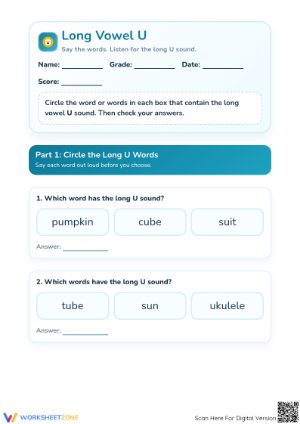
A second error appears when students overgeneralize ue after first learning it. A student who has just been taught that ue spells long u will sometimes write "cube" as cueb or "mule" as muel, inserting the vowel pair into a magic-e word. They know ue produces the right sound, but they have not yet internalized that it appears at the end of a word rather than in the middle. Worksheets that require students to circle only the letters that represent the long u sound — not the whole word — help them isolate what each pattern actually covers rather than applying it globally.
Why Long U Gets Its Own Worksheet Set in Grade 1
Long u is more cognitively demanding than long a or long i because the same phoneme appears at roughly equal frequency across three different spelling patterns. Students learning long a can rely heavily on a_e and ai and still decode most words correctly. Long u requires holding three common spellings simultaneously — u_e, ue, ew — and sorting each new word into the correct category from the first encounter. That categorization demand sits on top of the decoding demand, which increases cognitive load in a way that single-pattern vowel sounds simply do not.
Worksheets address this by externalizing the sorting work. Instead of holding all three patterns in working memory while decoding, students can look at a column header and place the word beneath it. That structure reduces mental load enough for students to actually notice the pattern rather than guess and move on. Once sorting becomes automatic on paper, students begin applying the same three-way distinction during independent reading — which is exactly the transfer outcome RF.1.3c targets.
How to Build These Worksheets Into Your Lesson Plans
Most teachers drop one worksheet into morning work after the whole-group phonics lesson — five to eight minutes covers a decoding-and-circle task cleanly. Sorting worksheets work better in centers, where students have a few extra minutes and can use word cards alongside the printed page. For intervention groups, pulling one worksheet focused on a single pattern — rather than a mixed-pattern review version — keeps practice tight enough to show measurable progress within the session.
Teachers who have used long u worksheets for 1st grade as exit tickets report that the short-u versus long-u comparison section works especially well for that purpose. It takes about three minutes and immediately shows whether a student distinguishes the two sounds reliably without picture support. The sentence-reading worksheets travel well as homework because the directions are self-evident — a first grader can follow "underline the long u word" without a parent needing to interpret the task.
One technique that extracts additional value from a single worksheet: complete it as a class read-aloud on day one, then return to the same worksheet on day two and have students color-code the words by spelling pattern. The second pass takes about three minutes, adds no prep, and functions as spaced retrieval — students access the same vocabulary two days later without experiencing it as a repeated assignment.
Adjusting the Set for Students at Different Readiness Levels
Students who are still building phonemic awareness need the picture-supported tasks first — matching a photograph of a flute to its written word before reading the word cold. Moving these students directly to fill-in-the-blank before they can identify the long u sound reliably by ear produces errors that reflect a phonemic awareness gap rather than a decoding gap, and those two problems call for different follow-up instruction entirely.
Students working above grade level can take the same worksheet with a writing extension: after completing the sort, they write two original sentences using one word from each pattern column. That moves the pattern work into composition without requiring a different worksheet. In mixed-ability classrooms, every student completes the core page; students who finish early receive a blank sort mat and are asked to generate three additional words for each column from memory. The extension stays anchored to the phonics skill rather than sending fast finishers into unrelated activities.
Standard Alignment
These worksheets align with CCSS.ELA-LITERACY.RF.1.3c, which asks first graders to know final-e and common vowel team conventions for representing long vowel sounds. In classroom terms, RF.1.3c falls in the second half of first grade, after students have worked through short vowels and CVC patterns. Long u fits precisely within this standard because u_e exemplifies the final-e convention while ue and ew exemplify the vowel team conventions — all three represent the same phoneme in decodable one-syllable words like "cube," "blue," and "flew." Teachers using these worksheets as part of systematic phonics instruction address the decoding strand of the language arts standards directly, not as supplemental enrichment layered on top of it.
Frequently Asked Questions
Which long u spelling pattern should I introduce first?
u_e is the right starting point for most first graders because the magic-e rule is already familiar from long a and long i instruction. Students apply the same positional logic — the e at the end changes the vowel sound — before they encounter ue and ew, which require recognizing a new letter pair as a vowel team rather than relying on a rule they already know. Introducing ew second, before ue, also helps: the two letters in ew are visually distinct from each other and less likely to be confused with a consonant blend once students have had dedicated practice treating ew as a single unit.
How many words per worksheet is appropriate at this level?
Eight to twelve words per worksheet is a workable range. Fewer than eight gives too little exposure to make the pattern stick; more than twelve tips the task toward memorization rather than decoding. For sorting worksheets specifically, four to five words per column produces cleaner results than three large columns of seven, because students can hold a shorter list in mind while they reread and check their placements before moving on.
Can I use these worksheets for assessment, or are they only for practice?
The short-u versus long-u comparison tasks work well as informal assessment once you remove the picture cues before distributing the worksheet. That single adjustment shifts the task from recognition to recall, which is closer to what independent reading demands. Teachers searching for long u worksheets for 1st grade often find that the same worksheet serves both practice and assessment purposes depending on which visual supports remain on the page — picture cues in for instruction, picture cues removed when you want to see what students can do without prompting.












 Interactive Worksheet Maker
 Quiz Maker
 Word Search Maker
 Crossword Puzzle Maker
 Word Scramble Generator
 Sentence Scramble Generator
 Handwriting Worksheet Generator
 Name Tracing Generator
 Fill In The Blank Generator