


























Views
Downloads

Long U Vowel Worksheet | Printable Grade 1 Phonics
Paste this activity's link or code into your existing LMS (Google Classroom, Canvas, Teams, Schoology, Moodle, etc.).
Students can open and work on the activity right away, with no student login required.
You'll still be able to track student progress and results from your teacher account.
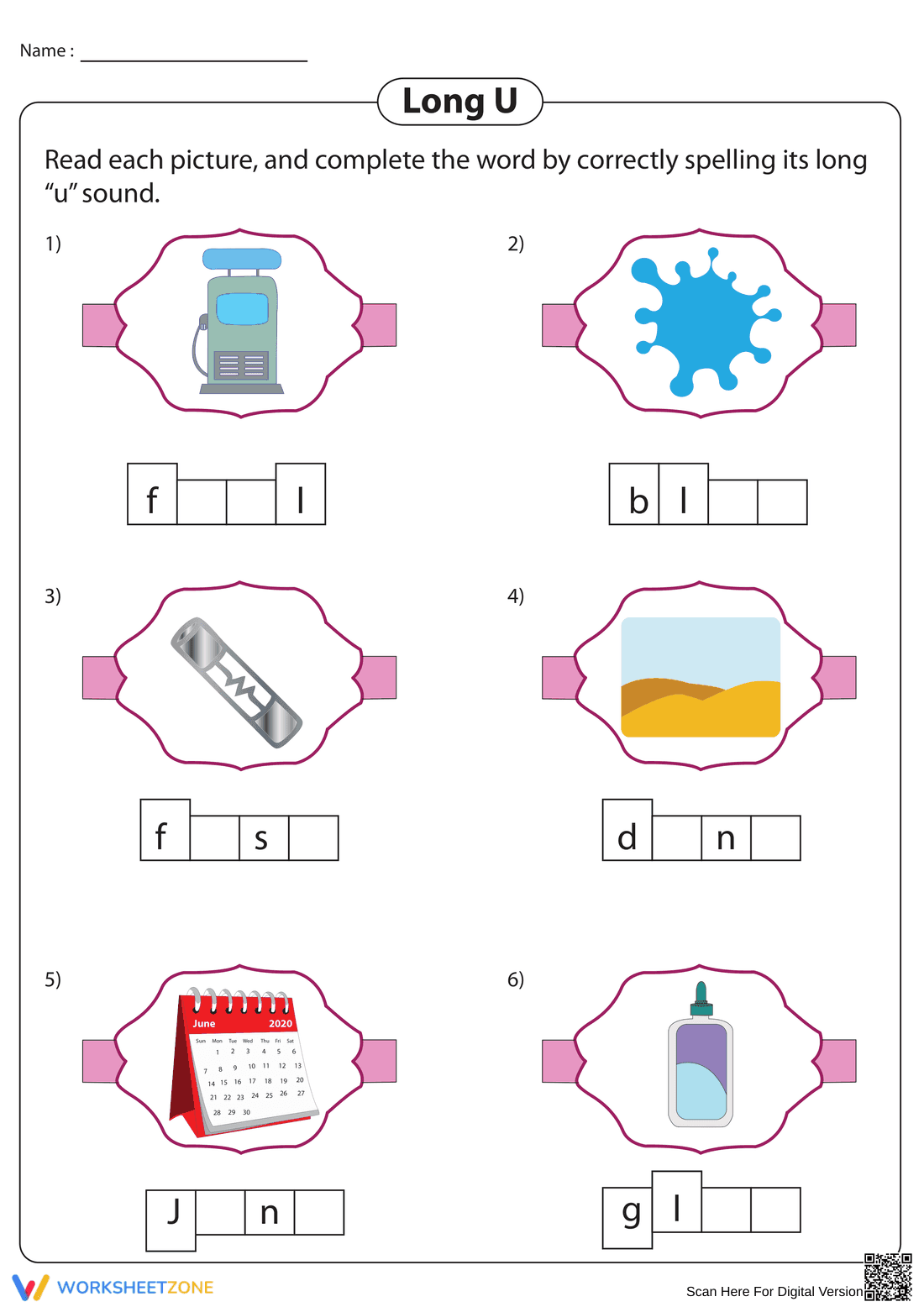
This printable long U phonics worksheet builds vowel decoding skills by asking students to complete the names of pictured objects using the long U sound. Across 8 fill-in-the-blank tasks, students connect spoken vowel sounds to written letters, reinforcing the phonics pattern in a visual, structured format.
At a Glance
- Grade: K–4 (core use: Grade 1–2) · Subject: ELA / Phonics
- Standard:
CCSS.ELA-LITERACY.RF.1.3.C— Know and apply long vowel sounds for common spellings- Skill Focus: Long U vowel sound recognition and spelling completion
- Format: 2 pages · 8 problems · Answer key included · PDF
- Best For: Phonics centers, word work, early intervention
- Time: 10–15 minutes
Inside: 2 pages of picture-based fill-in-the-blank items. Each task shows a labeled image with a missing letter or letters representing the long U sound. Students write the missing letters to complete each word. Answer key on the final page shows correct spellings for quick teacher review.
- Guided practice: First 2–3 items pair pictures with partial letter scaffolds (e.g., blanks placed after a consonant), reducing cognitive load while students identify the target sound.
- Supported practice: Middle 3 items reduce scaffolding — students supply the vowel pattern with only the picture as a cue, building phoneme-grapheme mapping.
- Independent practice: Final 2–3 items present pictures alone; students recall and write the full long U spelling without structural hints, demonstrating transfer.
This gradual-release sequence mirrors the I Do / We Do / You Do model, moving students from supported recognition to independent production within a single sitting.
Standards AlignmentCCSS.ELA-LITERACY.RF.1.3.C — Know final-e and common vowel team conventions for representing long vowel sounds. Tasks on this worksheet directly target the long U pattern across common single-syllable words. Supporting standard CCSS.ELA-LITERACY.RF.K.3.B applies for Kindergarten use: associate the long and short sounds with common spellings for the five major vowels. Both standard codes can be copied directly into lesson plans, IEP goals, or district curriculum mapping tools.
How to Use It
Use during or after direct instruction on long U patterns as a formative check. Assign as a phonics center rotation (10–12 minutes) or as a whole-class guided practice page projected on a whiteboard. For a quick formative observation, watch whether students hesitate on items 6–8 — consistent errors there signal the vowel-team pattern needs reteaching before moving to multisyllabic words. Expected completion: 10–15 minutes for Grade 1; 8–10 minutes for Grade 2.
Who It's For
Primary audience: Grade 1–2 students in core phonics instruction. Also suitable for Kindergarten enrichment and Grade 3–4 intervention with students who need long vowel remediation. Pairs naturally with a long U anchor chart listing common spellings (u_e, ue, ew) and a decodable reader featuring words like cube, mule, and flute.
Research supports explicit, picture-supported phonics practice for early readers. NAEP data show students who receive systematic phonics instruction — including vowel-pattern work — score significantly higher on decoding assessments by Grade 4. This worksheet targets CCSS.ELA-LITERACY.RF.1.3.C, the standard requiring students to know and apply long vowel sounds for common spellings. Students complete 8 picture-naming tasks that map the long U sound to its written form, building the phoneme-grapheme connections central to fluent decoding. Fisher and Frey (2014) identify structured, scaffolded practice as essential for moving students from phonics knowledge to automatic word recognition. By progressing from scaffolded to independent items, this worksheet operationalizes that principle in a format teachers can assign, collect, and score in under two minutes.


