


























Views
Downloads


Long U Phonics Chart & Word Sort | Printable Grade 1 ELA
Paste this activity's link or code into your existing LMS (Google Classroom, Canvas, Teams, Schoology, Moodle, etc.).
Students can open and work on the activity right away, with no student login required.
You'll still be able to track student progress and results from your teacher account.
Master the complexities of the Long U sound with this comprehensive phonics resource. Students transition from visual recognition to active application by identifying and sorting common spelling patterns. This worksheet ensures young learners can accurately decode and encode words containing tricky Long U vowel teams and silent-e structures.
At a Glance
- Grade: 1 · Subject: ELA
- Standard:
CCSS.ELA-LITERACY.RF.1.3.C— Know common vowel team conventions for representing long vowel sounds- Skill Focus: Long U spelling patterns (ew, ue, oo, u_e)
- Format: 2 pages · 11 tasks · Answer key included · PDF
- Best For: Independent phonics practice and literacy centers
- Time: 15–20 minutes
What's Inside
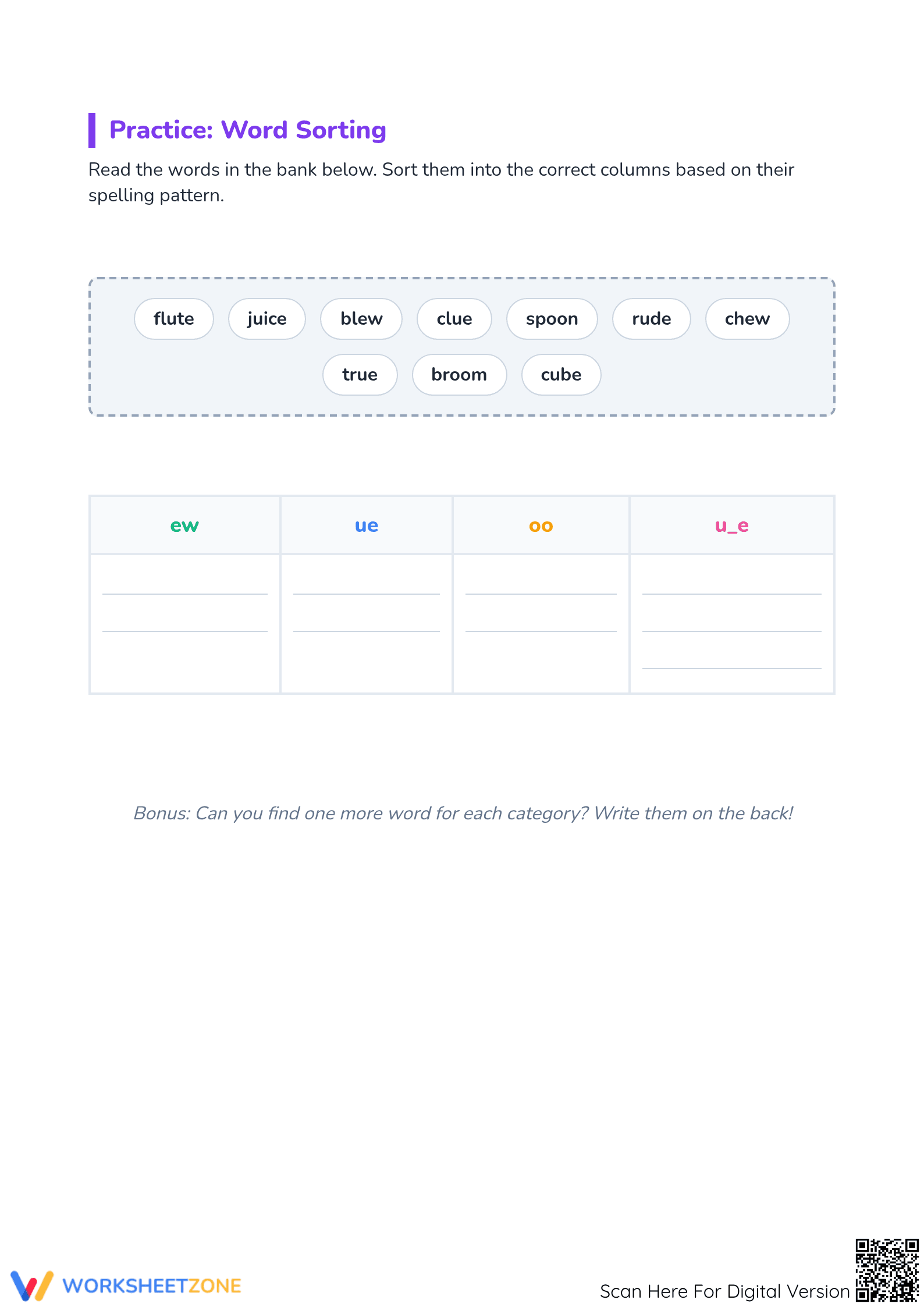
This two-page PDF includes a high-impact anchor chart and a structured word-sorting activity. The first page provides a visual reference for the four primary Long U patterns—ew, ue, oo, and u_e—complete with illustrative icons like a screw, blue paint, a zoo, and a musical tune. The second page features a word bank of 10 targeted words and a bonus challenge to encourage original word generation. A full answer key is provided for immediate feedback.
Zero-Prep Workflow
To implement this resource, teachers need fewer than 2 minutes of preparation. First, print the dual-sided document (30 seconds). Second, distribute the anchor charts for students to keep in their writing folders (30 seconds). Finally, review the word bank together before students begin independent sorting (1 minute). This streamlined process makes it an ideal choice for emergency sub plans or quick bell-ringer activities.
Standards Alignment
This worksheet is primarily aligned to CCSS.ELA-LITERACY.RF.1.3.C, which requires students to "know final -e and common vowel team conventions for representing long vowel sounds." By isolating the Long U sound and presenting it across multiple orthographic representations, it also supports CCSS.ELA-LITERACY.RF.1.2.C. Both standard codes can be copied directly into lesson plans, IEP goals, or district curriculum mapping tools.
How to Use It
Use the anchor chart during direct instruction as a visual scaffold while introducing long vowel teams. After the lesson, assign the word sort as a formative assessment to gauge mastery of the different spelling rules. Teachers should observe whether students can correctly place "juice" and "fruit" in the correct columns, as these often represent the most challenging variations. Expect most students to complete the sorting tasks in under 15 minutes.
Who It's For
This resource is designed for first-grade students but is also appropriate for Kindergarteners ready for advanced phonics and second-grade students needing remediation. It pairs naturally with decodable passages focusing on Long U or interactive whiteboard lessons. The clear icons provide essential support for English Language Learners and students with processing challenges.
The development of phonics resources that utilize categorical sorting is supported by research in cognitive load theory and literacy acquisition. According to the NAEP 2024 Framework, explicitly teaching vowel team conventions like CCSS.ELA-LITERACY.RF.1.3.C is a critical precursor to reading fluency and orthographic mapping. This worksheet provides the "Long U" focus necessary for students to build mental models of spelling patterns through repeated exposure and active categorization. Fisher & Frey (2014) emphasize that such scaffolds—combining visual anchor charts with independent practice—facilitate the gradual release of responsibility in early elementary classrooms. By engaging with 11 distinct tasks, students solidify their understanding of the Long U phonics chart, ensuring they move beyond simple decoding to automatic word recognition. This instructional design provides the evidence-based practice required for foundational literacy success and long-term reading proficiency in diverse classroom environments.


