


























Views
Downloads

Printable Long Vowel U Phonics Worksheet | Grade 1 Ready
Paste this activity's link or code into your existing LMS (Google Classroom, Canvas, Teams, Schoology, Moodle, etc.).
Students can open and work on the activity right away, with no student login required.
You'll still be able to track student progress and results from your teacher account.
Mastering the long vowel U sound is an essential milestone for early readers transitioning from simple decoding to advanced phonics. This printable phonics worksheet provides targeted practice in identifying various long U spellings, including the CVCe pattern and vowel teams. By discriminating between short and long vowel sounds, students build the foundational phonemic awareness required for fluent reading and accurate spelling.
At a Glance
- Grade: Grade 1 · Subject: English Language Arts
- Standard:
CCSS.ELA-LITERACY.RF.1.3.C— Know final -e and common vowel team conventions for representing long vowel sounds- Skill Focus: Long Vowel U Identification
- Format: 3 pages · 9 problems · Answer key included · PDF
- Best For: Literacy centers and phonics small group instruction
- Time: 15–20 minutes
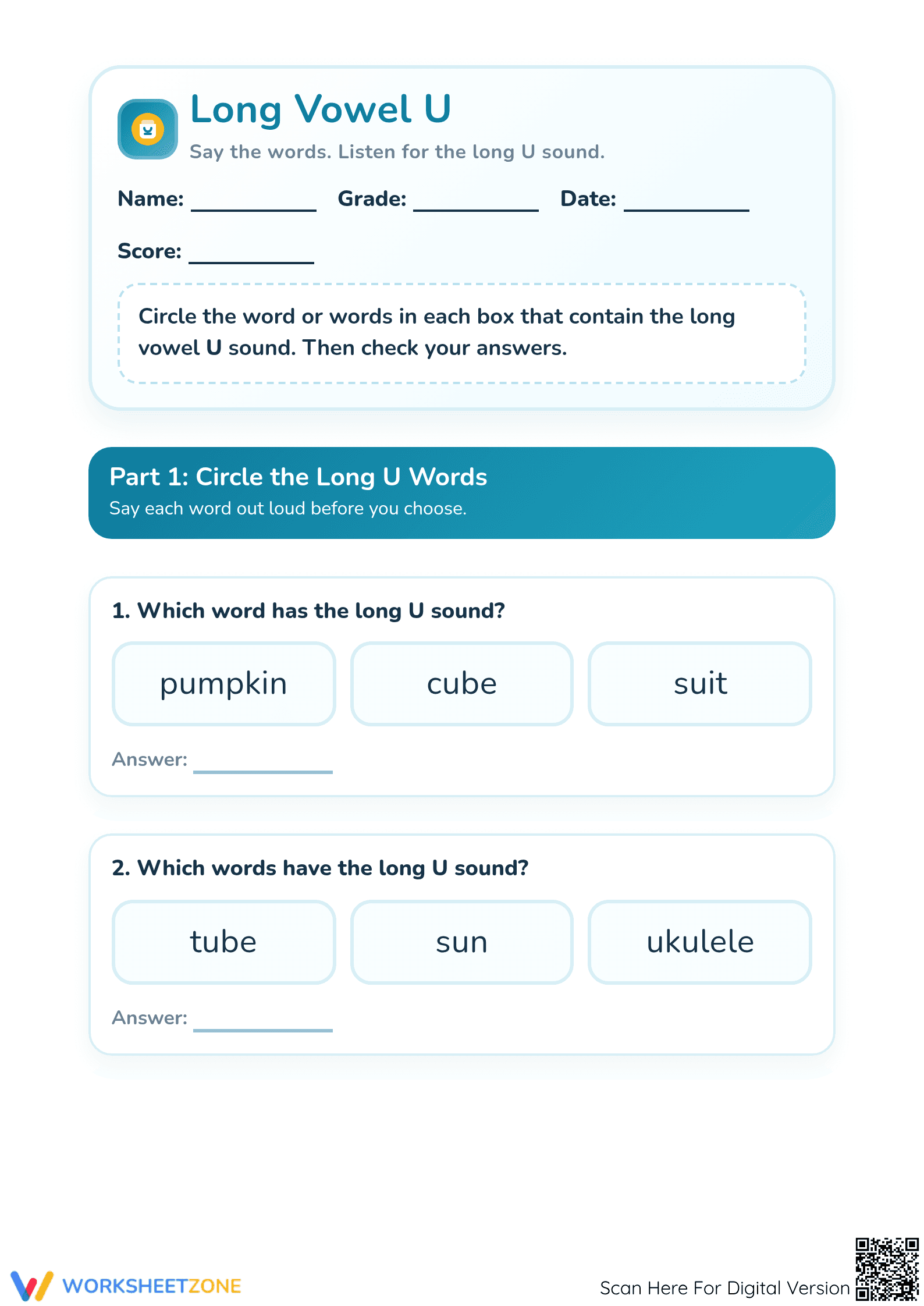
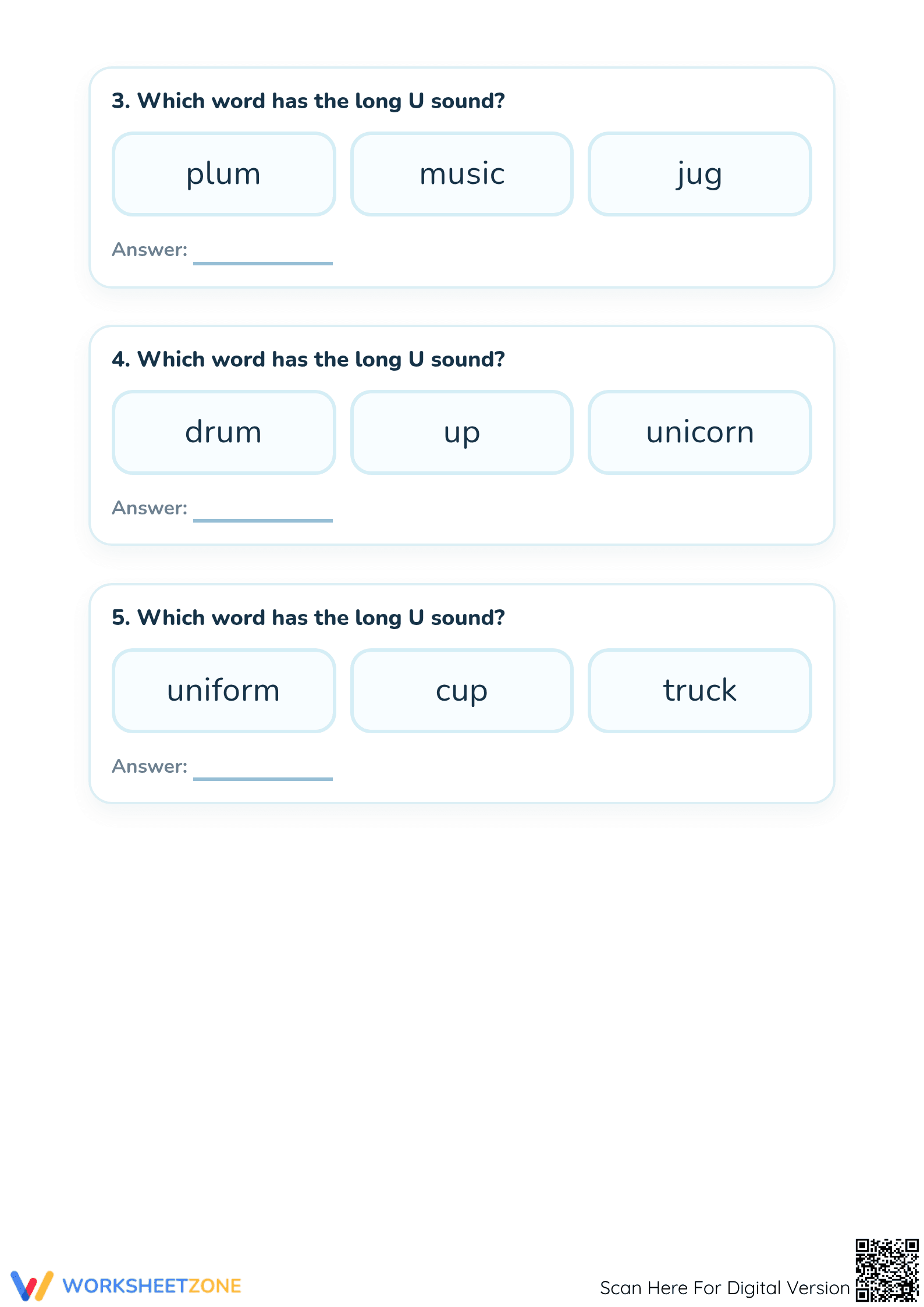
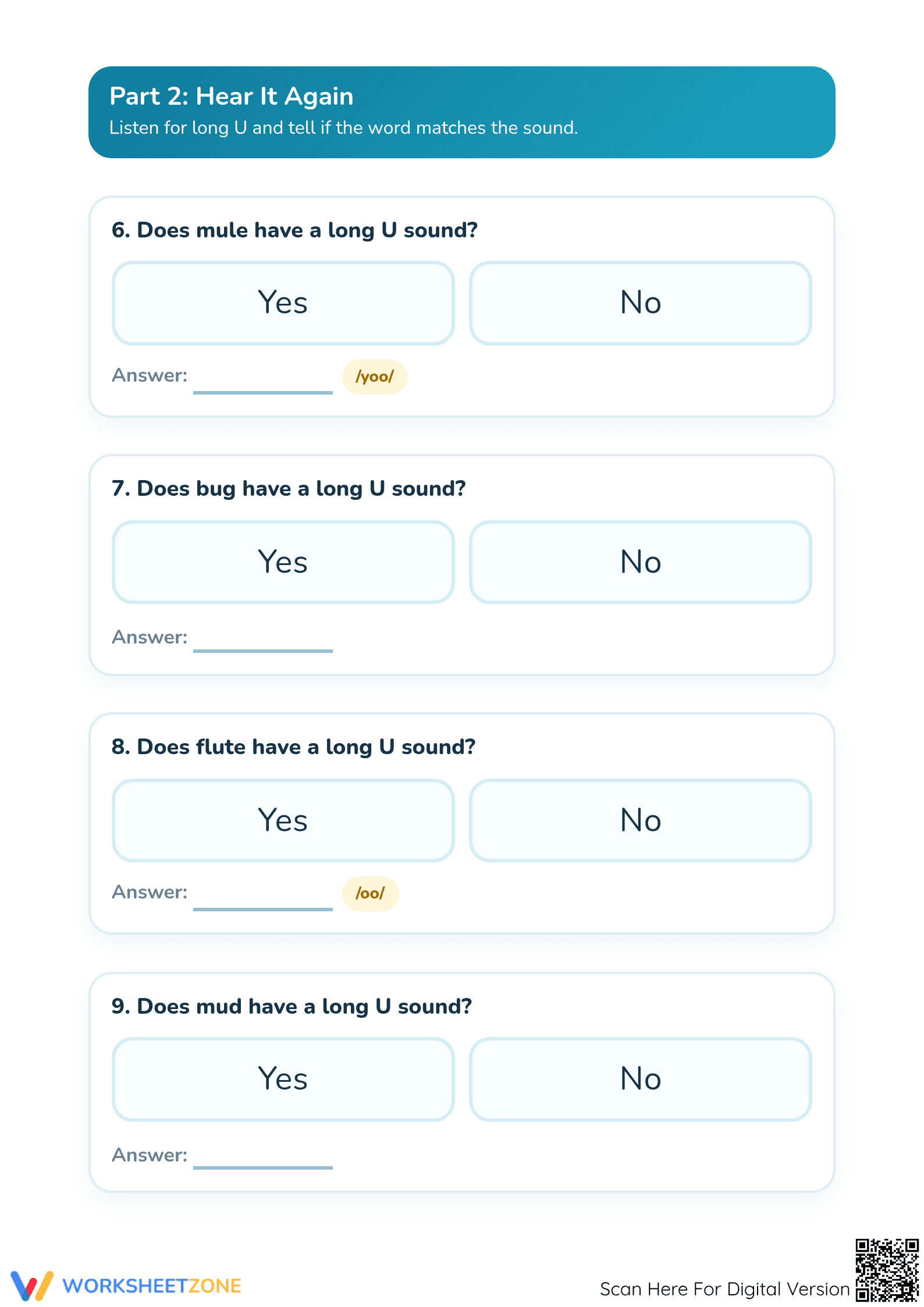
This comprehensive three-page PDF features nine distinct phonics exercises designed to sharpen auditory and visual recognition of the long U sound. Students encounter two instructional parts: "Circle the Long U Words" and "Hear It Again." The worksheet includes clear typography, spacious answer lines, and a mix of multiple-choice and binary-choice (Yes/No) questions. A full answer key is provided to facilitate quick grading or student self-correction.
Skill Progression
The worksheet follows a structured release of responsibility to ensure student success:
- Guided practice: The first two problems feature high-frequency words like "cube" and "tube," allowing teachers to model the "say it and hear it" strategy with CVCe examples.
- Supported practice: Tasks 3 through 5 introduce multi-syllable words and initial vowel sounds, such as "music" and "unicorn," with two distractors per item.
- Independent practice: The final four tasks move to auditory discrimination, requiring students to determine if a single word contains the target sound without comparison words.
This gradual release supports the "I Do, We Do, You Do" instructional model, ensuring students master the phonics concept before moving to isolation.
Standards Alignment
The primary alignment for this resource is CCSS.ELA-LITERACY.RF.1.3.C, focusing on final -e and common vowel team conventions for representing long vowel sounds. It also supports Kindergarten standards regarding long and short vowel sounds in common words. Both standard codes can be copied directly into lesson plans or curriculum mapping tools to ensure instructional compliance.
How to Use It
For best results, use this worksheet during the independent practice phase of a phonics lesson after introducing the "silent e" rule for long U. It serves as an excellent formative assessment tool; observe students as they whisper-read words to see if they accurately elongate the vowel sound. The estimated completion time is 15 to 20 minutes, making it ideal for independent work or as a quiet sub-plan activity.
Who It's For
This resource is designed for Grade 1 students, though it is highly effective for Kindergarten students ready for advanced phonics or second graders needing intervention. It pairs naturally with a long vowel anchor chart or a reading passage featuring "U-E" words. The visual layout and clear instructions support English Language Learners and students with processing delays who require focused phonemic practice.
According to the RAND AIRS 2024 analysis of foundational literacy, targeted phonemic discrimination is a critical predictor of future reading comprehension success. This Grade 1 phonics resource directly addresses CCSS.ELA-LITERACY.RF.1.3.C by requiring students to distinguish the long vowel U sound across nine specific tasks. By engaging in both comparative selection and isolated auditory identification, learners internalize phonological patterns. Research by Fisher & Frey (2014) emphasizes that such structured practice provides scaffolding for students to move from simple phoneme-grapheme mapping to fluent word recognition. This worksheet serves as a high-quality instructional tool that can be integrated into Tier 1 core instruction or Tier 2 interventions. The inclusion of an answer key and standard-aligned tasks ensures educators can track progress toward mastery of vowel conventions.


