These long e printable worksheets for 1st grade arrive at exactly the right instructional moment: after students have stabilized short vowels and CVC blending but before they need to move fluently through multisyllabic words in connected text. Each worksheet gives teachers a low-prep, targeted task built around the spelling patterns and sound contrasts that define this phase of first-grade phonics.
The Specific Skills Targeted
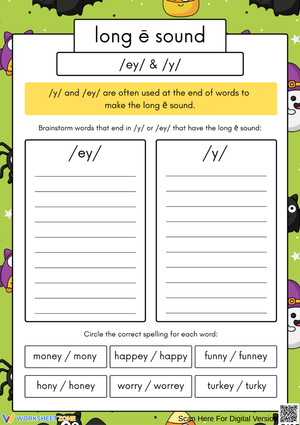
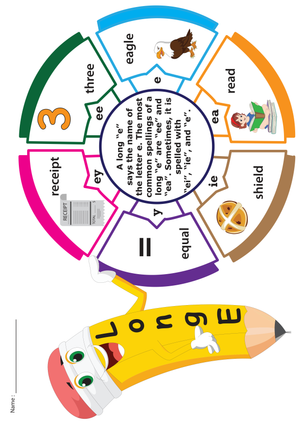
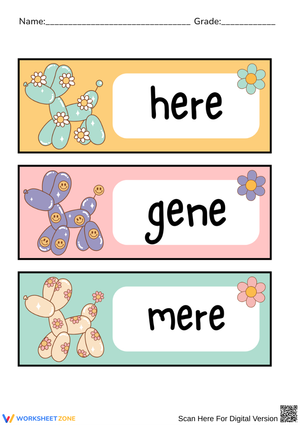
Long e appears in first grade across several spelling patterns, and the sequence matters. The worksheets address the most teachable forms in the order most structured phonics programs introduce them: open syllable words like he, me, and be; consonant-vowel-e words like Pete and these; the digraphs ee and ea; and the word-final y pattern in words like happy and baby. Each worksheet stays on one pattern rather than mixing all of them into one worksheet — that constraint keeps early readers focused on the sound-spelling connection instead of cycling through visual guessing strategies.
Students work through a range of response types across the set:
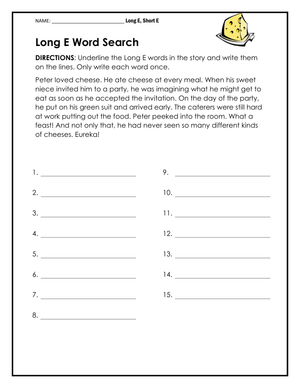
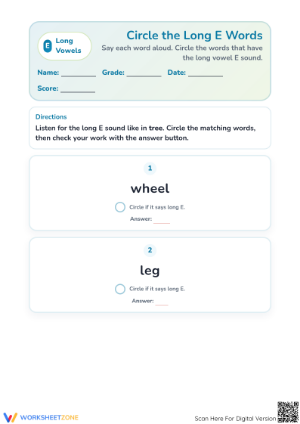
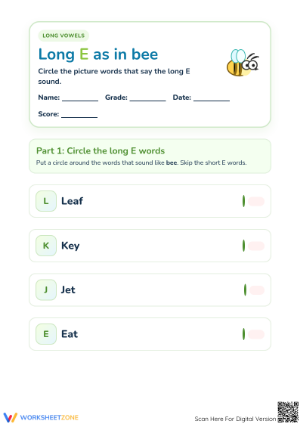
- Circle long e words inside a short decodable list
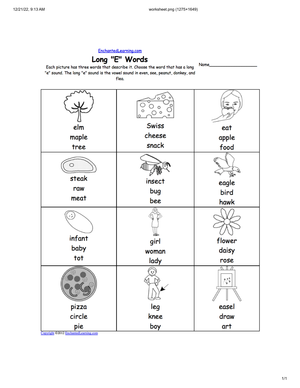
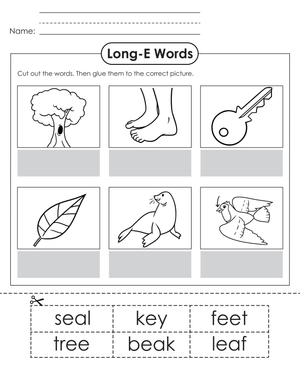
- Sort picture cards under the correct heading
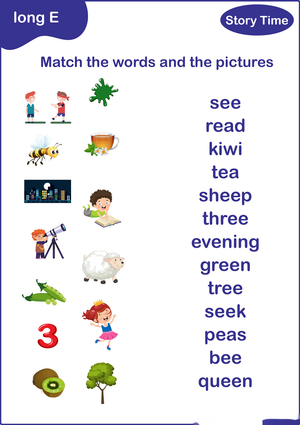
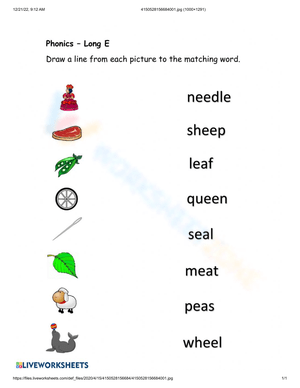
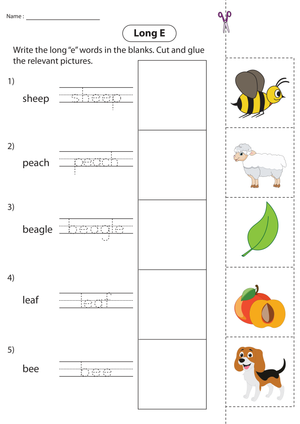
- Draw lines from pictures to printed words
- Read a small word set and then write the words from memory
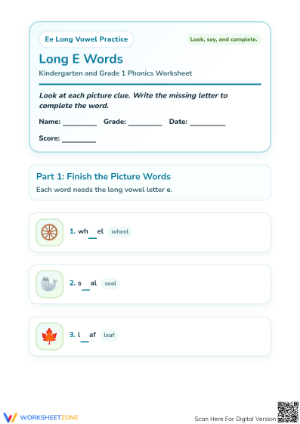
- Complete words by filling in the missing long e spelling
The variety across worksheets prevents students from going on autopilot while keeping the cognitive demand at a level a first grader can sustain for eight to ten minutes of independent work.
Frequent Student Errors Worth Watching For
The most consistent error we see in student work is over-generalization of the ea pattern. Students who have just learned that ea says long e will read head, bread, and dead with a long e vowel because the spelling looks identical to bead or seal. That confusion is developmentally normal — those exception words follow a different phoneme-grapheme correspondence — but it surfaces early and reliably during word sorts. Flagging those words before the sort begins, rather than letting students hit the error in isolation, keeps practice accurate and saves correction time mid-activity.
A second pattern shows up in writing: students who have internalized ee words will overapply the digraph and write mee for me or hee for he. The open syllable rule for single-letter long e is genuinely counterintuitive at this age, and a brief teacher statement before the writing task — "one letter can make the long e sound when it stands alone at the end of a word" — prevents most of those mistakes. Several worksheets include a sort-and-write format that makes this contrast visible without requiring lengthy explanation from the front of the room.
Standard Alignment
These worksheets align to RF.1.3b (decode regularly spelled one-syllable words) and RF.1.3c (know final-e and common vowel team conventions for representing long vowel sounds), the two decoding standards in the Common Core Reading: Foundational Skills strand that govern first-grade long vowel work. Classroom placement matters here: RF.1.3b is typically addressed mid-year once students blend CVC words quickly, while RF.1.3c extends into late first grade and early second for students who need additional exposure to the digraph patterns. The open syllable and CVe worksheets fit the RF.1.3b instructional window; the ee and ea focused worksheets align with the RF.1.3c progression.
How to Build These Worksheets Into Your Lesson Plans
The most reliable placement for long e printable worksheets for 1st grade is immediately after whole-group phonics instruction, not before it. When students tap, stretch, and say seat, tree, and be aloud first, the worksheet functions as a check of learning rather than a guessing task. That sequence also gives teachers cleaner formative data: when a student writes trea instead of tree, you know the error is orthographic, not auditory.
For literacy centers, choose worksheets with directions students can follow after a single whole-group introduction. Picture-match and circle-the-word formats meet that standard without additional reteaching once the routine is set. Small-group intervention calls for reducing the word set to four or five items and having students say each word aloud before any written response. On Fridays, a two-minute read-and-check using a completed worksheet from earlier in the week works as a low-stakes retrieval activity that strengthens retention without requiring new instruction time.
Adjusting the Worksheets for a Range of Learners
For students still consolidating short vowels alongside long e, cover the written portion of a word sort and work only through the picture-identification rows before moving to print matching. Keeping the response load light — point, say, then read aloud — lets those students practice auditory discrimination without the added demand of orthographic mapping in the same sitting. Long e printable worksheets for 1st grade work well in this stripped-down format during pull-out intervention blocks where the goal is accurate sound identification, not independent writing.
Students who have already internalized ee and ea benefit from a different kind of challenge: ask them to sort the same word list by spelling pattern rather than simply by sound. That secondary sort — ee column versus ea column — pushes toward the orthographic awareness that supports accurate spelling in second grade. A few worksheets include a two-column sort that serves this purpose directly; others can be adapted by drawing a dividing line and labeling the columns before printing.
Frequently Asked Questions
Which long e spelling pattern should I introduce first?
Start with the pattern your current phonics sequence introduces, but if you have flexibility, open syllable words (me, he, be, we) and the ee digraph are the most consistent entry points — every word spelled with ee carries the long e sound, which makes early practice accurate and predictable. Reserve ea for a second round, after you address the exception words explicitly.
How do I use these worksheets with students who are behind grade level?
Reduce the word count, add oral blending before any written response, and pair the worksheet with a picture key so students can self-check. If a student cannot yet distinguish long e from short e by ear, the worksheet tasks will not do that teaching on their own — use brief listening drills first, then return to the printed page once the auditory foundation is stable.
Can I send these home for homework?
Only send a worksheet home when the pattern and the specific words on it have already been practiced in class. Homework works best as retrieval of something familiar. A short circle-the-word worksheet with five words from the week's word wall is a reasonable homework format; a new sorting task with unfamiliar words puts families in the position of teaching rather than reviewing.
Do these worksheets work for kindergarten students who are reading ahead?
The word sets and task formats are calibrated to first grade, but an advanced kindergartener who has finished short vowels and mastered CVC blending handles them without difficulty. The open syllable and ee worksheets are the most appropriate starting points in that situation. Long e printable worksheets for 1st grade are occasionally used by kindergarten teachers in late spring for exactly this reason.












 Interactive Worksheet Maker
 Quiz Maker
 Word Search Maker
 Crossword Puzzle Maker
 Word Scramble Generator
 Sentence Scramble Generator
 Handwriting Worksheet Generator
 Name Tracing Generator
 Fill In The Blank Generator