


























Views
Downloads

Essential Long E Vowel Team Chart | Grade 2 Aligned
Paste this activity's link or code into your existing LMS (Google Classroom, Canvas, Teams, Schoology, Moodle, etc.).
Students can open and work on the activity right away, with no student login required.
You'll still be able to track student progress and results from your teacher account.
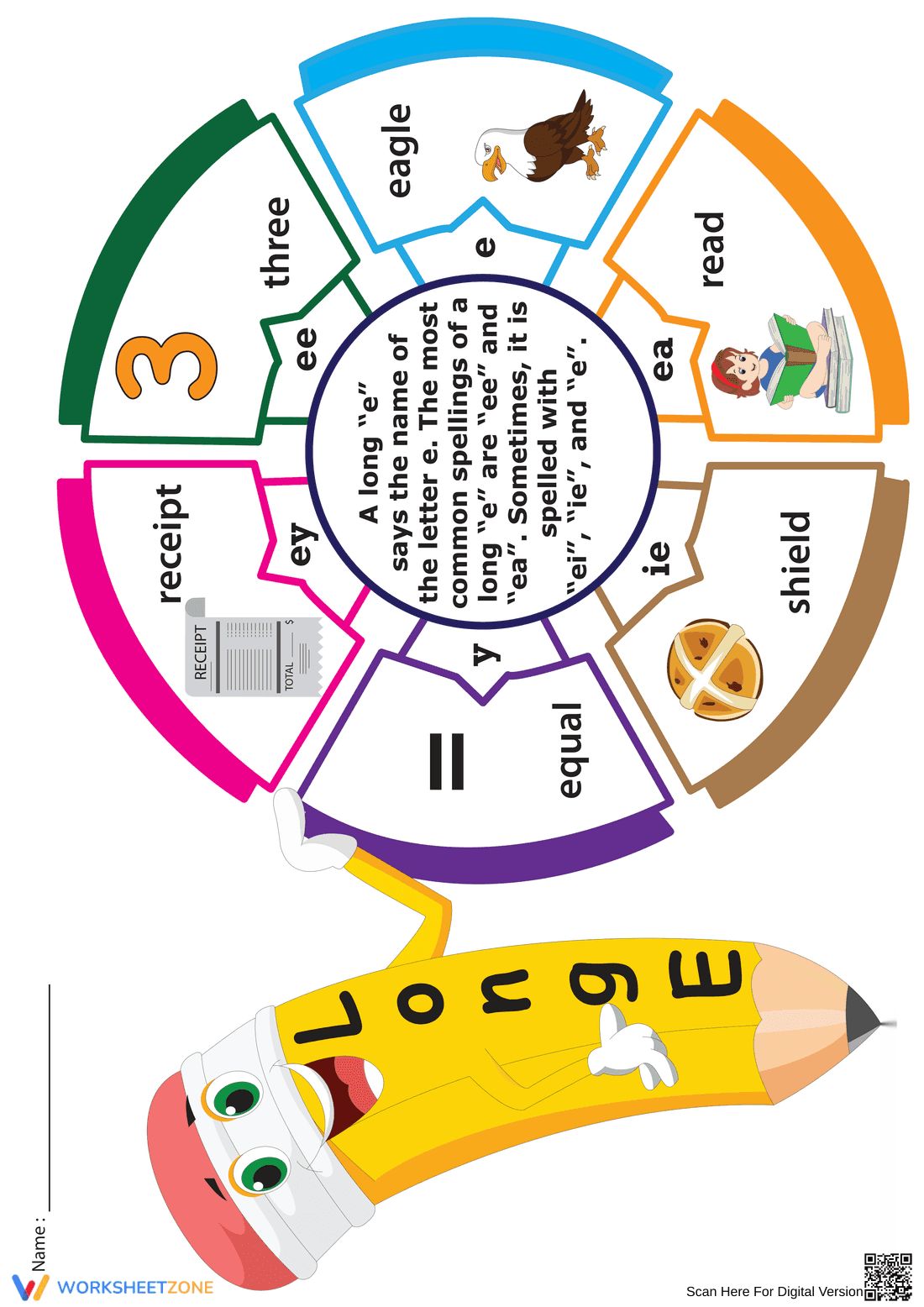
This Essential Long E Chart provides a clear visual reference for Grade 2 students learning complex vowel patterns. Students use this colorful anchor chart to identify how different letter combinations produce the same long vowel sound in their daily reading and writing.
At a Glance
- Grade: 2 · Subject: ELA
- Standard:
CCSS.ELA-LITERACY.RF.2.3.B— Identify and use common vowel teams to represent long vowel sounds accurately- Skill Focus: Long E vowel team spellings and patterns
- Format: 1 page · 0 problems · Answer key included · PDF
- Best For: Small group phonics, literacy centers, and classroom reference
- Time: 5–10 minutes per session
What's Inside
Inside this resource, you will find a high-resolution, one-page anchor chart featuring six distinct spelling patterns for the long E sound. Each segment of the colorful wheel provides a specific phonics rule—such as "ie" in "shield" or "ey" in "receipt"—paired with a recognizable illustration to support visual learners. The clear layout ensures students can find the information they need without assistance.
Zero-Prep Workflow
The zero-prep workflow for this resource is designed for immediate classroom impact. Simply print the PDF (30 seconds), distribute copies to student folders or display it on an interactive board (30 seconds), and review the core examples as a whole class (1 minute). Total teacher preparation time is under two minutes, making it an ideal tool for substitute plans or quick phonics warm-ups.
Standards Alignment
This resource aligns with CCSS.ELA-LITERACY.RF.2.3.B, which requires students to know spelling-sound correspondences for additional common vowel teams. It also supports foundational reading standards regarding phonological awareness and decoding. This standard code can be copied directly into lesson plans, IEP goals, or district curriculum mapping tools to ensure all instructional activities are rigorous and measurable.
How to Use It
Use this chart as a tabletop reference during independent writing sessions to help students self-correct spelling errors. Teachers can also project the image during direct instruction and ask students to find "Long E" words in their current leveled readers that match the patterns on the wheel. A typical review session takes roughly seven minutes and provides a powerful formative assessment opportunity.
Who It's For
This chart is designed for Grade 1 and Grade 2 students, particularly those requiring visual scaffolds for decoding. It also serves as an excellent support for English Language Learners (ELL) who are navigating the irregularities of English orthography. Pair this chart with a word-sorting activity or a reading passage focused on vowel teams to reinforce the connection between isolated phonics and real-world reading.
The CCSS.ELA-LITERACY.RF.2.3.B standard focuses on the mastery of common vowel teams to represent long vowel sounds, a critical milestone in early literacy development. According to Fisher & Frey (2014), visual anchors and reference charts play a pivotal role in the gradual release of responsibility model, allowing students to transition from teacher-led phonics instruction to independent decoding and encoding. This Grade 2 Long E chart organizes complex spelling patterns like "ie," "ea," and "ey" into a structured, accessible format that reduces cognitive load during the writing process. By providing immediate visual cues and word examples such as "eagle" and "receipt," the resource helps students internalize phonemic patterns that are otherwise inconsistent. Research suggests that consistent exposure to these visual representations accelerates the acquisition of orthographic mapping skills, leading to improved reading fluency and spelling accuracy in young learners.


