


























Views
Downloads

Printable Long Vowel E Phonics Worksheet | Grade 1 ELA
Paste this activity's link or code into your existing LMS (Google Classroom, Canvas, Teams, Schoology, Moodle, etc.).
Students can open and work on the activity right away, with no student login required.
You'll still be able to track student progress and results from your teacher account.
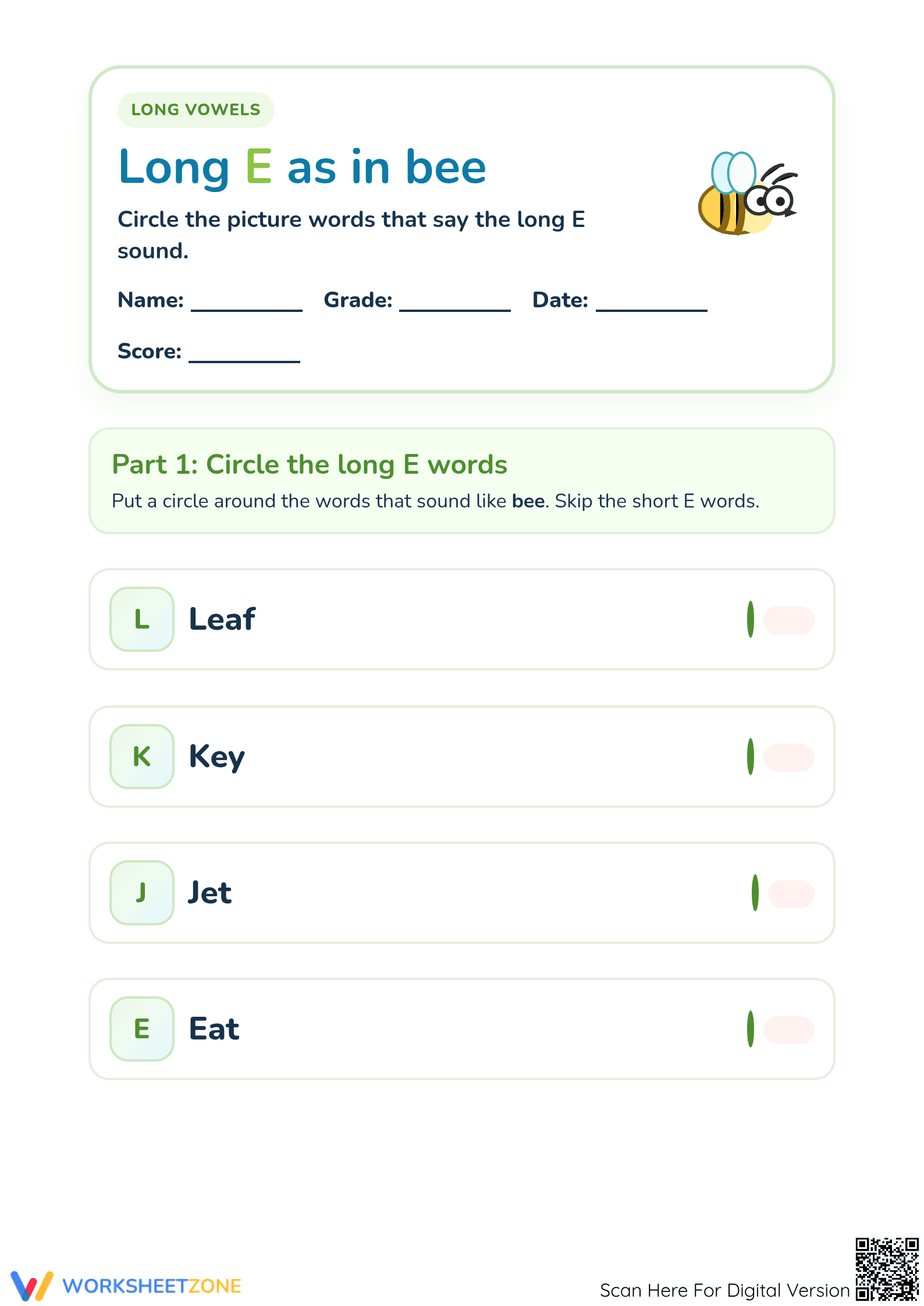
This comprehensive phonics resource targets the long vowel E sound through interactive identification and spelling exercises. Students strengthen their phonemic awareness by distinguishing between long and short vowel sounds before mastering common vowel teams. This worksheet ensures young learners can confidently decode and encode words containing essential English vowel patterns, moving from basic recognition to active production.
At a Glance
- Grade: Grade 1 · Subject: ELA Phonics
- Standard:
CCSS.ELA-LITERACY.RF.1.3.C— Know common vowel team conventions for representing long vowel sounds- Skill Focus: Long Vowel E (ee, ea, ey)
- Format: 2 pages · 10 problems · Answer key included · PDF
- Best For: Independent phonics practice and vowel reinforcement
- Time: 15–20 minutes
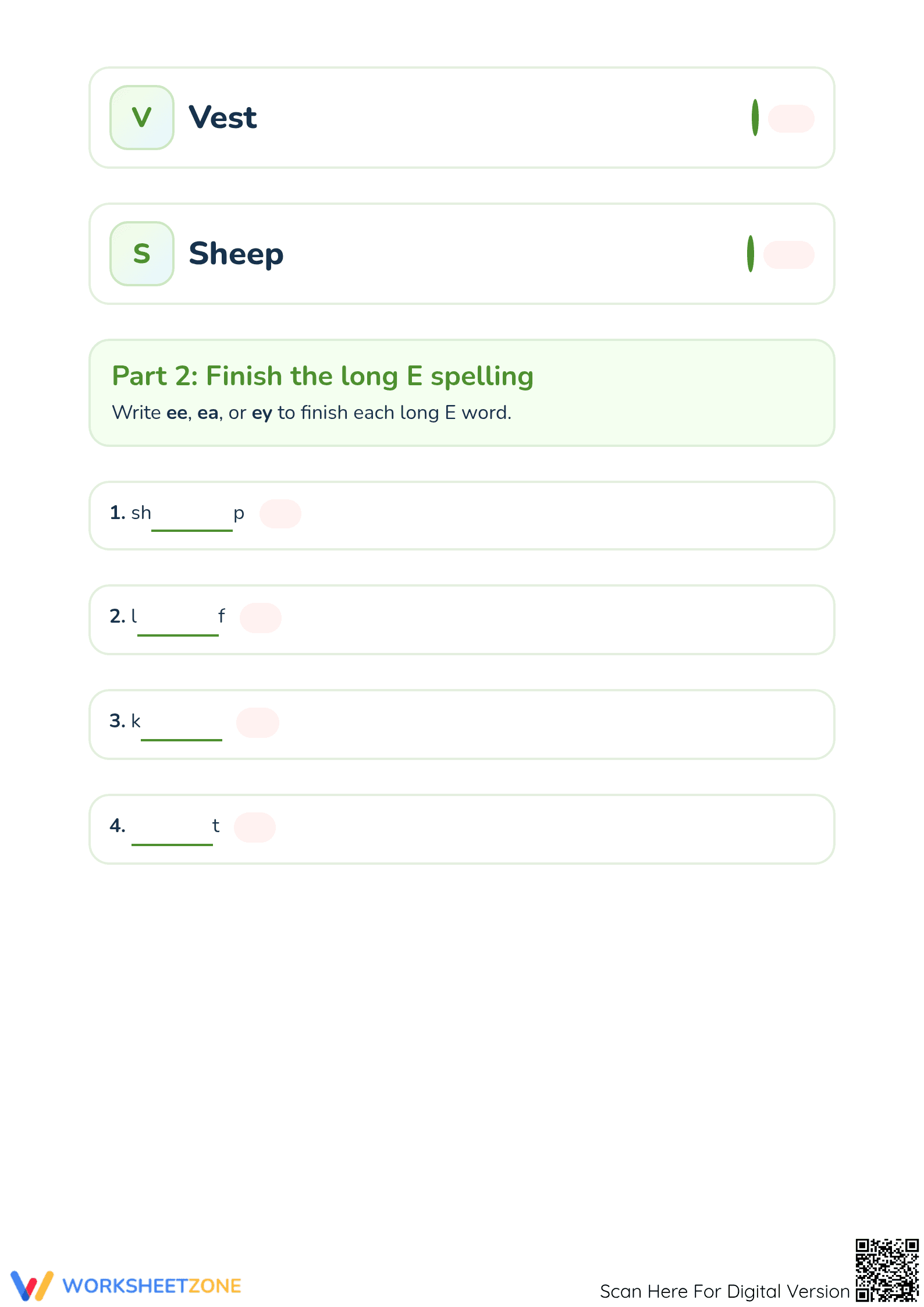
This two-page PDF includes ten high-quality problems divided into two logical sections. Part 1 features identification tasks where students circle words containing the target sound, such as "leaf" and "sheep," while ignoring short vowel distractors. Part 2 provides spelling support where students fill in missing vowel teams including "ee," "ea," and "ey" to complete common words. A full answer key is included to facilitate quick grading or self-correction.
Skill Progression
- Guided practice: Six identification problems use visual cues and simple word lists to help students hear the target phoneme in various word positions and distinguish it from short vowel sounds.
- Supported practice: Four fill-in-the-blank spelling items require students to choose the correct vowel team (ee, ea, or ey), reinforcing specific orthographic patterns for the long E sound.
- Independent practice: Students apply their cumulative knowledge to decode and encode words without assistance, moving toward reading fluency and automaticity.
This structured approach follows the gradual release model to transition students from auditory recognition to technical spelling mastery.
Standards Alignment
This worksheet is primarily aligned to `CCSS.ELA-LITERACY.RF.1.3.C`, which requires students to know common vowel team conventions for representing long vowel sounds. It also supports RF.K.3.B by helping learners associate long sounds with their common graphemes. Both standard codes can be copied directly into lesson plans, IEP goals, or district curriculum mapping tools to ensure instructional compliance.
How to Use It
Use this worksheet during the "You Do" phase of a phonics lesson after introducing the "ee," "ea," and "ey" vowel teams through direct instruction. It serves as an excellent formative assessment tool; observe if students struggle to differentiate "jet" (short E) from "leaf" (long E) to identify needed interventions. The structured format also makes it a reliable choice for homework or morning work. Most students complete both pages within 20 minutes.
Who It's For
This resource is designed for first-grade students or kindergarteners ready for advanced phonics concepts. It provides excellent support for English Language Learners (ELL) through high-frequency vocabulary and clear, uncluttered formatting. Pair this worksheet with a decodable text focused on long vowels or a vowel team anchor chart to maximize instructional impact during small group literacy rotations.
According to the NAEP 2024 reading framework, mastery of vowel team conventions like `CCSS.ELA-LITERACY.RF.1.3.C` is a critical precursor to reading fluency and overall comprehension. Research by Fisher & Frey (2014) emphasizes that structured practice in identifying and spelling long vowel E sounds allows students to build the phonological awareness necessary for decoding multisyllabic words later in their academic careers. This worksheet provides ten focused opportunities for students to engage with these specific phonics rules, moving from simple auditory identification to complex orthographic application. By isolating the long vowel E phoneme, educators can address specific gaps in a student's decoding skills and provide targeted reinforcement that aligns with evidence-based literacy instruction. This approach is consistent with the ScienceDirect TpT Analysis which highlights the effectiveness of high-frequency word practice and isolated skill reinforcement in early childhood education settings.


