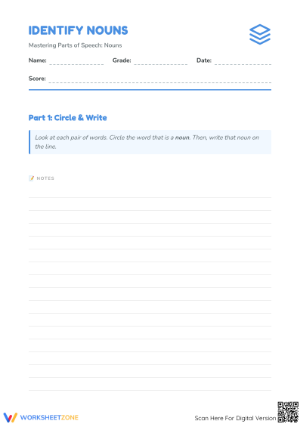
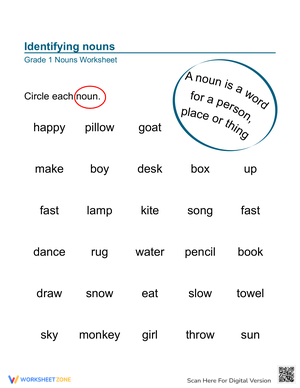
1st Grade Identifying Nouns worksheets
These 1st grade identifying nouns worksheets give teachers a ready set of printable grammar tasks organized around the four noun categories first graders encounter — people, places, things, and animals. Each worksheet targets a distinct skill, from image-based sorting to sentence-level noun marking, making the set useful for whole-group lessons, literacy centers, and morning independent practice alike.
What Students Practice Across the Set
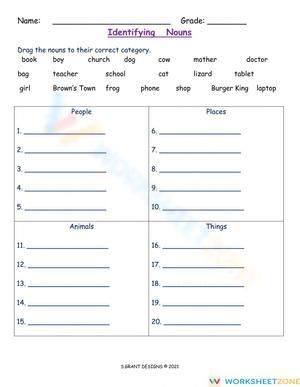
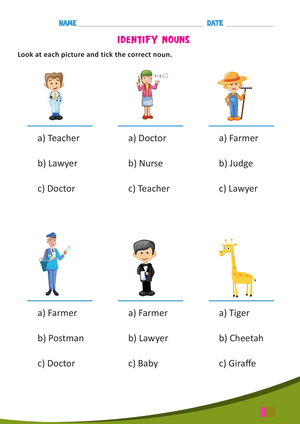
The worksheets move through a deliberate progression. Early tasks use picture grids where students color only the images that show a person, place, thing, or animal — a format that removes decoding pressure entirely and lets beginning readers focus on the grammar concept rather than the text. From there, students advance to cut-and-paste sorting, placing word cards into labeled columns and reinforcing that the four noun categories are genuinely distinct, not interchangeable.
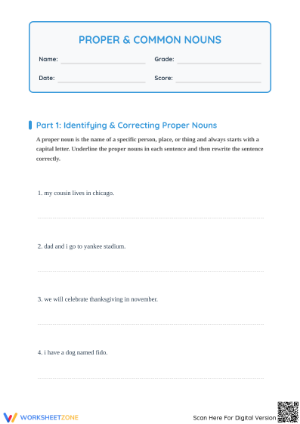
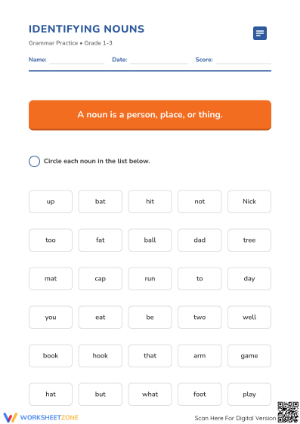
Sentence-level exercises form the next layer. Students read short, decodable sentences and underline or circle every noun. A portion of the worksheets ask students to distinguish between common and proper nouns by identifying which words would need a capital letter — connecting grammar to a writing convention in a way that makes the rule feel purposeful rather than arbitrary. Across all formats, the verbs students practice are concrete: they circle, underline, color, cut, sort, and rewrite.
Why This Concept Lands Where It Does in First Grade
First graders are simultaneously decoding print and learning how language is organized — two cognitively demanding tasks running at the same time. Worksheets that separate those demands let students build confidence with the grammar concept before they encounter it inside running text. Picture sorts introduce the idea at a fully concrete level; sentence tasks transfer it to more abstract contexts only after the category feels natural. That sequence — concrete to representational to abstract — is particularly important for six- and seven-year-olds whose working memory is already taxed by phonics instruction.
There is also a developmental logic to teaching nouns before verbs or adjectives. Naming things is the first linguistic act children master — toddlers say dog and mama long before they produce run or big. Building formal grammar instruction around what students already know intuitively gives the lesson something solid to attach to, rather than asking students to construct a new mental category from scratch.
Frequent Student Errors Worth Watching For
The most persistent error at this level is circling the adjective alongside — or instead of — the noun. A student who reads the red ball and marks both red and ball is not being careless; they are applying a reasonable but incorrect heuristic: important-sounding words must be nouns. The sentence worksheets surface this confusion quickly. The same student will skip past red without trouble on a picture-labeling task but revert to over-marking it the moment it appears immediately before a noun in a sentence. Catching that pattern early prevents it from calcifying into a habitual mistake that follows students into second-grade noun work.
A second pattern appears with plural and irregular nouns. Students reliably identify concrete singular forms — dog, school, apple — but overlook plurals, especially irregular ones. When children or geese appears in a sentence, many first graders skip it entirely. Worksheets that mix singular, plural, and proper nouns give teachers a fast read on which students have internalized the category broadly and which have memorized only a narrow list of canonical examples.
Smart Ways to Work These Worksheets Into Your Instructional Week
The most reliable use pattern is morning work Monday through Thursday, with Friday's last eight minutes reserved for a whole-class review of whatever errors showed up during the week. That review is far more targeted than any pre-planned reteaching lesson, because the completed worksheets have already done the diagnostic sorting. Students who struggled have a second exposure before the weekend; students who flew through can attempt a brief extension task.
During literacy center rotations, pair the cut-and-paste sorting worksheet with a small bin of real classroom objects — a pencil, a block, a toy animal, a photograph of a park. Students handle each object, say the word aloud, and then place it in the correct noun column on the worksheet before writing the word in. That physical-to-paper sequence reduces the number of students who sort correctly with objects but then stall on the paper task alone. A 1st grade identifying nouns worksheets set also laminates cleanly, allowing dry-erase reuse across multiple center groups without reprinting — a practical consideration on a tight supply budget.
Standard Alignment
These worksheets address CCSS.ELA-LITERACY.L.1.1.B, which requires first graders to use common, proper, and possessive nouns in both writing and speaking. In classroom terms, that standard sits in the Language strand alongside phonics and high-frequency word instruction, and most teachers hit it formally in the second and third quarters once students have enough reading stamina to work at the sentence level. The picture-based tasks serve as an on-ramp during the first quarter, when most students cannot yet read a full sentence fluently but can confidently identify a noun in an image — meeting the standard's spirit before the full decoding foundation is in place.
Adapting These Worksheets for Different Student Levels
Students still developing print awareness work most successfully with picture-only sorting. If even that feels like too much at once, narrow the sort to two categories — person or thing — before introducing all four. For students who need additional support on sentence-level tasks, a word bank at the top removes the vocabulary barrier without changing the grammar demand: they are still identifying nouns, just without the added pressure of decoding unfamiliar words mid-sentence.
On the other end of the range, students who move through basic identification quickly benefit from an extension format included in the 1st grade identifying nouns worksheets set: they read a sentence, mark every noun, and then rewrite the sentence by substituting a different noun in the same slot. Changing The dog ran across the yard to The rabbit ran across the park demonstrates that students understand nouns as a replaceable category of naming words — not a fixed list to memorize. That is a meaningfully different cognitive move than simple identification, and it shows which students are genuinely ready for possessive and proper noun instruction.
Frequently Asked Questions
How do you introduce nouns to first graders who aren't yet reading fluently?
Start with picture-only tasks. Show students images of a firefighter, a library, a chair, and a cat and ask them to sort by category — person, place, thing, or animal. The concept lands cleanly without decoding getting in the way. Once students sort pictures without hesitation, introduce the same words in print beside the images, then gradually remove the images. Most students make that transition within a few weeks of consistent practice.
What distinguishes the common noun worksheets from the proper noun worksheets?
The common noun worksheets ask students to identify any naming word — category membership is the only criterion. The proper noun worksheets layer in the capitalization convention: students read sentences, identify which nouns name a specific person or place, and add the missing capital letter. That task connects the grammar concept directly to a writing skill students apply immediately in their own sentences, rather than treating proper nouns as a separate grammar topic unrelated to their daily writing.
Can these worksheets function as formative assessment tools?
A single sentence-level worksheet takes most first graders six to eight minutes to complete, and the error patterns in the finished work tell a teacher exactly where to focus small-group time. Students who mark adjectives as nouns need a concrete re-teaching moment with physical objects. Students who skip plural nouns need broader exposure to noun examples before moving on. The worksheets do that sorting work without requiring a separate assessment instrument — which is one of the practical reasons teachers return to this 1st grade identifying nouns worksheets format repeatedly across the year.
How often should students practice noun identification each week?
Short, frequent sessions outperform long, infrequent ones at this age. Ten to twelve minutes of focused practice three or four times a week produces stronger retention than a single thirty-minute grammar lesson. The format of these worksheets makes that frequency easy to sustain — the directions are consistent enough that students work independently after the first few exposures, freeing the teacher to run a guided reading group at the same time.
Clear All