




























Views
Downloads

Identifying Nouns Worksheet | Grade 1-3 Printable

Paste this activity's link or code into your existing LMS (Google Classroom, Canvas, Teams, Schoology, Moodle, etc.).
Students can open and work on the activity right away, with no student login required.
You'll still be able to track student progress and results from your teacher account.
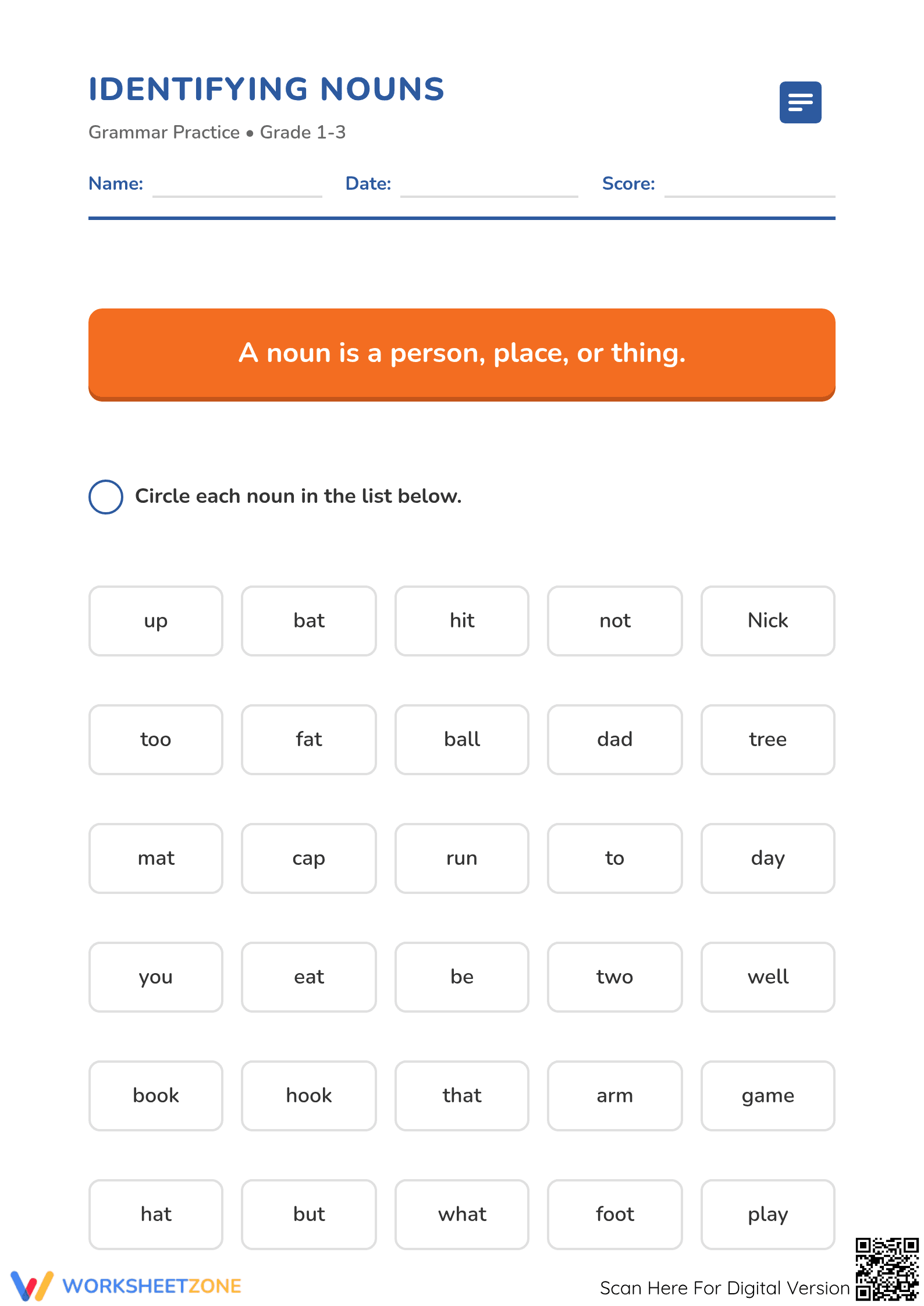
Master the fundamentals of grammar with this comprehensive noun identification worksheet. Designed for early elementary students, this resource helps learners distinguish naming words from other parts of speech through active selection and categorization. Students will build a solid foundation for sentence construction by recognizing the essential building blocks of English language arts.
At a Glance
- Grade: 1-3 · Subject: ELA
- Standard:
CCSS.ELA-LITERACY.L.1.1.B— Use common, proper, and possessive nouns in written and spoken English- Skill Focus: Noun identification and categorization
- Format: 2 pages · 32 tasks · Answer key included · PDF
- Best For: Independent practice or morning work
- Time: 15–20 minutes
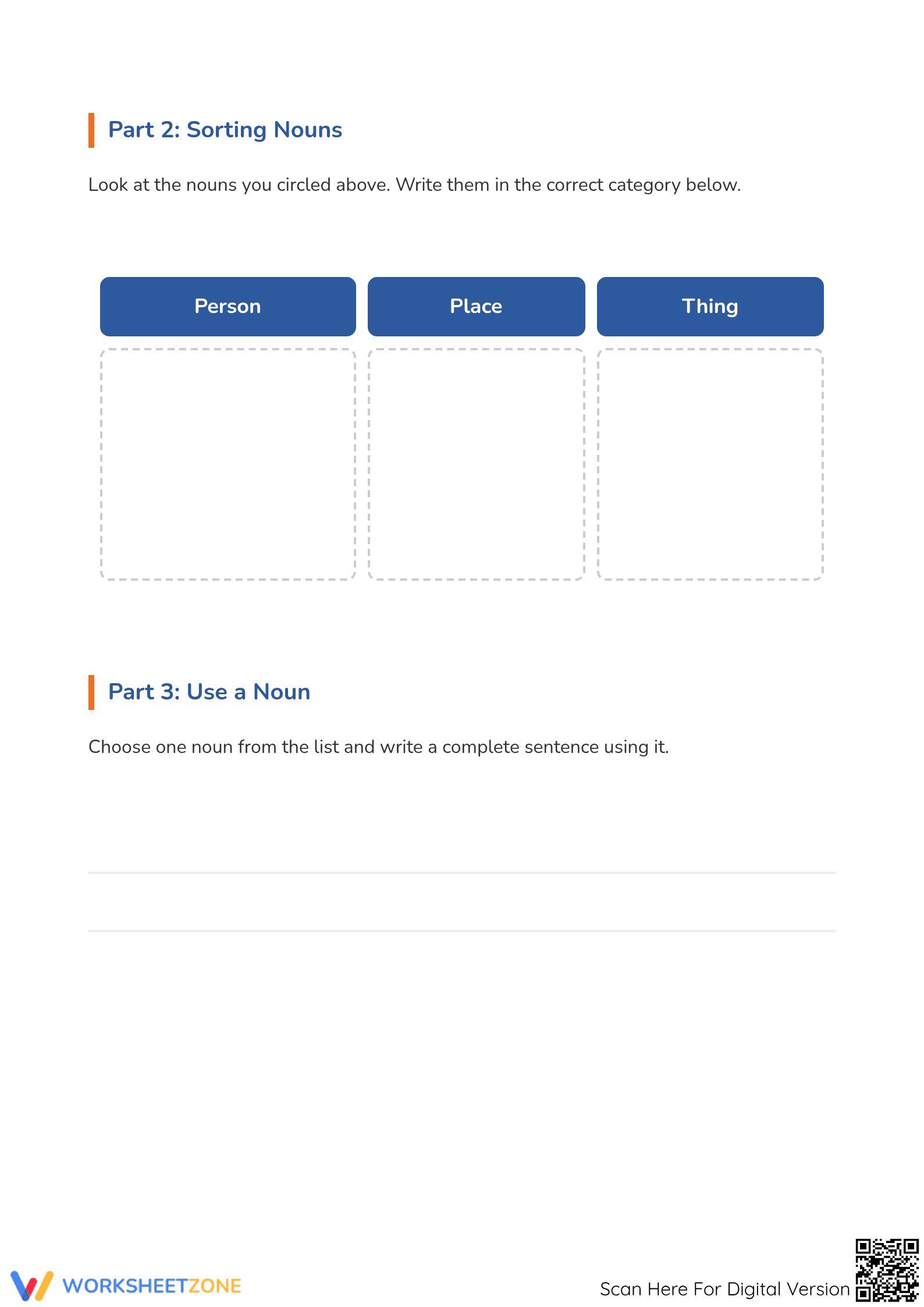
This 2-page PDF features a clear, student-friendly definition of a noun as a person, place, or thing. The first page contains a grid of 30 high-frequency words where students must circle the nouns. The second page transitions to higher-order thinking with a sorting table for categorization and a sentence-writing prompt. A complete answer key is provided for quick grading and immediate student feedback.
Zero-Prep Workflow
- Print: Generate double-sided copies for your entire class in under 1 minute.
- Distribute: Hand out the worksheets as a warm-up or transition activity with zero teacher setup required.
- Review: Use the included answer key to conduct a 2-minute rapid review, allowing students to self-correct their work.
This streamlined workflow makes it an ideal choice for emergency sub plans or as a supplemental resource for your existing grammar curriculum.
Standards Alignment
This resource aligns with `CCSS.ELA-LITERACY.L.1.1.B`, which requires students to use common, proper, and possessive nouns. It also supports the broader L.1.1 anchor for demonstrating command of the conventions of standard English grammar and usage when writing or speaking. Both standard codes can be copied directly into lesson plans, IEP goals, or district curriculum mapping tools.
How to Use It
Use this worksheet as a formative assessment after an introductory lesson on parts of speech. Observe students during the sorting phase to identify if they confuse abstract "things" with verbs or adjectives. It also functions well as a literacy center activity where students work in pairs to justify why specific words like "bat" or "tree" qualify as nouns. The expected completion time is approximately 15 to 20 minutes.
Who It's For
This practice is tailored for Grade 1, 2, and 3 students who are developing their lexical awareness. It provides necessary scaffolding for English Language Learners (ELL) through the use of simple, concrete nouns. Pair this with a classroom anchor chart or a picture book read-aloud to reinforce the "person, place, or thing" concept during direct instruction.
According to the Fisher & Frey (2014) framework for purposeful literacy instruction, students require repeated exposure to word classes in varied contexts to achieve grammatical fluency. This worksheet provides the structured repetition necessary for internalizing the CCSS.ELA-LITERACY.L.1.1.B standard. By isolating 30 distinct words for evaluation, the resource ensures that learners move beyond rote memorization toward active discrimination of lexical categories. Research from EdReports 2024 emphasizes that high-quality foundational materials must balance discrete skill practice with application tasks, such as the sentence-writing component included here. This dual-approach ensures that Grade 1-3 students not only identify nouns in isolation but also understand their functional role within a complete sentence structure. This evidence-based design supports long-term retention and prepares students for more complex syntactic structures in later elementary grades.


