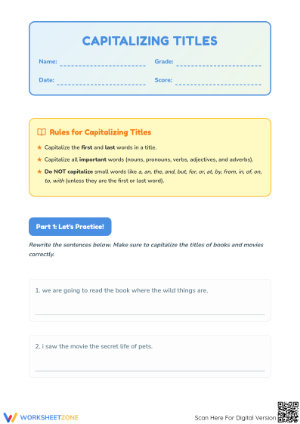
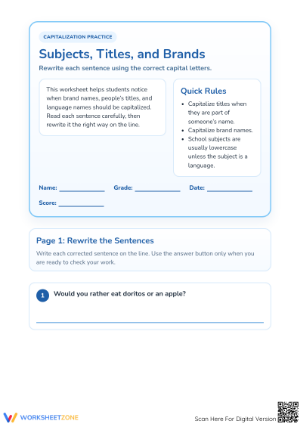
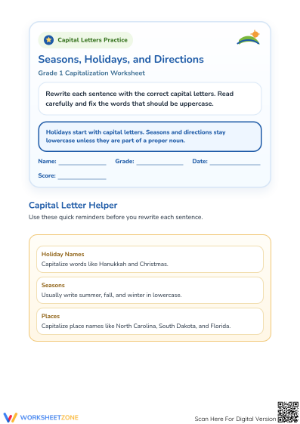
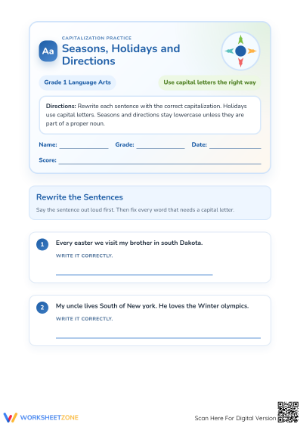
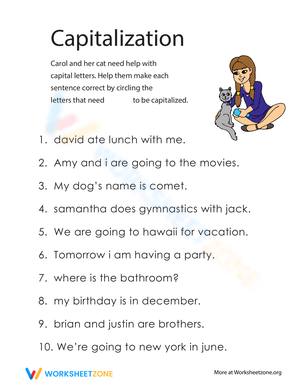
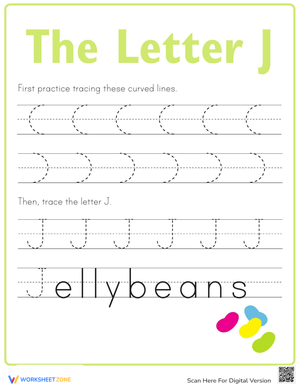
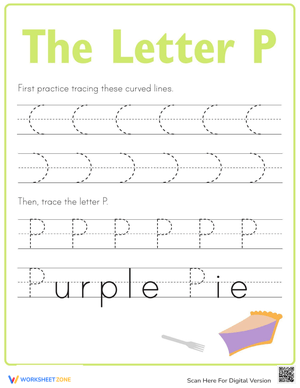
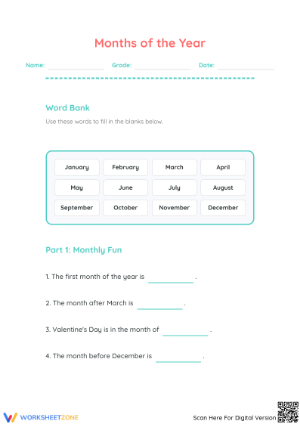
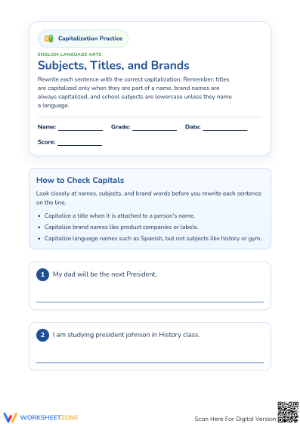
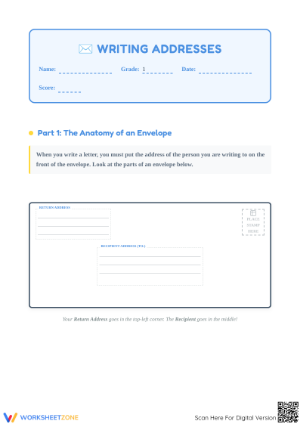
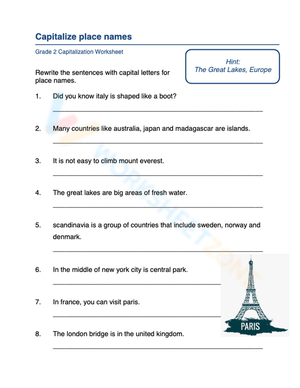
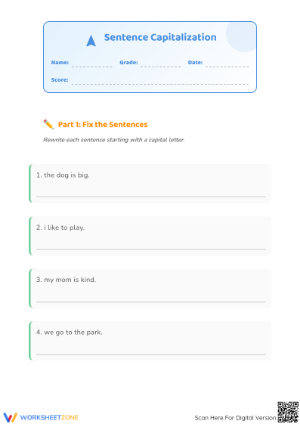
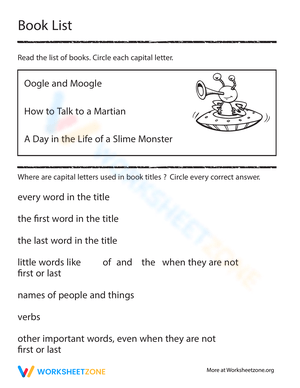
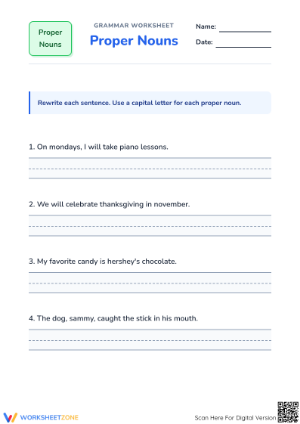
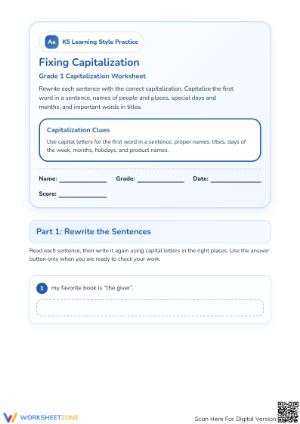
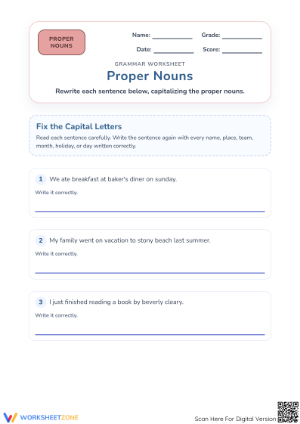
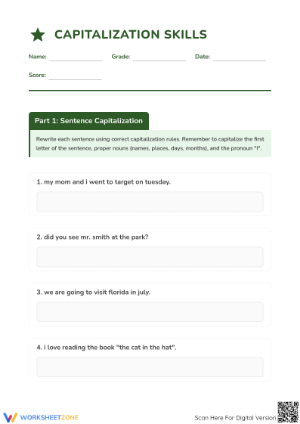
These capitalization worksheets for 1st grade give teachers a print-ready set targeting the three rules first graders are expected to own by June — sentence beginnings, the pronoun "I," and proper nouns including days of the week and months of the year. Each worksheet zeroes in on one rule before asking students to sort or edit mixed examples, keeping cognitive load manageable at a stage when children are already tracking phonics, spacing, and letter formation simultaneously.
The Specific Skills Each Worksheet Targets
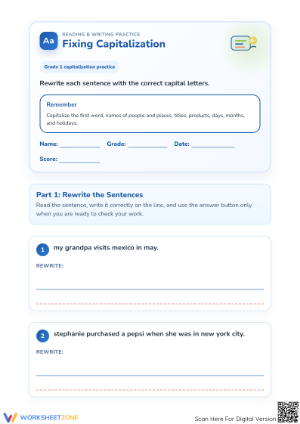
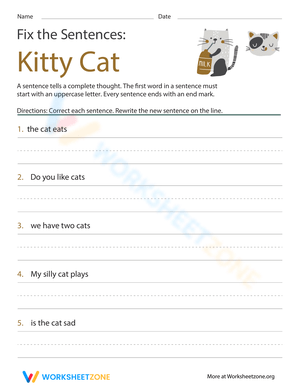
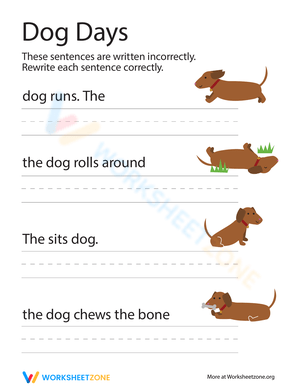
The set moves through first-grade capitalization expectations in a deliberate sequence. Students begin by identifying which letter in a sentence needs to be capitalized, then rewrite the corrected version in full. Later worksheets shift to mixed editing tasks where two or three rules appear in the same sentence.
- Sentence-initial capitals — students underline the first word and rewrite it with the correct uppercase letter, reinforcing the connection between sentence boundaries and capitalization
- The pronoun "I" — exercises present "I" in the middle of sentences, not just at the start, so students cannot rely on position alone and must recognize it as a special case
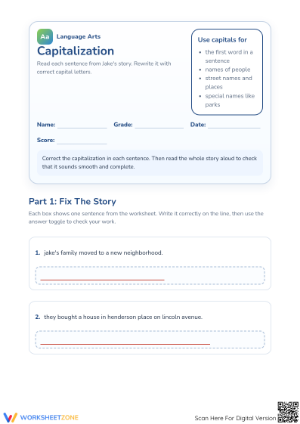
- Names of specific people — sorting activities ask students to mark which words need capitals and explain why, drawing a clear line between "a teacher" and "Mrs. Chen"
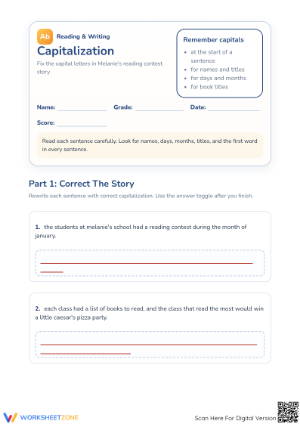
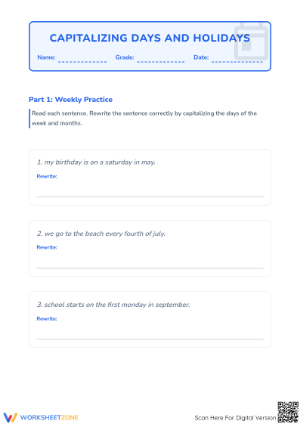
- Calendar words — days of the week and months of the year appear both in isolation and embedded in short sentences like "My birthday is in october"
- Mixed proofreading passages — students annotate every capitalization error before rewriting the corrected version, practicing the full editing sequence
Common Misconceptions to Watch For and Correct
The most persistent problem in first-grade capitalization work is transfer failure. A student who writes "Tuesday" correctly during morning calendar will still write "my friend david" in a personal narrative because the two contexts feel entirely unrelated to a six-year-old. The rule has been stored as a procedure specific to calendar time, not as a principle that applies everywhere proper names appear. These worksheets address that by presenting the same rule across varied sentence types — a student who edits five different sentences using someone's name starts to see the pattern rather than the isolated case.
A second pattern that appears regularly: students who have been corrected on the pronoun "I" begin overcorrecting. They write "I" accurately, then also capitalize other short words they perceive as important — "Me," "Dog," "Mom" — because they've absorbed the idea that some words are special without fully grasping the defining criteria. The fix-it format on these worksheets surfaces this confusion by requiring students to explain their corrections rather than simply mark them, which separates correct capitalization from the feeling that a word deserves emphasis.
How to Build These Worksheets Into Your Lesson Plans
The most productive placement for one of these worksheets is the first eight to ten minutes of literacy block, used as a shared editing task before students move into independent writing. Display the same sentence on the board, have students mark it on the worksheet, then discuss. That short ritual does more for long-term retention than a longer isolated lesson because students apply the rule again immediately when they open their writing journals.
For literacy centers, set up an editing station with a small stack of worksheets, red pencils, and a simple three-item reference card — "First word," "I," "Names." Students who finish early write a new sentence containing at least one proper noun and swap papers with a partner to check each other's work. The capitalization worksheets for 1st grade in this set are formatted for standard copy paper, so running a classroom set takes one print job with no special adjustments.
Standard Alignment
These worksheets directly address CCSS.ELA-LITERACY.L.1.2.A, which requires first graders to capitalize dates and names of people. In instructional sequence, this standard typically receives focused attention in the second and third quarters of first grade — after students have developed enough sentence sense to recognize where one sentence ends and another begins, but before second-grade writing units expect those conventions to be automatic. Teachers frequently pair this standard with L.1.2.B (end punctuation) because proofreading for both together builds the editing habit rather than treating capitalization as a one-time checklist item to check off and move past.
Adjusting the Worksheets for a Range of Learners
For students who grasp the core rules quickly, the most effective extension is production rather than more editing. Ask them to write three original sentences — one using a classmate's name, one using a month or day of the week, one beginning with "I" — then trade with a partner to verify every capital. This moves from recognition to generation, which is the harder cognitive task and the one that will be assessed in second-grade writing.
Students who need more support often benefit from a physical cue before the written task. Have them tap the first word of each sentence with a finger and say "capital" aloud, then check whether the word on the page matches their uppercase alphabet card. The capitalization worksheets for 1st grade in this set use generous line spacing and a larger-than-average font, which matters for students whose fine motor development is still catching up — narrow lines shift attention away from the grammar rule and onto letter formation.
One honest limitation worth naming: the fix-it format, where students correct errors in pre-written sentences, works smoothly for most first graders but can frustrate students who struggle to process text they didn't generate themselves. For those students, read the sentence aloud before asking them to mark it, or accept a verbal answer before a written one. The capitalization worksheets for 1st grade can also serve as a read-aloud-and-point activity rather than a strict write-and-correct task when a student needs that bridge between oral language and written conventions.
Frequently Asked Questions
Which capitalization rules should first graders have solid control over by the end of the year?
By June, first graders should consistently capitalize the first word of a sentence, the pronoun "I," names of specific people, days of the week, and months of the year. These align directly with CCSS.ELA-LITERACY.L.1.2.A and form the base that second grade builds on when students encounter holidays, geographic names, and titles of books.
My student edits capitalization correctly on worksheets but forgets to apply the rules in their own writing. Why?
This is a production-versus-recognition gap — one of the most common splits in first-grade writing development. Editing a pre-written sentence requires spotting an existing error; writing a new sentence requires applying the rule under the simultaneous cognitive pressure of managing spelling, word choice, and handwriting. The two tasks draw on different working memory resources. The most direct fix is to build a separate editing step into the writing routine: students finish a sentence, stop, physically touch the first word, and check the capital before moving to the next one. Making that editing move habitual and physical — rather than purely mental — is what closes the gap over time.
Students keep asking whether "Mom" and "Dad" get capitalized. How do I answer that?
This is one of the genuinely tricky proper noun cases, and it's worth being direct with students about it. "Mom" takes a capital when it functions as a name — when you could substitute the person's actual name and the sentence still makes sense. "Mom called me for dinner" gets a capital; "my mom called me" does not. For first grade, the most workable classroom rule is to tell students to capitalize "Mom" and "Dad" when those words stand alone without "my," "her," or "his" in front of them. That's not a complete linguistic explanation, but it's a testable rule students can apply in their writing this year, and it gives them a decision-making step rather than a feeling of uncertainty.












 Interactive Worksheet Maker
 Quiz Maker
 Word Search Maker
 Crossword Puzzle Maker
 Word Scramble Generator
 Sentence Scramble Generator
 Handwriting Worksheet Generator
 Name Tracing Generator
 Fill In The Blank Generator