




























Views
Downloads

Capitalization Practice Worksheet | Essential Grade 1 ELA

Paste this activity's link or code into your existing LMS (Google Classroom, Canvas, Teams, Schoology, Moodle, etc.).
Students can open and work on the activity right away, with no student login required.
You'll still be able to track student progress and results from your teacher account.
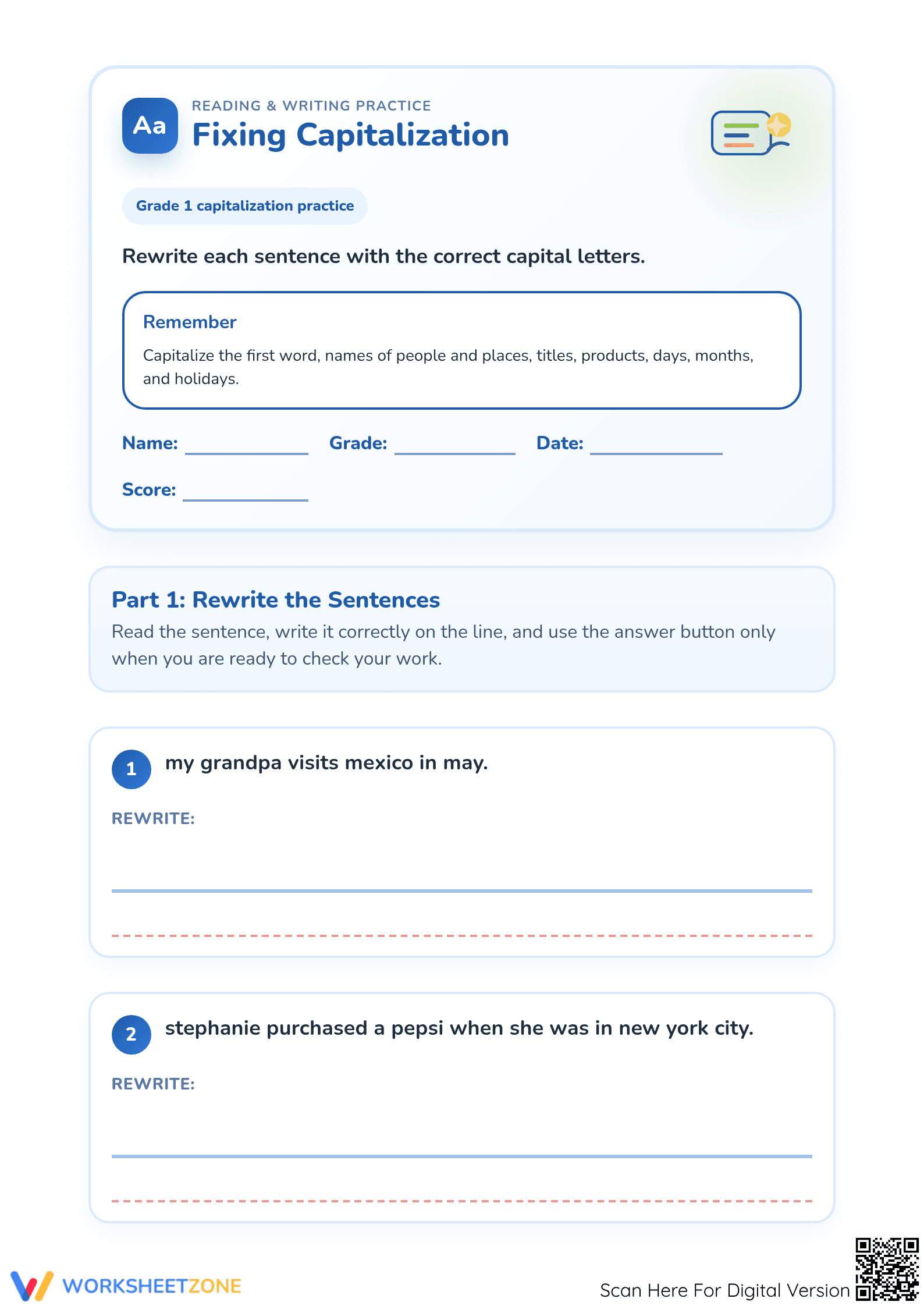
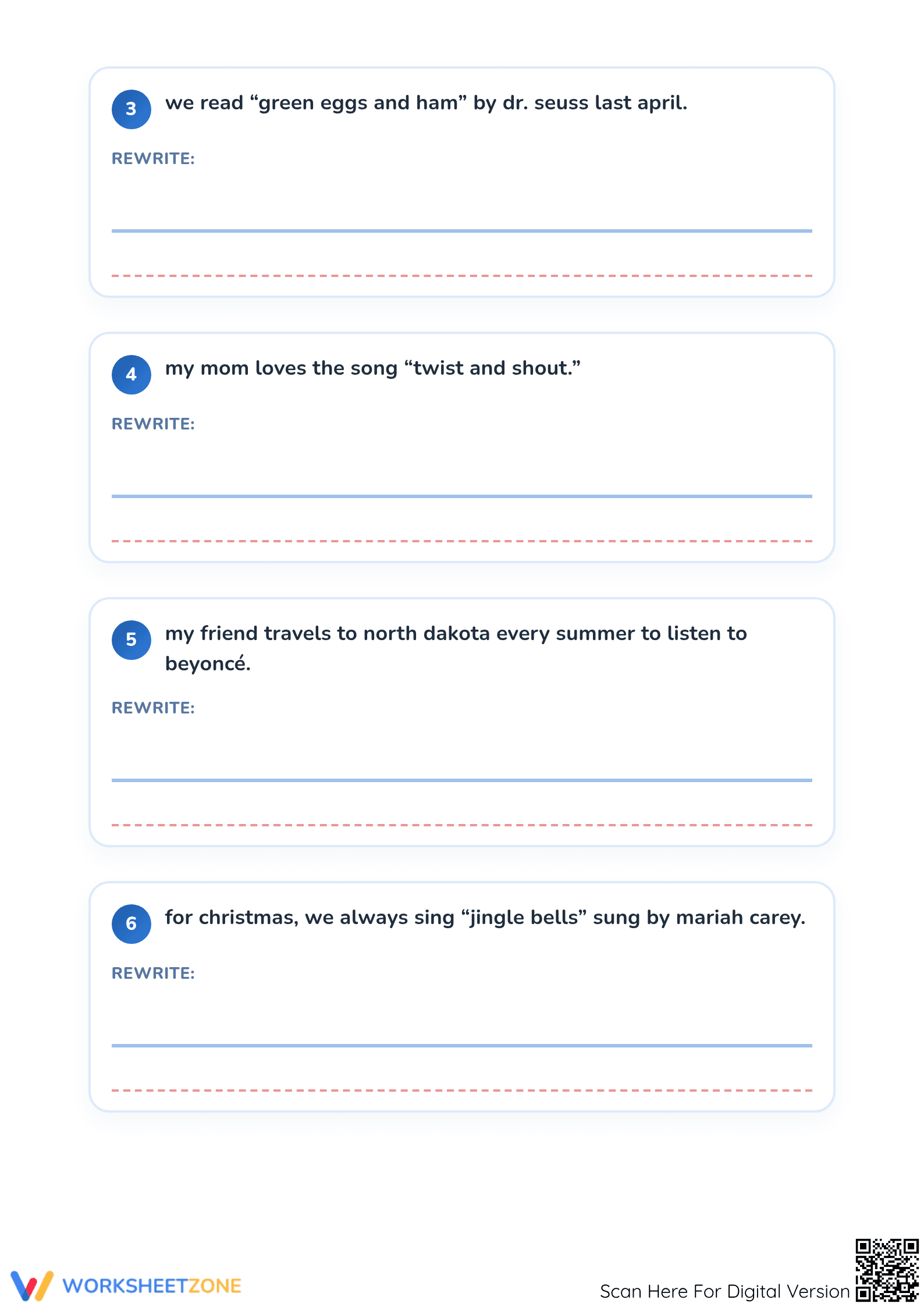
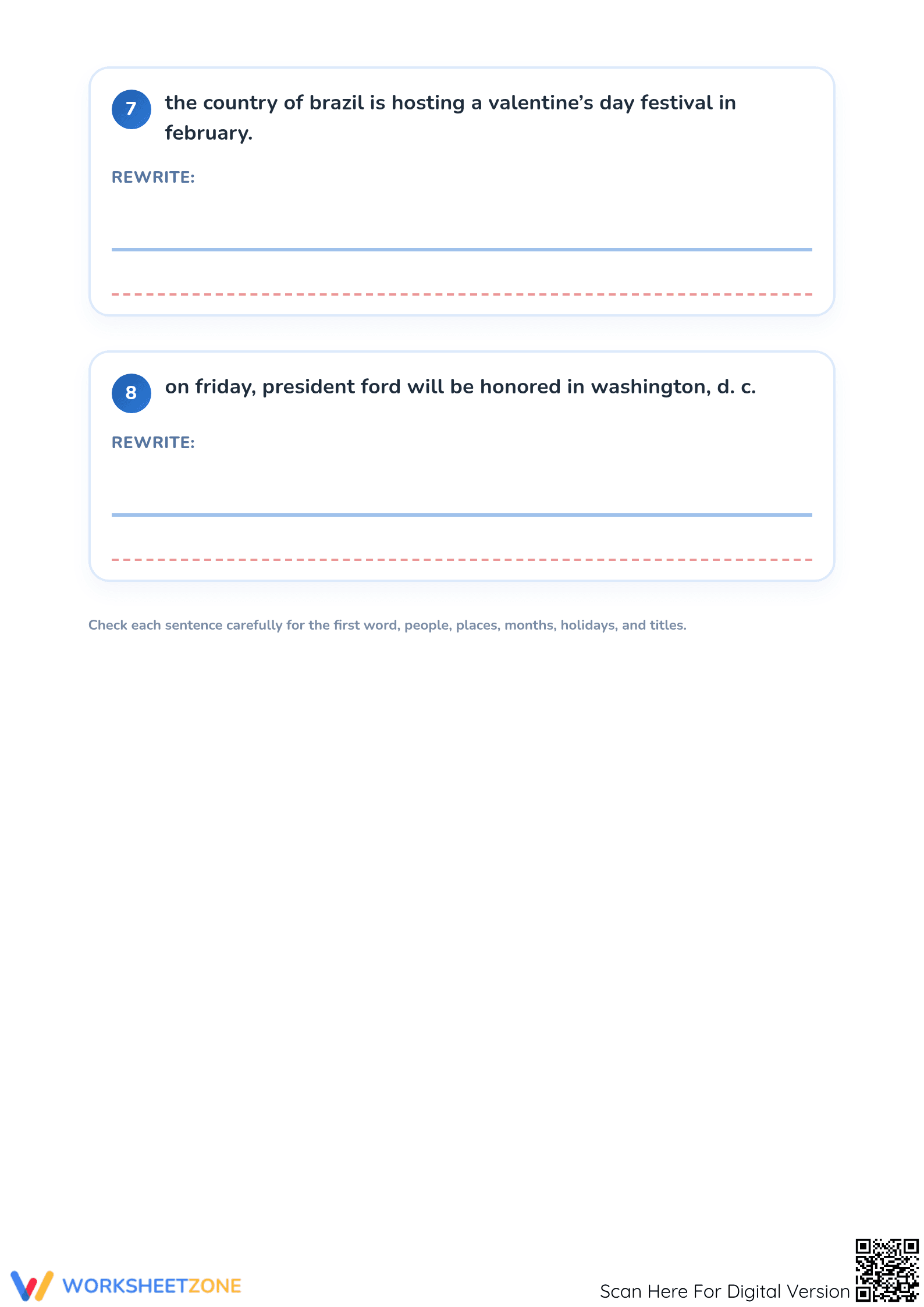
This Grade 1 capitalization worksheet provides targeted practice for young writers to master the conventions of standard English. Students identify and correct errors in 8 unique sentences, focusing on proper nouns and sentence beginnings. By rewriting each sentence, learners solidify their understanding of when to use uppercase letters in real-world contexts.
At a Glance
- Grade: 1 · Subject: ELA
- Standard:
CCSS.ELA-LITERACY.L.1.2.A— Capitalize dates and names of people in sentences- Skill Focus: Proper Noun Capitalization
- Format: 3 pages · 8 problems · Answer key included · PDF
- Best For: Independent practice or morning work
- Time: 15–20 minutes
The resource contains three pages of practice featuring eight comprehensive sentence-rewrite tasks. Each page includes a "Remember" anchor box that lists specific capitalization rules, such as names of people, places, titles, products, days, months, and holidays. A full three-page answer key is provided, showing the correctly capitalized versions of every sentence for quick grading or student self-correction.
Skill Progression
- Guided practice: The first page introduces the "Remember" rule box and provides two initial sentences to establish the correction workflow.
- Supported practice: Pages two and three offer six additional sentences with increasing complexity, including multiple proper nouns like "New York City" and "Dr. Seuss."
- Independent practice: Students conclude by applying rules to complex sentences involving holidays and specific geographic locations without additional prompts.
This gradual-release approach ensures students move from recognizing rules to applying them independently across various sentence structures.
Standards Alignment
The primary focus is CCSS.ELA-LITERACY.L.1.2.A, which requires students to capitalize dates and names of people. Additionally, it supports L.1.2 by demonstrating command of the conventions of standard English capitalization and punctuation when writing. Both standard codes can be copied directly into lesson plans, IEP goals, or district curriculum mapping tools.
How to Use It
Use this worksheet during the independent practice phase of a lesson on proper nouns to assess individual student mastery. It also serves as an excellent formative assessment tool; observe if students remember to capitalize the first word of the sentence versus just the names. Expect students to complete the eight tasks in approximately 15 to 20 minutes.
Who It's For
This resource is designed for first-grade students developing foundational writing skills. It is also suitable for second-grade review or English Language Learners (ELL) who need explicit practice with English capitalization conventions. Pair this with a capitalization anchor chart or a mentor text highlighting proper nouns for a complete instructional unit.
According to research from Fisher & Frey (2014) on the gradual release of responsibility, providing students with clear scaffolds followed by independent application is critical for linguistic mastery. This worksheet aligns with CCSS.ELA-LITERACY.L.1.2.A by requiring students to actively rewrite sentences rather than just circling errors, a method shown to improve long-term retention of grammatical rules. By focusing on eight high-frequency capitalization categories—including names, places, and dates—the resource ensures that Grade 1 learners meet the rigorous demands of early literacy standards. The inclusion of a multi-page answer key supports immediate feedback, which is a key driver of student growth in foundational writing. This structured approach helps bridge the gap between recognizing a rule and applying it fluently in original composition, preparing students for more complex Grade 2 language standards.


