


























Views
Downloads

Printable Letter T Tracing Worksheet | Kindergarten ELA
Paste this activity's link or code into your existing LMS (Google Classroom, Canvas, Teams, Schoology, Moodle, etc.).
Students can open and work on the activity right away, with no student login required.
You'll still be able to track student progress and results from your teacher account.
This foundational handwriting worksheet provides targeted practice for early learners mastering the letter T. By combining fine motor line tracing with letter recognition, students develop the essential muscle memory needed for fluent writing. The structured activities ensure preschoolers and kindergarteners confidently identify and form both uppercase and lowercase T.
At a Glance
- Grade: Kindergarten · Subject: English
- Standard:
CCSS.ELA-LITERACY.L.K.1.A— Print many upper- and lowercase letters- Skill Focus: Letter T Tracing and Recognition
- Format: 2 pages · 4 problems · No answer key · PDF
- Best For: Independent practice and centers
- Time: 10–15 minutes
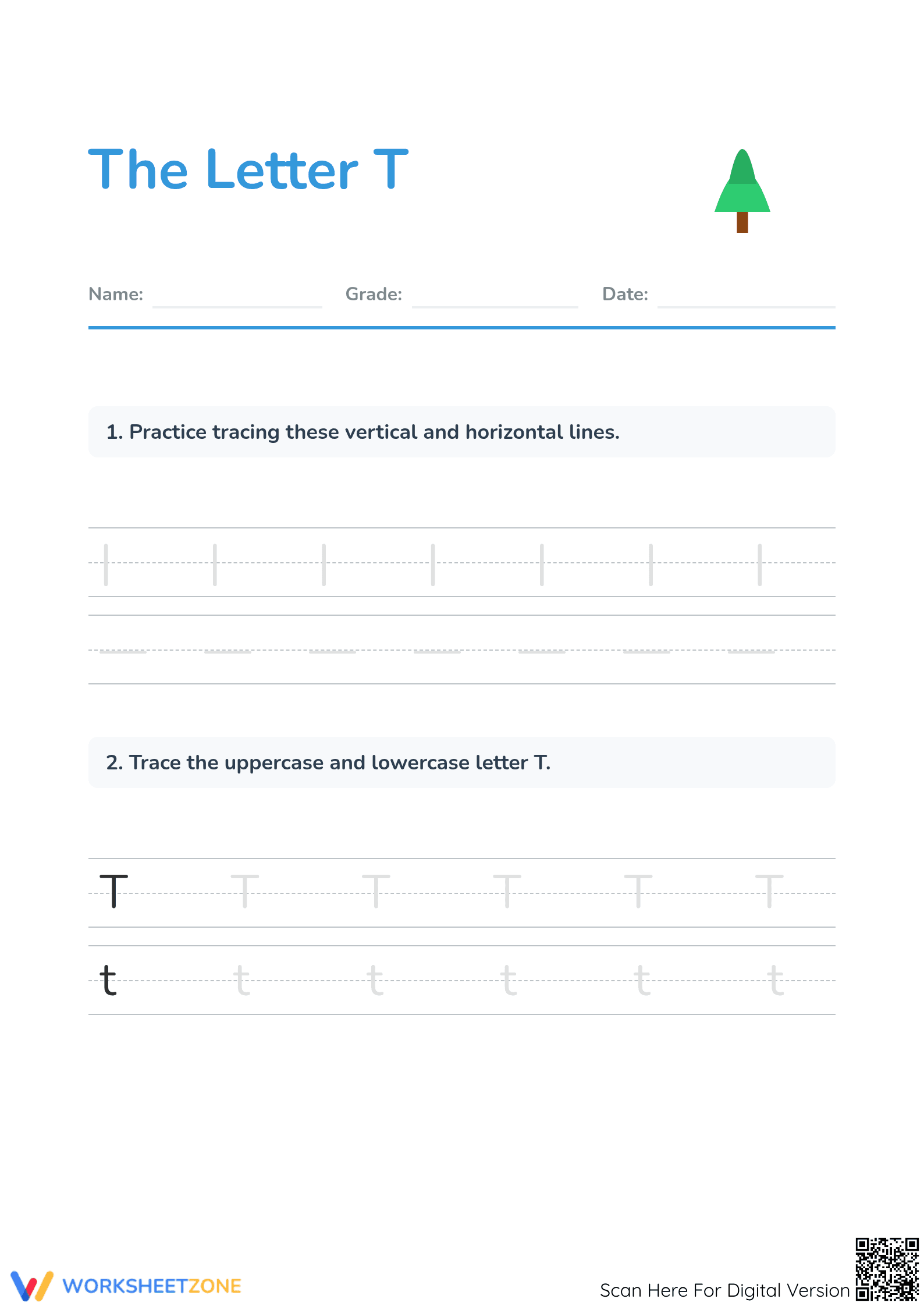
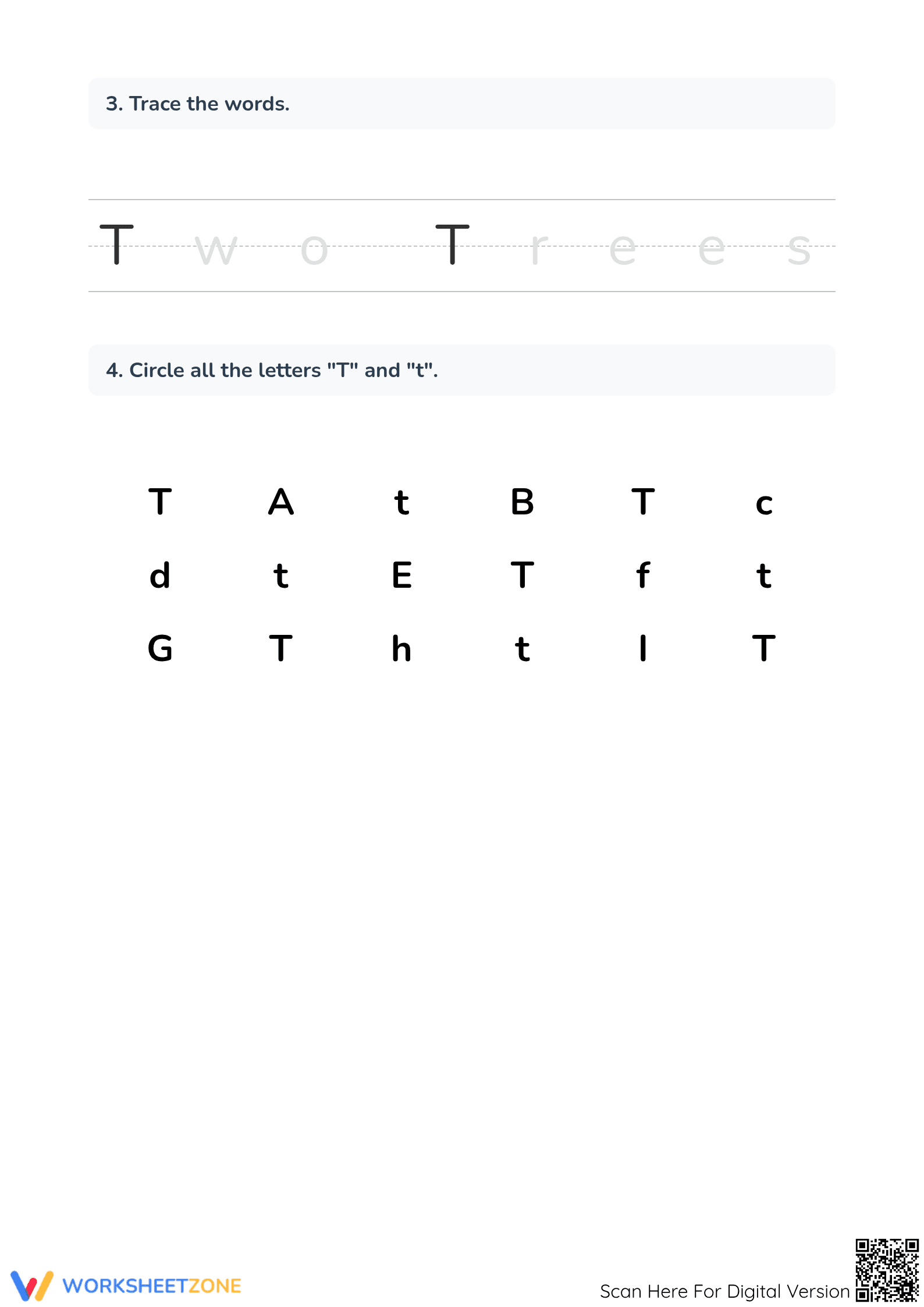
Inside this two-page printable, educators will find four distinct task types designed to build handwriting proficiency. The worksheet begins with basic vertical and horizontal line tracing to warm up fine motor skills. It then progresses to tracing uppercase and lowercase letter T, followed by tracing full words ("Two Trees"). Finally, a visual discrimination activity requires students to circle all instances of the letter T within a mixed letter bank.
- Guided practice: Students start by tracing simple vertical and horizontal dashed lines, establishing the foundational strokes required for the letter T.
- Supported practice: Learners trace the uppercase "T" and lowercase "t" using clear, dashed guidelines to ensure proper proportion and placement on the writing lines.
- Independent practice: The final tasks challenge students to trace complete words and independently identify the target letter among distractors.
This gradual-release approach moves from basic stroke mechanics to applied letter recognition, following a proven I Do, We Do, You Do instructional model.
This resource is directly aligned to CCSS.ELA-LITERACY.L.K.1.A, requiring students to print many upper- and lowercase letters. The activities specifically target the formation and identification of the letter T, ensuring foundational literacy skills are met. Both standard codes can be copied directly into lesson plans, IEP goals, or district curriculum mapping tools.
Deploy this worksheet during morning work or as a dedicated literacy center activity after introducing the letter T. It serves as an excellent independent task while the teacher conducts small group guided reading. As a formative assessment tip, observe students during the line-tracing portion to ensure they are using a proper pincer grasp and pulling their pencil top-to-bottom. Expected completion time is 10 to 15 minutes.
This resource is primarily designed for preschool and kindergarten students developing early literacy and fine motor skills. It is also highly effective for occupational therapy sessions or special education students needing targeted handwriting interventions. Pair this worksheet with a tactile alphabet anchor chart or a read-aloud focusing on words starting with the /t/ sound to reinforce the learning objective.
Mastering letter formation through explicit practice is a critical step in early childhood literacy development. Aligned with CCSS.ELA-LITERACY.L.K.1.A, this resource helps students print many upper- and lowercase letters with accuracy and confidence. According to a comprehensive EdReports 2024 analysis of foundational reading programs, students who engage in systematic handwriting practice demonstrate significantly higher spelling and decoding fluency by the end of first grade. The physical act of tracing letters like T solidifies the cognitive link between visual letter recognition and phonetic sound production. By integrating both stroke practice and visual discrimination tasks, this worksheet provides the repetition necessary to build automaticity. Early mastery of these alphabetic skills reduces cognitive load during later writing tasks, allowing young learners to focus on expressing their ideas rather than struggling with basic letter mechanics.


