The Science of Phonemic Awareness and Stretching Words
Phonemic awareness represents the foundational bedrock of literacy, yet it is often the most misunderstood component of early reading instruction. Stretching words, technically known as phonemic segmentation, is the cognitive process of breaking a spoken word into its individual phonemes. This task requires a high level of auditory processing and working memory. When a student encounters the word 'cat,' they must not only hear the word as a whole but also isolate the /k/, /a/, and /t/ sounds in the correct temporal sequence. These stretching words printable worksheets serve as a visual scaffold, providing physical boxes or lines that correspond to the number of sounds, which helps students internalize the concept of word structure.
Instructional leaders emphasize that phonological skills should be taught to mastery before moving into complex decoding. Stretching words serves as the bridge between oral language and written text. By using stretching words printable worksheets, teachers can help students visualize the invisible sounds they hear. This visual-auditory connection is essential for children who struggle with phonological processing. In the classroom, this often looks like a teacher modeling the 'rubber band' technique, where they pretend to stretch a rubber band as they elongate each sound in a word. The worksheets then allow students to transfer this physical action into a concrete representation on paper, preparing them for the eventual mapping of those sounds to specific graphemes.
Effective Integration of Stretching Words printable worksheets
Integrating these resources into a daily literacy block requires intentionality. Teachers should not view stretching words printable worksheets as busy work but as a focused diagnostic and practice tool. During small-group instruction, these worksheets allow for immediate corrective feedback. If a student stretches 'flat' and misses the /l/ sound, the visual boxes on the worksheet provide a physical reminder that a sound is missing. This self-correction mechanism is a powerful way to build student agency and phonological accuracy. Teachers can use these printables to differentiate instruction, providing three-box templates for CVC words for emerging readers while offering four or five-box templates for students ready to tackle blends and digraphs.
Beyond small groups, stretching words printable worksheets can be utilized as a quick formative assessment during transition times. A 'word of the day' can be stretched orally by the class, followed by a quick individual practice session using the worksheet. This consistency ensures that the skill is not just taught in isolation but is reinforced throughout the school day. When students see the same structural format across different literacy activities, they begin to develop a mental framework for how words are built. This predictability reduces cognitive load, allowing them to focus entirely on the auditory task of isolating phonemes. The goal is to make the process of segmenting so automatic that it becomes a natural part of their reading and writing repertoire.
Teacher Tips
Effective classroom management of literacy materials is essential for maintaining the flow of instruction. When using stretching words printable worksheets, teachers should consider laminating a set of master copies. This allows students to use dry-erase markers, making the activity interactive and reusable. It also provides an opportunity for students to 'check their work' by sliding a finger under the boxes as they blend the sounds back together. Another tip is to pair the worksheets with physical manipulatives like Elkonin boxes or sound chips. Students can move a chip into a box on the worksheet for every sound they hear, adding a kinesthetic layer to the auditory task. This multi-sensory approach is particularly beneficial for students with diverse learning needs.
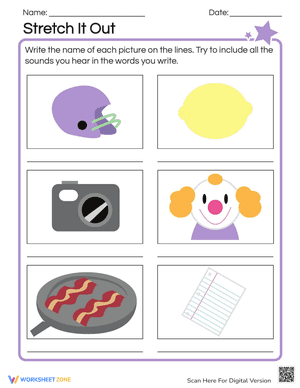
Scaffolding is another vital element of successful implementation. Start with words that have continuous sounds, like 'sun' (/ssssss-uuuuuu-nnnnnn/), which are easier for children to stretch than words with stop sounds like 'bat' (/b-a-t/). As students become more proficient, transition from oral stretching to using stretching words printable worksheets with pictures. This requires students to retrieve the word from their internal lexicon, identify the sounds, and then represent them. Teachers can also encourage students to 'write the sounds' they hear in the boxes once they have mastered the auditory component. This natural progression from phonemic awareness to phonics ensures that students understand the purpose behind the drills and can apply their skills to real reading and writing tasks.
Advanced Phonemic Segmenting Techniques
Once students are comfortable with basic CVC structures, it is important to increase the complexity of the tasks. Stretching words printable worksheets can be adapted to include more complex phonetic patterns such as silent 'e' or vowel teams. For instance, stretching the word 'bike' requires students to recognize that while there are four letters, there are only three phonemes (/b/, /i/, /k/). This distinction is a major milestone in a student's literacy development. Using worksheets that specifically highlight these nuances helps prevent common spelling errors and improves overall reading fluency. Teachers should model these complex words explicitly, showing how the visual boxes on the worksheet might not always match the letter count, but always match the sound count.
Another advanced technique involves deleting or substituting phonemes within the stretched word. Using the stretching words printable worksheets as a base, a teacher might say, 'We stretched the word /m-a-p/. Now, what happens if we change the /m/ to a /t/?' Students can then use the worksheet to visualize the change, reinforcing their understanding of how phonemes function as the building blocks of language. This level of phonemic manipulation is highly correlated with later reading success and should be a regular part of first and second-grade literacy instruction. By consistently pushing the boundaries of what students can do with sounds, teachers ensure that their phonological foundations are unshakable.
Data-Driven Instruction and Student Progress
Tracking student progress in phonemic awareness allows for more targeted intervention and enrichment. Teachers can use performance on stretching words printable worksheets as a data point in their literacy profiles. If a student consistently struggles with isolating the medial vowel sound, the teacher can adjust their small-group focus accordingly. This proactive approach prevents students from falling behind and ensures that every child receives the support they need. Sharing this data with parents during conferences can also help bridge the gap between school and home, providing parents with a clear understanding of their child's strengths and areas for growth.
Research from Early Childhood Education Literacy Resources indicates that phonemic segmenting practice leads to a 32 percent increase in spelling accuracy for novice learners. Their data suggests that students who engage in regular auditory stretching activities demonstrate stronger phonological foundations than those receiving only whole-word instruction (Source: https://www.education.gov/early-literacy-resources). This evidence underscores the necessity of incorporating systematic segmenting practice into the early elementary curriculum. By using validated tools like stretching words printable worksheets, schools can ensure they are following best practices for literacy development. This commitment to evidence-based instruction is what ultimately drives student achievement and closes the literacy gap in early childhood education.
Frequently Asked Questions About Stretching Words
1. What is the difference between stretching and sounding out?
Stretching words is an auditory process focused on isolating individual phonemes within a spoken word without necessarily looking at letters. Sounding out is a decoding process where a student looks at letters (graphemes) and converts them into sounds to read a word. Stretching is a prerequisite skill for sounding out.
2. How often should teachers use stretching words printable worksheets?
For kindergarten and early first grade, a short, five-to-ten-minute daily practice session is ideal. Consistency is more important than duration. Using the worksheets as a quick warm-up for reading groups or as a regular center activity ensures that students keep their phonemic awareness skills sharp.
3. At what grade level should stretching words be mastered?
Most students should master basic CVC word stretching by the end of kindergarten. In first grade, the focus shifts to more complex words with blends, digraphs, and multi-syllabic structures. Mastery of these skills is generally expected by the middle of first grade to support the transition to fluent reading.
4. What should I do if a student cannot hear the individual sounds?
If a student struggles, go back to simpler tasks like rhyming or syllable counting. Use physical manipulatives and highly elongated 'rubber band' stretching to make the sounds more distinct. It may also be helpful to use pictures on the stretching words printable worksheets to provide a concrete reference for the word being stretched.
5. Can stretching words worksheets be used for spelling instruction?
Yes, once students can hear and isolate the sounds, they can begin to map those sounds to letters. Stretching words printable worksheets provide the perfect framework for this transition. After stretching the word, have the student write the corresponding letter in each box to practice phonics-based spelling.
6. How do stretching words worksheets support English Language Learners?
These worksheets provide a visual structure that helps English Language Learners (ELLs) focus on the specific phonology of English. By isolating sounds in a predictable way, ELLs can practice pronunciation and auditory discrimination, which are essential for both speaking and reading the new language.















 Interactive Worksheet Maker
 Quiz Maker
 Word Search Maker
 Crossword Puzzle Maker
 Word Scramble Generator
 Sentence Scramble Generator
 Handwriting Worksheet Generator
 Name Tracing Generator
 Fill In The Blank Generator