Understanding the Complexity of Silent Letters in English Phonics
Phonics instruction is one of the most demanding aspects of elementary literacy, particularly when students encounter words that do not follow standard phonetic rules. Silent letters represent a significant hurdle for young learners in grades 1 through 5, as these characters are visible in text but remain unspoken during oral reading. For teachers planning small-group interventions or whole-class lessons, using a silent letters worksheets provides a structured way to bridge the gap between spelling and pronunciation. These worksheets allow students to visualize the word structure while practicing the auditory skills necessary to identify silent components.
Research into the English language reveals that silent letters are not merely random inclusions; they often serve as historical artifacts or linguistic markers. When teachers introduce these concepts, it is helpful to frame them as 'ghost letters' or 'hidden partners' to make the concept more approachable for younger children. By providing consistent practice through no-prep PDF resources, Worksheetzone helps curriculum leads and classroom practitioners ensure that students develop the decoding skills required for fluent reading. This foundation is essential for moving beyond simple phoneme-grapheme correspondence into more advanced morphological awareness.
Common Silent Letter Patterns and Phonetic Science
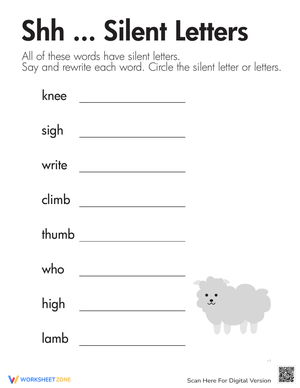
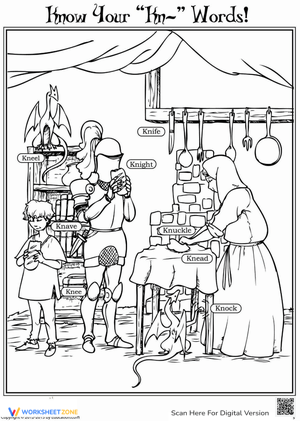
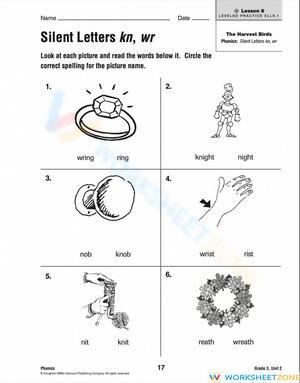
To teach silent letters effectively, teachers must categorize them into recognizable patterns. The most frequent occurrences in the English language include the silent 'k' before 'n', the silent 'w' before 'r', and the silent 'b' following an 'm'. Each of these patterns has its own logic and set of common words that students encounter daily. For example, 'kn' words like knee, knot, and knight are staple vocabulary terms that require explicit instruction. Similarly, 'wr' words like wrap, wrist, and wrong appear frequently in early writing assignments.
According to Grammarly, approximately 60 percent of English words contain at least one silent letter. These phonetic anomalies exist because of the complex history of the language, where pronunciations shifted over centuries while spelling remained fixed, or words were borrowed from other languages like Greek and Latin without phonetic updates.
Another common pattern is the silent 'g' before 'n', found in words like gnat, gnaw, and sign. While these are less frequent than 'kn' or 'wr', they often appear in science and social studies texts, making them important for cross-curricular literacy. Teachers can use worksheets that specifically isolate these patterns, allowing students to focus on one phonetic rule at a time before integrating them into broader reading tasks. This focused approach prevents cognitive overload and ensures that the rules are internalized before moving on to more complex vocabulary.
The Magic E Rule: Beyond Simple Silent Letters
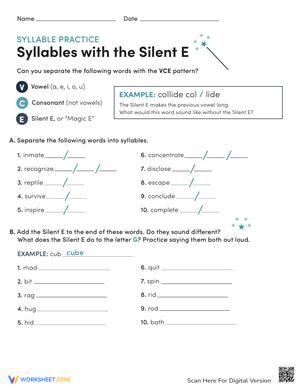
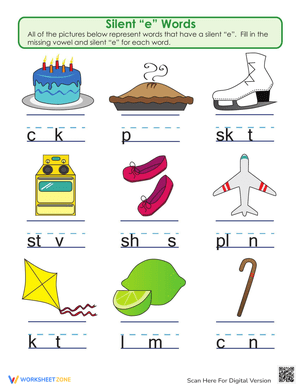
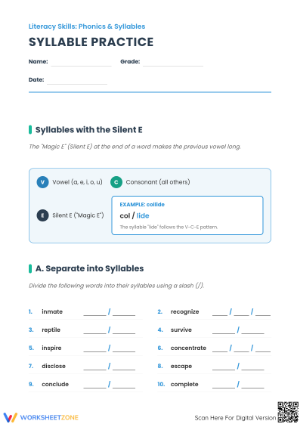
One of the most foundational concepts in early phonics is the 'Magic E' or silent 'e' rule. Unlike other silent letters that simply remain quiet, the silent 'e' at the end of a word performs a specific function: it changes the sound of the preceding vowel. In words like 'hat' versus 'hate' or 'kit' versus 'kite,' the presence of the 'e' signals to the reader that the vowel should have a long sound. This is a primary focus for teachers in late kindergarten and first grade, as it represents the first major shift from short vowel decoding to long vowel recognition.
Worksheets focused on the silent 'e' often use 'before and after' activities where students add an 'e' to a short-vowel word to see how the meaning and sound change. This visual transformation is powerful for young learners. It demonstrates that letters can have roles beyond their basic sounds, introducing the idea of markers in the English writing system. This concept is a stepping stone to understanding more complex vowel teams and diphthongs that students will encounter in second and third grade.
While many students view silent letters as obstacles, they actually serve as visual cues to help differentiate between homophones. For instance, the 'k' in knight separates it from night, providing a morphological anchor that allows readers to instantly identify the word's meaning even when the auditory signal is identical. This visual differentiation is a key component of orthographic mapping, where the brain stores the spelling, sound, and meaning of a word as a single interconnected unit.
Teacher Tips for Effective Phonics Intervention
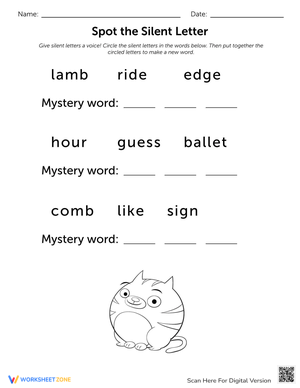
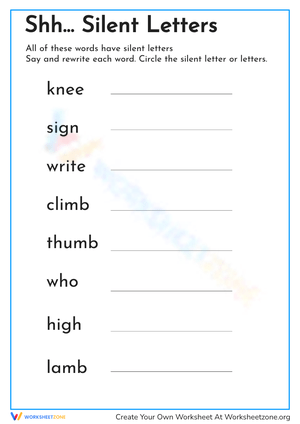
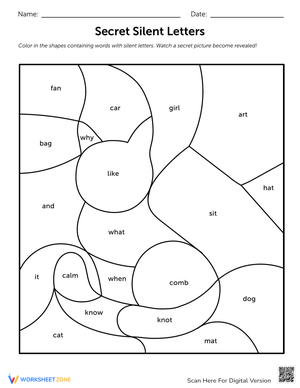
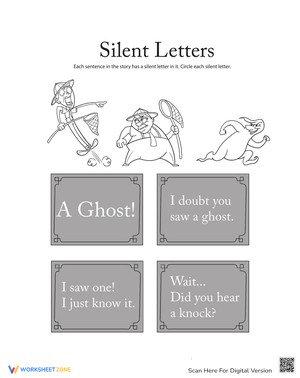
When students fall behind in phonics, silent letters are often one of the areas requiring intensive intervention. To support these learners, teachers should adopt a multi-sensory approach. For example, when using a silent letters worksheets, encourage students to 'trap' the silent letter by drawing a circle or a cage around it. This physical action reinforces the idea that the letter is present but must be kept quiet during reading. Another technique is to have students highlight the silent letter in one color and the sounded letters in another, creating a clear visual distinction between the two.
Consistency is key in any intervention program. Worksheetzone recommends integrating silent letter practice into daily morning work or literacy centers. Rather than teaching all silent letters at once, introduce one pattern per week. Start with 'kn' and 'wr' as they are the most common, then move to more obscure patterns like 'gn' and 'mb'. This allows for deep dives into specific vocabulary and gives students the time they need to master one rule before being introduced to the next. Small-group instruction is particularly effective here, as teachers can provide immediate feedback and correction as students work through their PDF assignments.
Classroom Implementation: Engaging Activities for PDF Worksheets
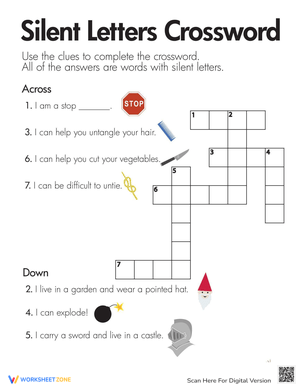
Integrating a silent letters worksheets into the classroom goes beyond simple pencil-and-paper tasks. To maximize engagement, teachers can transform these static documents into interactive learning experiences. One effective method is the 'Silent Letter Hunt.' After completing a worksheet, students can take their newfound knowledge into their independent reading books, searching for more words that follow the same patterns they just practiced. They can record these findings in a literacy journal, creating a personalized list of silent letter words that they can reference during writing time.
For formative assessment, use a quick 'Find the Silent Letter' race. Provide each student with a paragraph from a worksheet and give them sixty seconds to find and underline as many silent letters as possible. This builds reading fluency and scanning skills. It also provides teachers with a quick check on who has mastered the concept and who may need further small-group support. By varying the way these worksheets are used, teachers can maintain student interest and ensure that the learning stays fresh and relevant. Downloadable PDF files are ideal for this flexibility, as they can be printed in multiples or displayed on an interactive whiteboard for whole-class instruction.
Frequently Asked Questions About Silent Letters
1. Why does the English language have silent letters?
Silent letters exist primarily due to changes in pronunciation over time while the written spelling remained the same. Many of these letters were actually pronounced in Old or Middle English but were eventually dropped in speech as the language evolved. Other silent letters were added to words borrowed from languages like Greek, Latin, or French to reflect their original spellings, even if those letters didn't correspond to English sounds.
2. What are the most common silent letter rules for kids?
The most important rules for young learners are the silent 'k' before 'n' (knot, knee), the silent 'w' before 'r' (write, wrong), and the silent 'b' after 'm' (comb, thumb). Additionally, the 'Magic E' or silent 'e' at the end of a word is a vital rule that changes a short vowel sound to a long vowel sound. Mastering these four patterns covers a large portion of the silent letter words children encounter in early reading.
3. How can I help my child remember which letters are silent?
Using visual and kinesthetic strategies is the best way to help a child remember silent letters. Have them circle or highlight the silent letter in a word to make it stand out. You can also use word sorts and matching games from a silent letters worksheets to provide repetitive, engaging practice. Encouraging the child to write the word several times while saying the name of the silent letter also helps with orthographic mapping.
4. Is there a list of common words with silent letters?
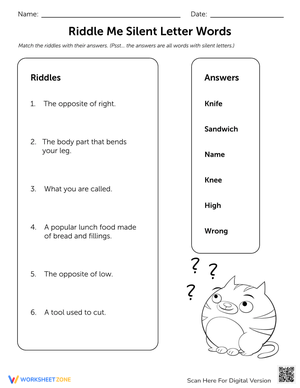
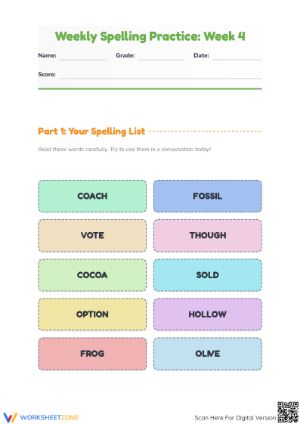
Yes, many worksheets provide comprehensive lists for student reference. Common words include knife, knee, wrap, wrist, gnaw, sign, comb, lamb, ghost, honest, and walk. Categorizing these words by their silent letter pattern makes them easier for students to learn. Teachers often use these lists to create word walls or personal spelling dictionaries for their students to use during writing assignments.
5. What is the Magic E rule and how does it work?
The Magic E rule states that when a word ends with a silent 'e', it usually makes the vowel before it say its name (a long vowel sound). For example, in the word 'hop', the 'o' is short. When you add an 'e' to make 'hope', the 'o' becomes long. This rule is essential for decoding and is one of the first silent letter concepts taught in elementary phonics programs.












 Interactive Worksheet Maker
 Quiz Maker
 Word Search Maker
 Crossword Puzzle Maker
 Word Scramble Generator
 Sentence Scramble Generator
 Handwriting Worksheet Generator
 Name Tracing Generator
 Fill In The Blank Generator