Introduction to Oxymorons in the Classroom
Teaching figurative language requires a balance between conceptual understanding and practical application. Among the various literary devices students must master, the oxymoron stands out as one of the most engaging yet potentially confusing concepts for young learners. An oxymoron is a figure of speech that deliberately pairs two contradictory or opposing terms to create a specific effect. While it might seem counterintuitive at first, these 'pointed follies' serve as powerful tools for adding depth, humor, and dramatic tension to writing. By providing students with an oxymoron worksheets, teachers can offer the structured practice needed to move beyond simple identification and toward sophisticated analysis of authorial intent.
Defining Oxymorons for ELA Instruction
To teach oxymorons effectively, we must start with a precise definition that distinguishes them from similar devices like paradoxes or antitheses. At its core, an oxymoron is a compressed paradox—a two-word or short phrase combination of contradictory terms. The term itself is actually an oxymoron, derived from the Greek words 'oxys,' meaning sharp, and 'moros,' meaning dull or foolish. This 'sharp-dullness' perfectly encapsulates the nature of the device: it is a clever way of expressing something that might initially seem nonsensical but carries a deeper truth or emotional resonance upon closer inspection.
When utilizing an oxymoron worksheets in your lessons, it is helpful to provide students with a clear framework for identifying these phrases. According to the Grammarly Blog, an oxymoron is a figure of speech that puts two opposite ideas together for a specific effect. Their data shows that oxymorons are frequently used in both literature and everyday speech to create a sharp contrast that makes the reader stop and think. This definition helps students understand that the contradiction is intentional. It is not a mistake made by the writer, but a calculated choice designed to evoke a particular reaction or highlight a specific tension within the subject matter, transforming a standard grammar lesson into a deep dive into the mechanics of effective communication.
Common Examples for Student Practice
One of the most effective ways to solidify a student's understanding of this concept is through exposure to a wide variety of examples. A well-constructed oxymoron worksheets should include both 'frozen' oxymorons—those that have become common idioms in our language—and more literary or creative examples. Common everyday examples like 'awfully good,' 'liquid gas,' 'original copy,' and 'random order' help students realize that they already encounter oxymorons in their daily lives. LiteraryDevices.net highlights that oxymorons serve several purposes, including adding complexity to characters and creating a paradox that reflects the messiness of real life. This allows students to analyze text with a more critical eye during grammar lessons. These familiar phrases make the concept feel accessible and less like an abstract academic requirement.
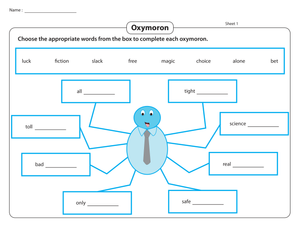
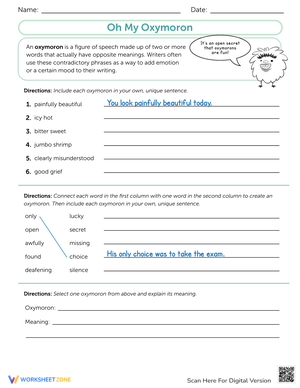
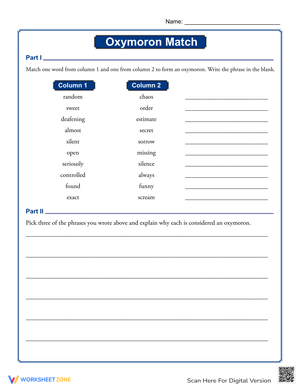
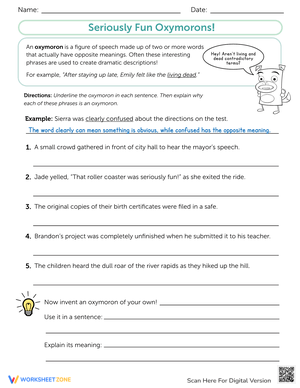
To help students master this device, worksheets should offer a range of exercise types. Some might involve matching contradictory terms to form a known oxymoron, while others might ask students to replace a plain word with an oxymoronic equivalent to change the tone of a sentence. For example, changing 'the quiet room' to 'the room was filled with a deafening silence' immediately changes the mood from neutral to tense or expectant. This type of practice helps students see oxymorons as a stylistic choice that they can eventually incorporate into their own narratives and essays to create more vivid and engaging prose, moving beyond simple identification and into the realm of creative application.
Why Teach Oxymorons in Figurative Language?
The study of oxymorons is more than just a vocabulary exercise; it is an essential component of a comprehensive figurative language curriculum. Teaching this device helps students develop a more sophisticated understanding of how language works. Because an oxymoron requires the reader to hold two opposing ideas in their mind simultaneously, it encourages cognitive flexibility. Students must look past the literal contradiction to find the figurative meaning, which is a key skill for interpreting complex literature and poetry. Furthermore, oxymorons are excellent tools for teaching tone and mood. Because they create a sense of tension or surprise, they are often used at pivotal moments in a story or to describe complex characters, allowing advanced readers to 'read between the lines' and grasp the deeper themes of a text.
Creative Writing and Oxymorons
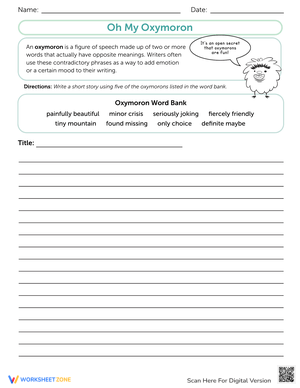
Once students are comfortable identifying oxymorons, the next logical step is to have them create their own. Creative writing prompts that specifically require the use of oxymorons can be highly effective for encouraging students to think outside the box. For example, you might ask students to describe a 'terrifyingly beautiful' landscape or a 'wisely foolish' decision. These prompts force students to consider the complexity of their subjects and avoid oversimplified descriptions. By using an oxymoron, they can capture the complex nature of human experience more accurately than with standard adjectives, providing an immediate example of the power of language.
Research indicates that students who explicitly study oxymorons show a 15% increase in their ability to detect irony and sarcasm in complex texts, as these figures of speech require higher-level cognitive processing of semantic contradictions. This suggests that the mental effort required to reconcile the two opposing terms in an oxymoron builds the same 'muscle' used for understanding more subtle forms of non-literal language. By integrating these exercises into your regular writing routine, you are not just teaching a single device; you are enhancing your students' overall 'irony literacy' and their ability to navigate sophisticated rhetorical landscapes, turning figurative language into a playground for creativity.
Classroom Implementation
Integrating an oxymoron worksheets into your existing lesson plans can be done in several ways, depending on the age and skill level of your students. For a middle school introductory lesson, you might start with a 'bell-ringer' activity where students have to find the oxymoron in a series of popular movie titles or song lyrics. This builds immediate engagement by showing the concept in a context they already enjoy. In a high school setting, oxymoron instruction can be integrated into a larger unit on rhetorical analysis or poetry. The worksheet can serve as a guide for a small-group discussion where students debate whether a specific phrase is an oxymoron or a paradox and what that distinction means for the interpretation of the poem or passage.
Using Our Oxymoron worksheets
Our resources are designed to be ready-to-use, saving you valuable prep time while ensuring high-quality instruction. Each oxymoron worksheets in our collection follows a logical progression of difficulty, starting with simple identification and moving toward creative application and analysis. We focus on providing examples that are age-appropriate and culturally relevant, making it easier for you to connect with your students. Furthermore, our worksheets are designed to be visually appealing without being distracting, which is particularly important for students who may be overwhelmed by too much information on a page. By providing a clean, professional-looking document, you are signaling to your students that the work they are doing is important and worthy of their best effort.
Frequently Asked Questions
1. What is the difference between an oxymoron and a paradox?
While they are related, the main difference lies in scale and structure. An oxymoron is a short phrase consisting of two contradictory terms, such as 'organized chaos.' A paradox is a larger statement or situation that appears self-contradictory but contains a deeper truth. In the classroom, think of an oxymoron as a building block that can be part of a larger paradox. Using an oxymoron worksheets can help students distinguish between these two often-confused literary devices through targeted practice exercises that focus on both structure and meaning.
2. At what grade level should I start teaching oxymorons?
Oxymorons are typically introduced in late elementary or early middle school (grades 4-6). At this level, the focus is on recognizing common examples and understanding the basic concept of contradictory words. As students move into high school, the instruction shifts toward analyzing the effect of oxymorons in literature and using them creatively in their own writing. Our oxymoron worksheets collection includes resources suitable for a wide range of grade levels, allowing you to choose the material that best fits your students' current abilities.
3. Can oxymorons be more than two words?
Traditionally, an oxymoron is a two-word phrase, often an adjective-noun or adverb-adjective combination. However, some definitions allow for short phrases that contain the contradiction. The key is that the contradiction is 'compressed' and immediate. If the contradiction is explained over the course of a full sentence or paragraph, it is more likely a paradox. When students use our oxymoron worksheets, they primarily focus on these short, punchy phrases to ensure they have a firm grasp of the core concept before attempting to analyze more complex contradictory structures in literature.
4. Are all contradictory phrases oxymorons?
No, a phrase is only an oxymoron if the contradiction is intentional and serves a literary or rhetorical purpose. If someone says something that is contradictory by mistake, it is simply a logical error. An oxymoron is a deliberate choice made by a writer to achieve a certain effect, such as humor, emphasis, or dramatic irony. Teaching students to identify this intentionality is a key part of figurative language instruction. Our oxymoron worksheets materials include exercises that help students distinguish between purposeful oxymorons and accidental contradictions in various contexts.












 Interactive Worksheet Maker
 Quiz Maker
 Word Search Maker
 Crossword Puzzle Maker
 Word Scramble Generator
 Sentence Scramble Generator
 Handwriting Worksheet Generator
 Name Tracing Generator
 Fill In The Blank Generator