Free Printable Literary Archetypes PDF Worksheets for ELA Classrooms
Understanding the Power of Archetypes in Literature and Media
Archetypes are the universal symbols, character types, and narrative patterns that have shaped human storytelling since the dawn of oral tradition. For middle and high school English teachers, teaching archetypes is not just about identifying recurring tropes; it is about giving students the keys to unlock the deeper meaning of every story they encounter. These patterns are found across world literature, ancient myths, and modern media, serving as a shared language that connects diverse cultures and eras. By utilizing archetypes worksheets resources, teachers can help students move beyond surface-level reading and begin to analyze the underlying structures that make stories resonate with audiences on a global scale.
Common Character Archetypes Every Student Should Know
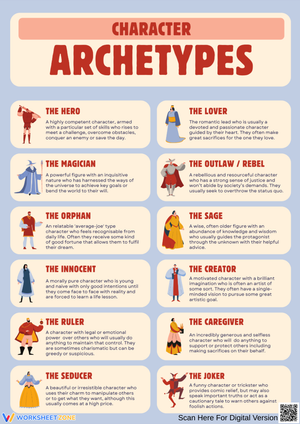
Building a solid vocabulary of character archetypes is the first step in any successful literature unit. While there are dozens of specialized archetypes, a few core figures appear most frequently and provide the most utility for student analysis. The Hero is perhaps the most recognizable, representing the protagonist who must overcome obstacles to achieve a goal. However, students should also be introduced to the Mentor, the wise figure who provides training and advice to the hero, often sharing a specific item or piece of knowledge that becomes vital later in the journey. Understanding these relationships helps students track character development and the shifting dynamics within a group of characters.
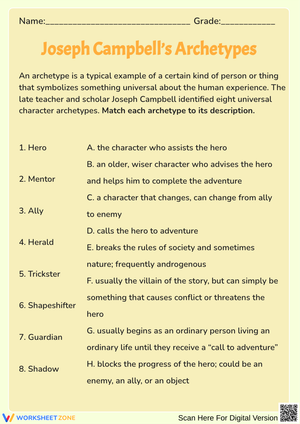
- The Hero: The central character who answers a call to adventure and faces challenges.
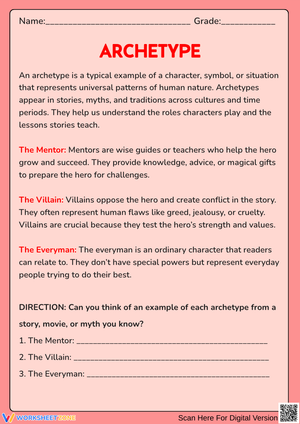
- The Mentor: A guide who provides wisdom, training, and support to the protagonist.
- The Shadow: The primary antagonist who represents the hero's greatest fears or negative traits.
- The Herald: The character or event that delivers the call to adventure, signaling that change is coming.
- The Trickster: A character who uses wit and deception to challenge authority and provide comic relief.
- The Threshold Guardian: A figure who tests the hero's resolve before they can move into the next phase of the journey.
- The Shape-shifter: A character whose loyalty is uncertain, often keeping the hero and the audience guessing.
The Hero’s Journey and Narrative Patterns
Archetypes do not exist in a vacuum; they are often organized into larger narrative structures, the most famous of which is the Hero’s Journey. This pattern provides a roadmap for how protagonists move from their ordinary world into a world of adventure and back again. For ELA teachers, the Hero’s Journey is an invaluable tool for teaching plot structure and pacing. By mapping a story onto these stages, students can see how individual archetypes serve specific functions at different points in the narrative. For instance, the Herald typically appears in the 'Call to Adventure' stage, while the Mentor often assists during the 'Crossing of the First Threshold' or the 'Tests, Allies, and Enemies' phase.
According to The Hero's Journey: Archetypes Defined from ReadWriteThink, this narrative pattern consists of twelve distinct stages that are universally recognizable in stories across all cultures. Their research indicates that students who learn to identify these stages show a 35% improvement in their ability to map complex plot structures compared to those who only learn linear story arcs. This data suggests that archetypal study is a powerful booster for general literacy and structural understanding in middle and high school settings.
How Archetypal Study Improves Reading Comprehension
One of the primary benefits of incorporating archetypes into the ELA curriculum is the immediate boost it provides to reading comprehension. When students encounter a new text, they are often overwhelmed by unfamiliar names, settings, and vocabulary. However, if they can identify that the mysterious stranger at the inn is a Herald, they already have a set of expectations for what that character will do. This cognitive scaffolding allows them to focus their mental energy on more complex tasks, such as analyzing the author's tone or the story's unique cultural context. Archetypes act as a bridge between the known and the unknown, making difficult texts more accessible to all learners.
While many teachers focus on the static nature of archetypes, the most profound learning occurs when students analyze how modern authors subvert these traditional patterns to reflect contemporary values and social shifts. In today's literature, we frequently see 'Anti-Heroes' who reject the call to adventure or 'Strong Female Leads' who take on roles traditionally reserved for male protagonists. By comparing classic archetypal depictions with these modern variations, students develop a more sophisticated understanding of how literature both reflects and influences societal change. This level of analysis requires students to hold two conflicting ideas at once: the existence of a universal pattern and the intentional breaking of that pattern for thematic effect.
Teacher Tips: Classroom Implementation
Successfully integrating archetypes into your curriculum requires a scaffolded approach that starts with simple recognition and moves toward complex analysis. Teachers should begin by introducing the most common archetypes using familiar examples from popular culture. This builds a foundation of success before moving on to more challenging texts. Using archetypes worksheets materials that include graphic organizers can help students keep track of different character traits and roles as they read. These visual aids are particularly helpful for English Language Learners and students with diverse learning needs, as they provide a clear structure for organizing their thoughts and findings.
- Start with Pop Culture: Use clips from well-known movies to introduce the concept of the Hero, Mentor, and Shadow.
- Use Graphic Organizers: Provide students with charts to track archetypal traits as they read a novel or play.
- Encourage Creative Writing: Have students create their own characters by choosing two or three archetypal traits to blend.
- Comparative Analysis: Ask students to compare the same archetype across two different genres or time periods.
Finally, remember that the study of archetypes should be an ongoing part of the ELA experience, not just a one-off unit. Revisit these concepts throughout the year as you encounter new texts and genres. Ask students how the archetypes in a Shakespearean play differ from those in a modern short story. This consistent reinforcement helps students internalize these patterns, eventually allowing them to recognize them automatically. Over time, they will start seeing archetypes as a fundamental part of how they perceive the world around them. This shift in perspective is one of the most rewarding parts of teaching literature and is a testament to the enduring power of these ancient patterns.
Frequently Asked Questions
1. What is the difference between an archetype and a stereotype?
An archetype is a universal, recurring symbol or character type that represents a fundamental human experience or psychological pattern. It provides a deep, structural foundation for a character while allowing for significant individual development. In contrast, a stereotype is a shallow, often oversimplified and harmful generalization about a group of people based on their race, gender, or background. While archetypes add depth and resonance to a story, stereotypes often rely on lazy writing and can perpetuate negative biases.
2. Why are archetypes considered fundamental to storytelling?
Archetypes are considered fundamental because they tap into a shared human consciousness. They represent patterns that are universally understood across cultures and generations, providing a shorthand for audiences to connect with a story. By using archetypes, storytellers can quickly establish a character's role and purpose, allowing them to focus on the unique aspects of their narrative. These patterns help us make sense of the world and our place in it, which is why we see the same figures appearing in myths, legends, and modern movies alike.
3. How do archetypes help students analyze complex character motivations?
Archetypes provide a 'baseline' for character behavior, giving students a starting point for their analysis. If a student identifies a character as a Mentor, they expect them to provide guidance and wisdom. When the character acts in a way that aligns with this role, it confirms the student's understanding. When the character acts against their archetypal role, it prompts the student to ask 'why,' leading to a deeper investigation of the character's unique motivations and the author's intent. This process of comparing a character's actions to an established pattern is the heart of sophisticated character analysis.
4. Can a character embody more than one archetype at once?
Yes, many of the most compelling characters in literature are those who embody multiple archetypes or transition between them. For example, a character might act as a Mentor to the protagonist while also serving as a Herald for a different subplot. A character could also start as a Trickster and eventually evolve into a Hero. These layers and transitions add complexity to a story and provide fertile ground for student analysis. Tracking these shifts through archetypes worksheets activities helps students understand character growth and the dynamic nature of storytelling.
5. How do archetypes relate to the Hero's Journey?
The Hero's Journey is a narrative structure that organizes archetypes into a specific sequence of events. Each stage of the journey typically involves the appearance of specific archetypal figures. For instance, the Mentor often appears early in the journey to prepare the Hero, while the Shadow is often the focus of the Ordeal. Understanding how these figures function within the larger story arc helps students see the connection between character roles and plot structure, leading to a more comprehensive understanding of narrative theory.
Clear All