


























Views
Downloads


Printable Run-On Sentence Practice | Grade 5 and 6 ELA
Paste this activity's link or code into your existing LMS (Google Classroom, Canvas, Teams, Schoology, Moodle, etc.).
Students can open and work on the activity right away, with no student login required.
You'll still be able to track student progress and results from your teacher account.
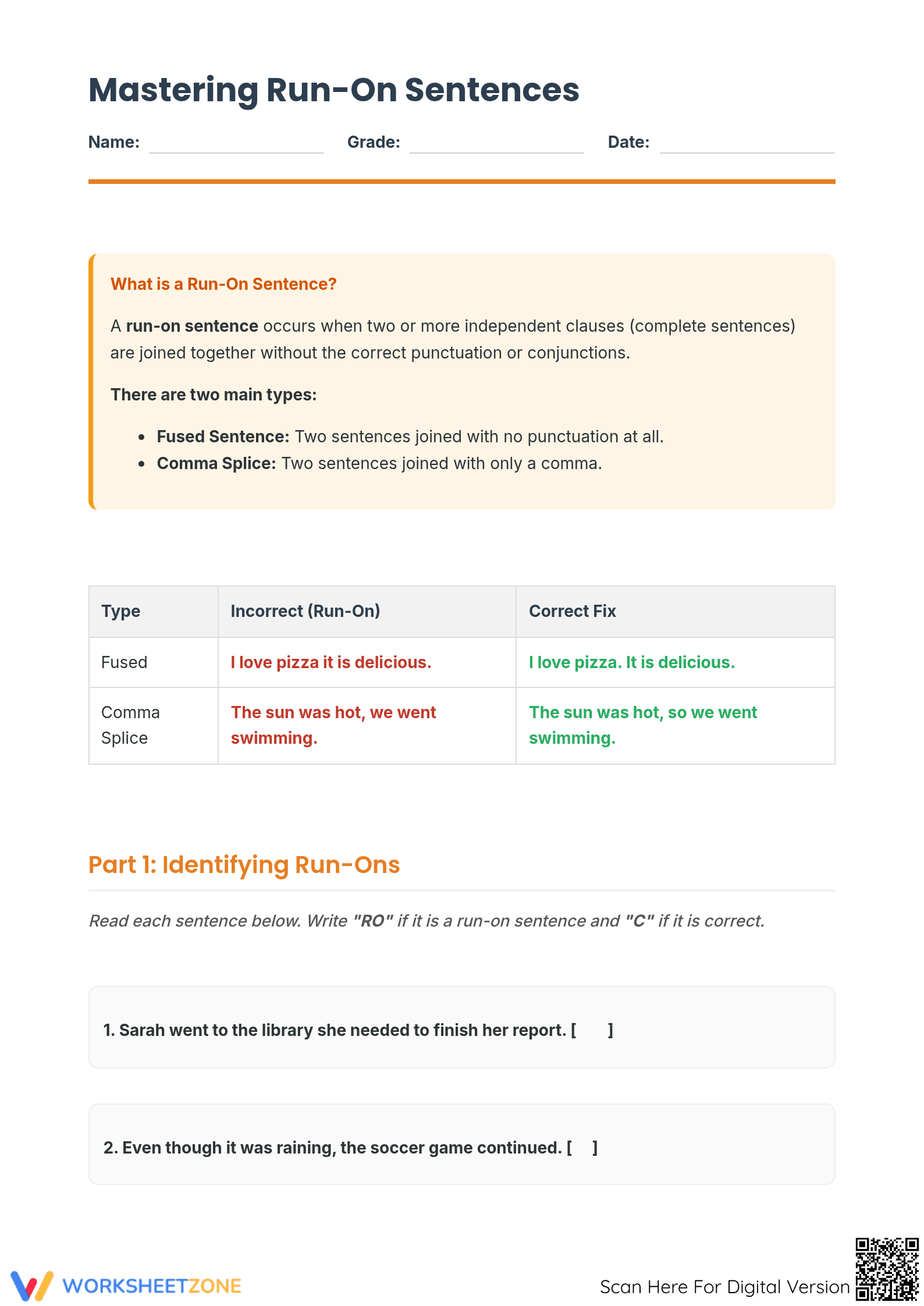
Correcting run-on sentences is essential for clear writing. This worksheet helps students identify fused sentences and comma splices, then provides guided practice in fixing them using conjunctions and punctuation. By the end of these three pages, students will demonstrate a clear command of sentence boundaries and improved narrative flow in their writing.
At a Glance
- Grade: 5 & 6 · Subject: English Language Arts
- Standard:
CCSS.ELA-LITERACY.L.5.1— Use conjunctions and punctuation to join clauses and correct sentence boundary errors.- Skill Focus: Run-on sentence identification and correction
- Format: 3 pages · 11 problems · Answer key included · PDF
- Best For: Independent practice and formative grammar assessment
- Time: 20–30 minutes
This 3-page packet features 11 specific tasks designed to build mastery of sentence mechanics. It begins with a clear instructional header defining fused sentences and comma splices with "before and after" examples. The activities span three distinct parts, including a final paragraph-writing challenge and a bonus "mega" run-on fix to ensure high student engagement.
Skill Progression
- Guided Recognition: Students evaluate five sentences, labeling them as "RO" or "C" to sharpen their error-detection skills and distinguish between fused clauses and comma splices.
- Supported Correction: Four rewriting tasks require students to apply specific tools—periods, semicolons, or coordinating conjunctions—to repair broken sentence structures.
- Creative Application: A short paragraph-writing prompt and a complex "mega" sentence challenge force students to synthesize their learning in an original creative context.
This structured approach utilizes a gradual-release model, ensuring students move from simple identification to sophisticated sentence construction and independent writing.
Standards Alignment
Aligned to CCSS.ELA-LITERACY.L.5.1, which requires students to demonstrate command of standard English grammar conventions. Specifically, it targets the ability to recognize and correct run-on sentences and comma splices, which is a critical sub-skill for achieving grade-level writing proficiency. Both standard codes can be copied directly into lesson plans, IEP goals, or district curriculum mapping tools.
How to Use It
Assign this worksheet during the independent practice phase of a grammar lesson on compound sentences. For a quick formative check, observe how students handle the transition from Part 1 to Part 2; those who correctly identify errors but struggle to rewrite them may need additional support with coordinating conjunctions like "and, but, or, so." The expected completion time range is 20 to 30 minutes.
Who It's For
This resource is designed for Grade 5 and 6 students, but it also serves as a robust remediation tool for middle schoolers. It is particularly effective for students who rely on repetitive "and" strings in their writing drafts. Pair this with a short informational passage to have students hunt for correctly formed compound sentences in professional writing.
According to Fisher & Frey (2014), the gradual release of responsibility is most effective when students move from teacher-modeled examples to independent synthesis. This worksheet applies that research-backed framework to the specific mechanical challenge of the run-on sentence. By providing an initial instructional cheat sheet followed by identification and rewriting tasks, the resource ensures that the cognitive load is managed appropriately for Grade 5 and 6 learners. Mastering CCSS.ELA-LITERACY.L.5.1 requires more than just knowing a definition; it requires the active manipulation of clauses and punctuation to create meaning. This printable guide provides the necessary repetition and variety of tasks—including a "Show What You Know" paragraph prompt—to move students toward permanent mastery of sentence boundaries. Using this focused practice helps bridge the gap between isolated grammar drills and the actual application of clear conventions in student-authored essays and narratives.


