


























Views
Plays
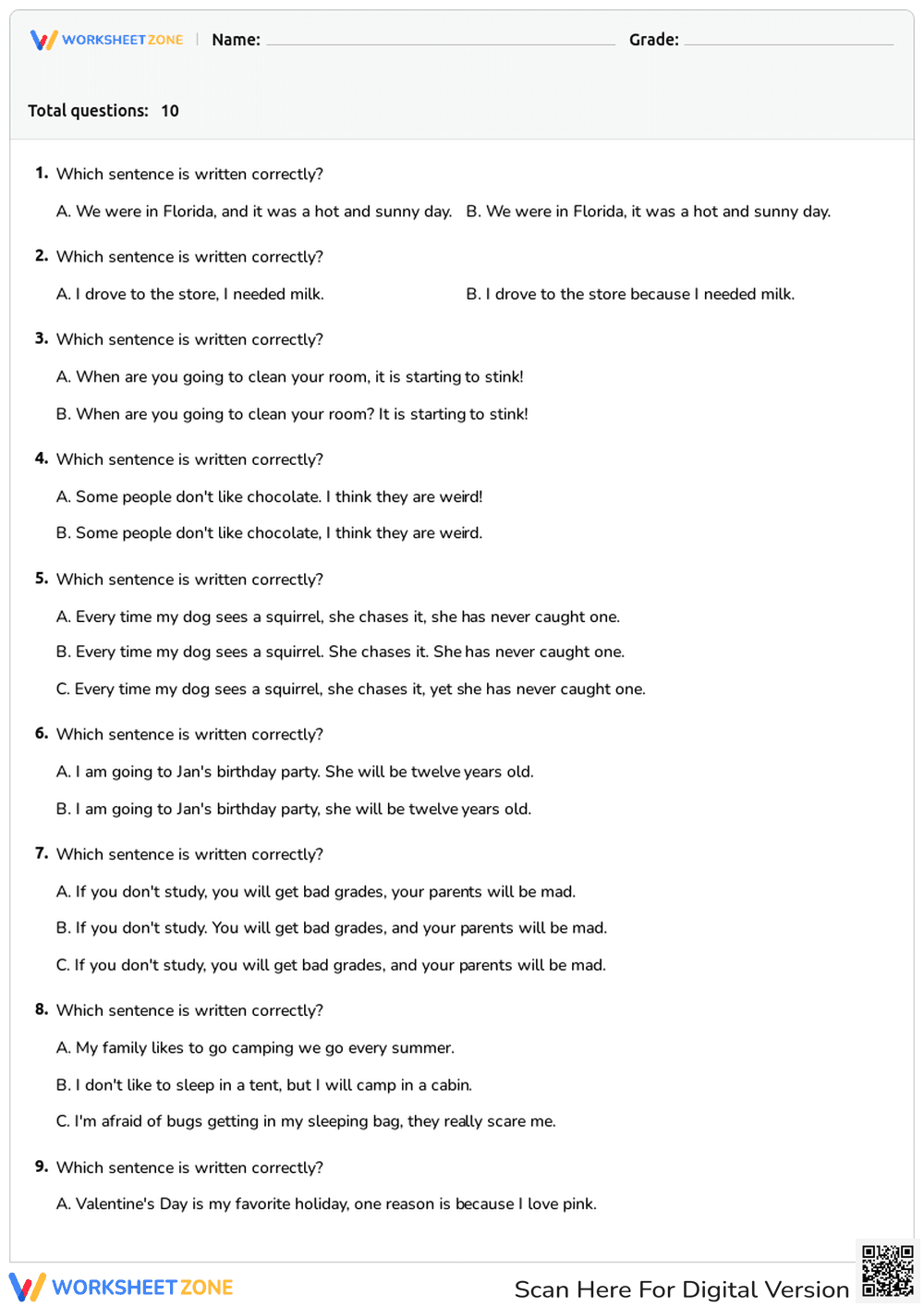


Sentence Structure Worksheet | Grade 5-6 Printable
Paste this activity's link or code into your existing LMS (Google Classroom, Canvas, Teams, Schoology, Moodle, etc.).
Students can open and work on the activity right away, with no student login required.
You'll still be able to track student progress and results from your teacher account.
This sentence structure worksheet helps students master the mechanics of writing by identifying correctly written sentences and avoiding common errors like run-ons and comma splices. By evaluating different sentence options, learners develop a stronger grasp of proper punctuation and grammar, leading to clearer and more effective communication.
At a Glance
- Grade: 5–6 · Subject: ELA
- Standard:
CCSS.ELA-LITERACY.L.5.1— Demonstrate command of standard English grammar conventions.- Skill Focus: Identifying correctly written sentences
- Format: 2 pages · 10 problems · Answer key included · PDF
- Best For: Independent practice and review
- Time: 15–20 minutes
What's Inside
This resource features a straightforward, two-page multiple-choice quiz format. Students are presented with ten distinct questions, each offering two to three sentence variations. They must carefully read each option and select the one that demonstrates correct grammar, punctuation, and sentence boundaries. A complete answer key is provided to make grading quick and efficient for educators.
Skill Progression
- Guided practice: Begin by reviewing the first two questions together as a class, discussing why certain options are run-on sentences or comma splices.
- Supported practice: Have students complete the next three questions in pairs, encouraging them to explain their reasoning to their partner before selecting an answer.
- Independent practice: Assign the remaining five questions for individual completion to assess their unassisted understanding of sentence boundaries.
This gradual-release approach ensures students build confidence before applying the concepts independently.
Standards Alignment
Aligned to CCSS.ELA-LITERACY.L.5.1: Demonstrate command of the conventions of standard English grammar and usage when writing or speaking. It also supports general sentence structure mastery expected in upper elementary and middle school grades. Both standard codes can be copied directly into lesson plans, IEP goals, or district curriculum mapping tools.
How to Use It
This worksheet is highly versatile for various instructional moments. Use it as a formative assessment after a direct instruction lesson on run-on sentences and comma splices to gauge student comprehension. Alternatively, it serves as an excellent morning work activity or homework assignment to reinforce previously taught grammar rules. While students work, observe whether they are correctly identifying the independent clauses within the options, which is a key indicator of sentence structure mastery. Expected completion time is 15 to 20 minutes.
Who It's For
This resource is primarily designed for fifth and sixth-grade students who are refining their writing mechanics. It is also appropriate for older students needing targeted intervention on sentence boundaries or English Language Learners practicing standard conventions. For a comprehensive lesson, pair this worksheet with an anchor chart detailing the differences between simple, compound, and run-on sentences.
Integrating targeted grammar exercises is essential for developing proficient writers in the upper elementary and middle school classroom. According to Fisher & Frey (2014), explicit instruction and guided practice in sentence construction significantly improve students' overall writing clarity and reading comprehension. By practicing the skill to demonstrate command of standard English grammar conventions, students learn to avoid common pitfalls like run-on sentences and comma splices. This alignment with CCSS.ELA-LITERACY.L.5.1 ensures that learners are meeting critical grade-level expectations for language use. Regular, focused practice with multiple-choice formats allows students to analyze sentence structures critically, reinforcing their ability to produce clear, well-punctuated text in their own independent writing assignments. Furthermore, mastering these foundational mechanics reduces cognitive load during complex writing tasks, allowing students to focus more on content generation and higher-order thinking rather than basic punctuation rules.


