




























Views
Downloads



Printable Linking Verbs Worksheet | Grade 3 ELA

Paste this activity's link or code into your existing LMS (Google Classroom, Canvas, Teams, Schoology, Moodle, etc.).
Students can open and work on the activity right away, with no student login required.
You'll still be able to track student progress and results from your teacher account.
This comprehensive linking verbs worksheet helps students master the difference between action and state-of-being verbs. By completing these targeted exercises, young learners will confidently identify linking verbs in context and use them to construct grammatically correct sentences, strengthening their overall writing and reading comprehension skills.
At a Glance
- Grade: 3 · Subject: ELA
- Standard:
CCSS.ELA-LITERACY.L.3.1.A— Explain the function of verbs in particular sentences.- Skill Focus: Identifying and using linking verbs
- Format: 3 pages · 17 problems · Answer key included · PDF
- Best For: Independent practice and grammar review
- Time: 15–20 minutes
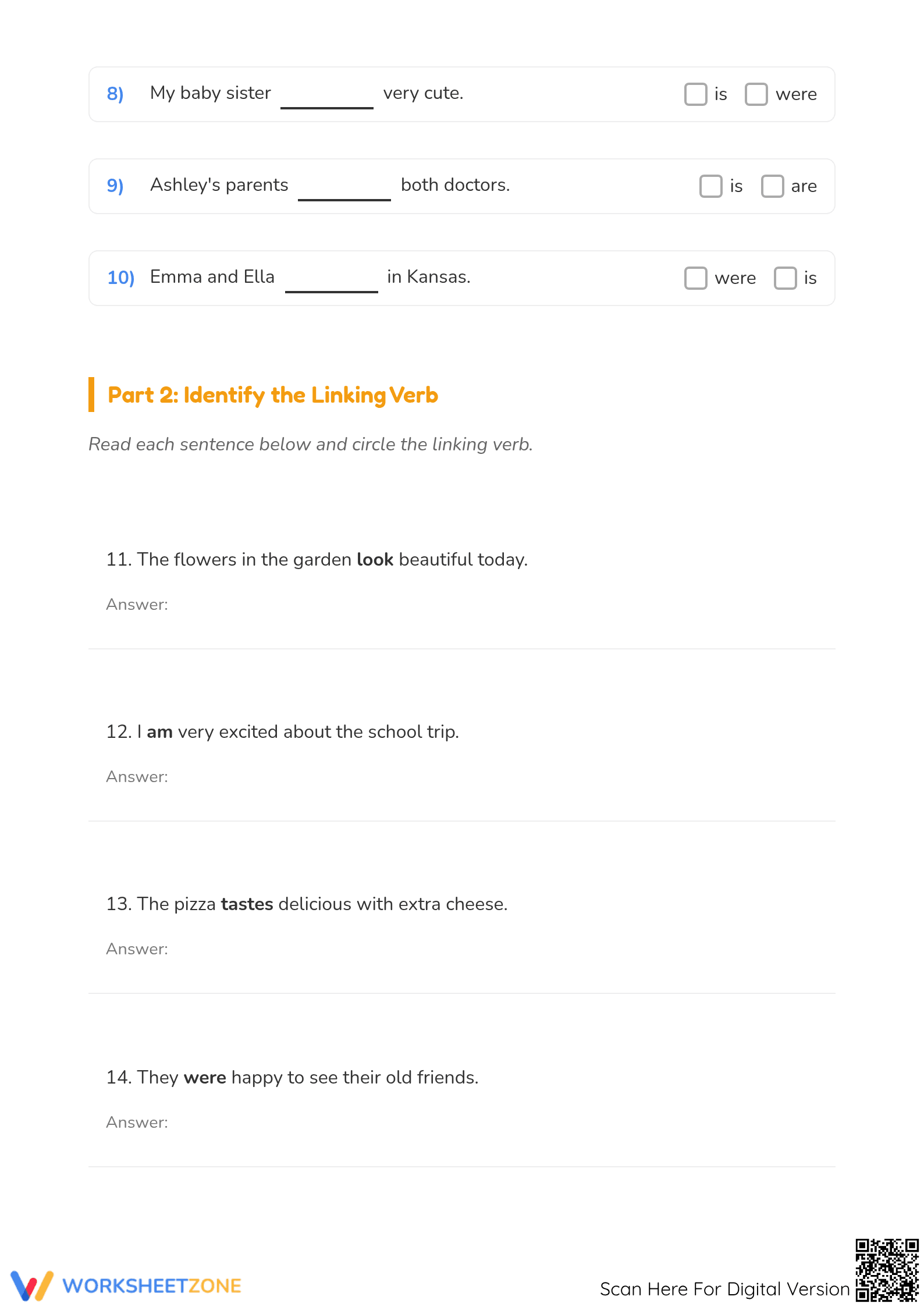
This three-page resource features a clear introductory definition and examples to anchor student understanding before they begin. The worksheet is divided into three distinct sections: a multiple-choice fill-in-the-blank activity, a sentence analysis task where students circle the correct verb, and a creative writing prompt. A complete answer key is provided for quick grading or self-assessment.
- Guided practice: The first 10 problems provide heavy scaffolding, requiring students to simply check the correct linking verb (such as is, are, was, or were) to complete a provided sentence.
- Supported practice: The next 5 problems ask students to read complete sentences and independently identify and circle the linking verb without multiple-choice options.
- Independent practice: The final 2 tasks challenge students to generate their own original sentences using linking verbs, demonstrating full conceptual mastery.
This gradual-release approach ensures students build confidence as they move from recognition to application.
This resource is strictly aligned to CCSS.ELA-LITERACY.L.3.1.A, requiring students to explain the function of nouns, pronouns, verbs, adjectives, and adverbs in general and their functions in particular sentences. By focusing specifically on linking verbs, students learn how these words connect subjects to their predicates rather than showing action. Both standard codes can be copied directly into lesson plans, IEP goals, or district curriculum mapping tools.
Deploy this worksheet immediately following a direct instruction mini-lesson on verbs. It serves perfectly as independent seatwork while the teacher pulls small groups for targeted reading intervention. Alternatively, use the first page as guided practice during whole-class instruction, assigning the remaining pages for homework. As a formative assessment tip, review the final two original sentences to quickly gauge which students have internalized the concept versus those who are still relying on action verbs.
This resource is designed for second and third-grade general education students, though it serves as an excellent remediation tool for fourth graders struggling with sentence structure. The clear, uncluttered layout and explicit examples make it highly accessible for English Language Learners (ELLs) who need explicit grammar instruction. Pair this worksheet with a classroom anchor chart detailing common linking verbs for maximum instructional impact.
Mastering grammar conventions is a critical component of early literacy development and foundational writing skills. According to a recent ScienceDirect TpT Analysis, explicit grammar instruction that isolates specific parts of speech significantly improves students' syntactic awareness and overall writing quality in elementary classrooms. This targeted resource aligns directly with CCSS.ELA-LITERACY.L.3.1.A, which requires students to explain the function of verbs in particular sentences. By isolating linking verbs, young learners develop a much more nuanced understanding of how sentences are constructed, moving beyond simple action verbs to accurately express states of being and complex relationships between subjects and predicates. Structured, sequential practice that transitions smoothly from basic identification to independent application ensures these essential grammatical concepts are firmly embedded in a student's working memory, ultimately leading to more sophisticated, accurate, and expressive written communication across all academic subjects.


