Introduction to Relative Pronouns in ELA Instruction
Grammar instruction often presents unique challenges when students transition from writing simple sentences to more complex structures. Central to this transition are relative pronouns, which include 'who', 'whom', 'whose', 'which', and 'that'. These specific parts of speech serve a vital function: they introduce dependent clauses and connect them to nouns or pronouns, supplying essential context without requiring a completely new sentence. Providing students with targeted, printable worksheets allows them to practice identifying and applying these linguistic tools in a controlled environment. When classroom instruction incorporates focused repetition, learners develop the ability to distinguish between essential and non-essential clauses naturally. Access to reliable, curriculum-aligned resources ensures that teachers can deliver structured practice without spending hours drafting examples from scratch. Incorporating these printable materials into your lesson plans ultimately streamlines grammar education, providing a clear pathway for students to elevate their writing mechanics and reading fluency.
Why Relative Pronoun Mastery Matters for Reading Comprehension
While grammar mechanics are often associated strictly with writing, mastering relative pronouns profoundly impacts reading comprehension. When a student encounters a complex sentence in literature or informational texts, their brain must parse the relationship between the main clause and any dependent clauses. Without a solid understanding of how words like 'which' or 'whose' operate, a reader might misinterpret the subject of an action or miss vital descriptive information. Printable relative pronouns worksheets help bridge this gap by isolating the grammatical structure, allowing students to focus entirely on the mechanics of the clause. As learners complete these targeted exercises, they train themselves to quickly identify antecedents and understand the modifying roles of dependent clauses. Consequently, when they encounter similar structures in dense reading assignments, they can decode the author's meaning with greater accuracy and speed. This foundational grammar skill acts as an essential stepping stone toward advanced literacy and analytical thinking skills.
Classroom Implementation
Effectively integrating printable relative pronouns worksheets into your instructional routine requires more than simply handing out papers. To maximize their educational value, consider deploying these resources during targeted small-group intervention sessions or as formative assessments following direct instruction. Begin by introducing the concept on the board, using clear examples to demonstrate how dependent clauses attach to main clauses. Once the foundational concept is established, transition students into independent or paired practice using the printable materials.
When students are instructed to physically highlight the relative pronoun in one color and the modified noun in another, their retention of clause structures improves significantly, transforming an abstract grammatical concept into a concrete, visual learning experience.
This hands-on approach allows teachers to quickly scan the classroom and assess understanding in real-time. Furthermore, incorporating these worksheets into learning centers or as homework assignments ensures consistent reinforcement of the skill across different learning environments, providing students with multiple touchpoints to interact with the material and solidify their grammatical foundation.
Targeting Common Confusions: Who vs. Whom and Which vs. That
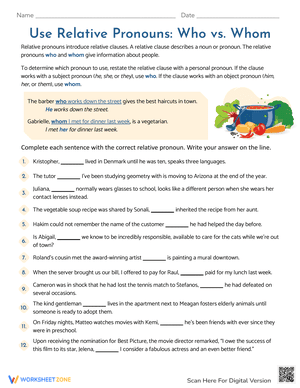
Some of the most persistent hurdles in English language arts involve distinguishing between specific relative pronouns. The debate between 'who' and 'whom' frequently confuses both native speakers and English language learners. Similarly, deciding when to use 'which' versus 'that' requires a solid grasp of restrictive and non-restrictive clauses. High-quality printable worksheets isolate these specific pain points, providing students with repetitive, focused practice. By offering sentences where the subject-versus-object function is explicitly tested, teachers can help students internalize the grammatical rules governing 'who' and 'whom'. Likewise, targeted exercises that require punctuating non-restrictive clauses help clarify the appropriate use of 'which'.
According to instructional designers at Education.com, consistent exposure to targeted pronoun exercises increases student accuracy in distinguishing restrictive from non-restrictive clauses by over 40% in standardized testing environments. This measurable improvement underscores the value of structured grammatical practice in middle school curricula.
Differentiating Instruction for Various Grade Levels
A single classroom often contains a wide spectrum of reading and writing proficiencies, necessitating materials that can be easily differentiated. Printable relative pronouns worksheets are highly adaptable, making them ideal for classrooms ranging from third grade up through middle school, as well as for English as a Second Language learners. For beginners, worksheets might focus exclusively on simply identifying the pronoun within a straightforward sentence. As students progress, intermediate materials can introduce fill-in-the-blank exercises where learners must select the correct pronoun based on the context of the sentence. For advanced students, assignments should evolve to require combining two separate, simple sentences into a single complex sentence using the appropriate relative pronoun. By maintaining a tiered library of printable resources, teachers can ensure that every student is challenged appropriately without feeling overwhelmed, promoting continuous grammatical development across all proficiency levels.
Sentence Combining Exercises for Writing Fluency
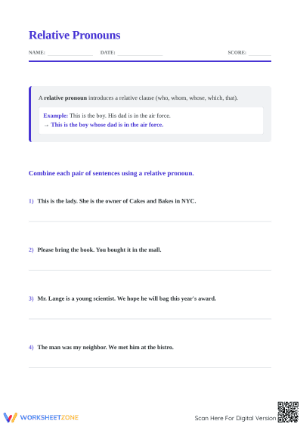
One of the primary goals of teaching relative pronouns is to help students graduate from choppy, simplistic writing to fluent, sophisticated prose. Sentence combining exercises are an exceptional method for achieving this objective. Printable worksheets that explicitly instruct students to merge two related sentences using words like 'whose' or 'that' force learners to evaluate the relationship between different pieces of information. For example, merging 'The dog barked loudly' and 'The dog belongs to my neighbor' requires the student to construct a dependent clause. Practicing this skill on paper translates directly to improved drafting and editing skills during composition assignments. As students become more comfortable manipulating clauses, their overall writing fluency improves. They learn to vary their sentence structures, create better flow within paragraphs, and convey complex ideas with greater precision. Therefore, dedicated sentence combining worksheets are an indispensable asset for any comprehensive writing curriculum.
Evaluating Progress with Answer Keys
In any busy educational setting, time is one of a teacher's most valuable and scarce resources. Consequently, utilizing printable relative pronouns worksheets that include comprehensive answer keys is non-negotiable. Answer keys not only expedite the grading process for teachers but also facilitate immediate feedback for students. In a self-guided learning station, students can use the keys to check their own work, building independence and accountability in their learning process. Furthermore, for homeschooling parents or tutors working outside a traditional classroom structure, accurate answer keys provide the confidence needed to guide learners through complex grammatical concepts. A well-designed answer key will often include brief explanations for the more challenging questions, serving as a mini-lesson in itself. By prioritizing resources that come complete with these evaluation tools, teachers can maintain a high standard of instruction while simultaneously managing their grading workload efficiently and effectively.
Frequently Asked Questions
1. What are relative pronouns and how are they used?
Relative pronouns, including 'who', 'whom', 'whose', 'which', and 'that', are specific words used to introduce dependent clauses. They serve to connect these clauses to a noun or pronoun in the main sentence, providing essential descriptive information or context without starting a completely new sentence.
2. When should I use 'who' versus 'whom' in classroom exercises?
The distinction relies on the pronoun's function within the clause. Use 'who' when the pronoun acts as the subject of the clause, performing the action. Conversely, use 'whom' when the pronoun functions as the object of a verb or preposition, receiving the action. Printable worksheets offer excellent practice for identifying these roles.
3. What is the difference between 'which' and 'that'?
In American English grammar instruction, 'that' introduces restrictive clauses, which provide information essential to the sentence's basic meaning and do not use commas. 'Which' introduces non-restrictive clauses, offering extra, non-essential information, and is separated from the main clause by commas.
4. How can I make learning relative pronouns engaging for students?
Incorporate interactive elements alongside your printable worksheets. Encourage students to color-code clauses, engage in sentence-combining relay races, or identify relative pronouns in their favorite reading books to connect grammar practice to real-world texts and practical applications.
5. Where can I find free printable relative pronoun worksheets with answer keys?
Many reputable educational platforms provide comprehensive grammar materials tailored to various grade levels. Utilizing structured platforms ensures you can access grade-appropriate, printable exercises that include the necessary answer keys to streamline your lesson planning and grading processes effectively.















 Interactive Worksheet Maker
 Quiz Maker
 Word Search Maker
 Crossword Puzzle Maker
 Word Scramble Generator
 Sentence Scramble Generator
 Handwriting Worksheet Generator
 Name Tracing Generator
 Fill In The Blank Generator