Understanding the Four Core Demonstrative Pronouns
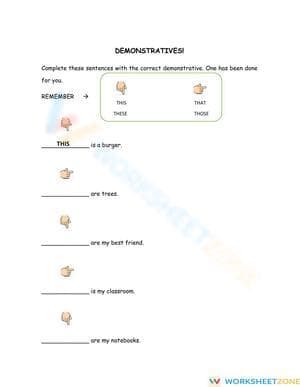
Demonstrative pronouns are essential tools in English grammar that help speakers and writers point to specific people, places, or things. The four primary examples include:
- This: Refers to a single item physically or conceptually nearby.
- That: Refers to a single item located farther away.
- These: Refers to multiple items that are close to the speaker.
- Those: Refers to multiple items positioned at a distance.
Mastering these words is a fundamental step for early learners and English language learners as they build sentence structure skills. When teachers introduce these concepts, they establish a foundation for clear communication.
The distinction between these four words relies on two main factors: number and proximity. This and that are singular, referring to one specific item. These and those are plural, indicating multiple items. Proximity determines whether to use the near forms or the far forms. Providing students with a demonstrative pronouns worksheets ensures they can practice these rules through guided, repetitive exercises.
Visual aids are incredibly helpful when teaching this concept. Because these words depend on the physical or metaphorical distance between the speaker and the object, using pictures or physical gestures during the lesson can make the abstract rules more concrete. Combining visual instruction with targeted written practice helps cement the knowledge in a young learner's mind.
Why Practice with Demonstrative Pronouns worksheets Matters
Providing structured practice is vital for young minds acquiring new language rules. A demonstrative pronouns worksheets gives teachers a ready-to-use resource that can be deployed for morning work, independent practice, or homework. Printable resources offer a tactile experience that digital platforms sometimes lack, allowing students to circle, underline, and actively engage with the text on the page.
Repetition is a proven strategy in grammar instruction. When students see multiple sentences requiring them to choose between near and far descriptors, they begin to internalize the proximity rule naturally. Carefully designed worksheets incrementally increase in difficulty, starting with simple picture-matching and moving toward writing original sentences using the correct demonstrative pronoun.
Furthermore, printable PDFs are highly accessible for all classroom environments. Whether you are working in a fully equipped modern classroom or a resource-limited setting, a printed worksheet requires no internet connection or specialized device during the lesson. This reliability makes PDF resources a staple in an educator's toolkit, ensuring every student gets the practice they need.
Common Challenges for ESL and Elementary Learners
English language learners often face specific hurdles when encountering these words. Many languages do not distinguish between near and far objects in the same way English does, or they might not require the pronoun to agree in number with the noun it replaces. As a result, ESL students might default to using a single term for everything, regardless of distance or quantity.
Elementary students, particularly those in kindergarten through second grade, might struggle with the abstract nature of distance. While pointing to a book on their desk and labeling it is intuitive, understanding that a bird in the sky requires a different identifier can be conceptually difficult. Teachers must provide abundant examples to clarify these spatial relationships.
Another common point of confusion is distinguishing between demonstrative pronouns and demonstrative adjectives. While the words are identical, their function in a sentence changes. A demonstrative pronoun stands alone, as in "That is my favorite book." A demonstrative adjective modifies a noun, as in "That book is my favorite." Clear instruction and focused exercises can help resolve this confusion.
Classroom Implementation
Integrating these printables into your daily lesson plans can be highly effective when done strategically. Begin with a whole-class direct instruction session, using physical objects in the room to demonstrate near and far relationships. After the concept is introduced, distribute the worksheets for guided practice, walking around the room to offer immediate feedback.
Small group intervention is another excellent setting for these resources. For students who are struggling with the singular and plural distinctions, a teacher-led small group can work through a worksheet together. This setting allows for rich discussion about why a specific word is the correct choice, building deeper comprehension.
When students physically sort objects before applying the grammar rules on paper, their retention improves significantly. Using a hands-on sorting activity where children place items into near and far bins helps bridge the gap between physical reality and abstract grammar concepts found on the page.
Finally, consider using a demonstrative pronouns worksheets as an assessment tool. A short, five-question printable can serve as an excellent exit ticket at the end of a lesson. This quick check for understanding allows teachers to adjust their instruction for the following day based on concrete data from the students' performance.
Differentiated Activities for Singular and Plural Mastery
Differentiation is key to meeting the needs of a diverse classroom. For learners who need foundational support, worksheets that feature large, clear images alongside simple sentences are ideal. These students benefit from activities where they only need to circle the correct word out of two choices, minimizing the cognitive load while isolating the grammar skill.
For students operating at grade level, fill-in-the-blank exercises offer an appropriate challenge. These worksheets require the student to read the context clues within the sentence to determine both the number and the distance of the object. This type of practice reinforces reading comprehension alongside grammar mechanics.
Advanced learners can be challenged with sentence-writing prompts. Providing a picture and asking the student to write a complete sentence using a specific demonstrative pronoun tests their ability to synthesize multiple language skills simultaneously. This open-ended practice prepares them for more complex writing tasks in the future.
Transitioning from Adjectives to Pronouns
Teaching the dual nature of these words is an important step in advanced grammar instruction. As students master the basic rules, teachers must introduce their function as adjectives. This transition requires clear examples and consistent practice to ensure students understand the structural differences in the sentences.
A helpful strategy is to have students rewrite sentences, changing the word from an adjective to a pronoun. For example, changing "These shoes are dirty" to "These are dirty shoes." This manipulation of language helps students see the flexibility of the words and deepens their understanding of English syntax.
According to a 2026 linguistic analysis by Grammarly, students who practice syntactic manipulation exercises show a forty percent improvement in identifying the functional difference between demonstrative pronouns and demonstrative adjectives (Grammarly, 2026). This evidence highlights the necessity of providing targeted practice that challenges students to reconstruct sentences rather than simply filling in blanks.
Assessing Student Progress with Formative Tools
Formative assessment provides teachers with ongoing feedback to inform instruction. Using targeted worksheets as formative checks allows teachers to pinpoint exactly where a student's understanding is breaking down. Are they struggling with singular versus plural, or is the near versus far concept causing the confusion?
Grading these assignments should go beyond simply marking answers right or wrong. Analyzing the pattern of errors can reveal specific misconceptions. If a student consistently uses plural forms instead of singular forms, they may have misunderstood the basic quantity rule. This detailed data is invaluable for planning subsequent lessons.
Maintaining a portfolio of a student's grammar worksheets over time offers a clear picture of their growth. Sharing these printables during parent-teacher conferences provides tangible evidence of the student's progress and areas needing reinforcement at home, creating a strong school-to-home connection.
Frequently Asked Questions
1. What is a demonstrative pronoun?
A demonstrative pronoun is a word used to point to specific people or things, indicating their proximity and number. The four primary examples in English are this, that, these, and those. They replace nouns in a sentence to avoid repetitive language.
2. When do I use this versus that?
Use this when referring to a single item that is physically or conceptually near to the speaker. Use that when referring to a single item that is farther away. Distance is the key differentiating factor between these two singular pronouns.
3. What is the difference between these and those?
These refers to multiple items that are close to the speaker, while those refers to multiple items located farther away. Both are plural forms, but their usage depends entirely on the proximity of the objects being discussed.
4. Can a demonstrative pronoun be used to talk about people?
Yes, they can be used to refer to people in specific contexts, such as introductions. For example, you might say, "This is my friend, Sarah," or "Those are the new students." However, they are most commonly used for objects.
5. What is the difference between a demonstrative pronoun and a demonstrative adjective?
A demonstrative pronoun replaces a noun entirely, standing alone in the sentence structure, as seen in "That is beautiful." A demonstrative adjective modifies a noun that immediately follows it, as demonstrated in the phrase "That painting is beautiful."















 Interactive Worksheet Maker
 Quiz Maker
 Word Search Maker
 Crossword Puzzle Maker
 Word Scramble Generator
 Sentence Scramble Generator
 Handwriting Worksheet Generator
 Name Tracing Generator
 Fill In The Blank Generator