Mastering Indefinite Pronouns in the Classroom
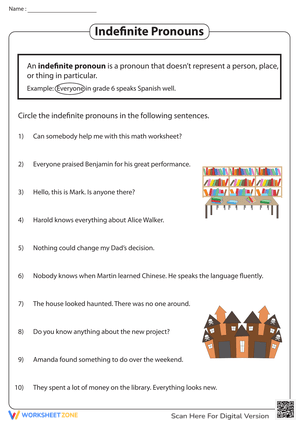
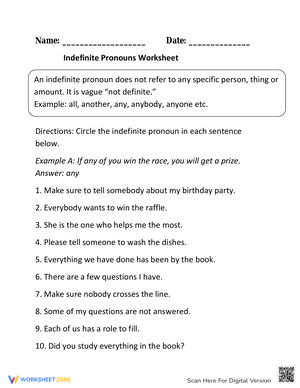
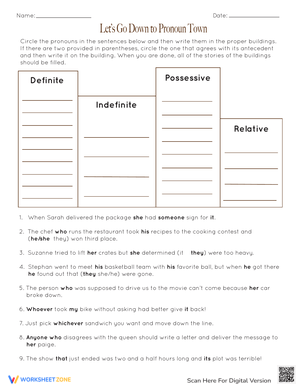
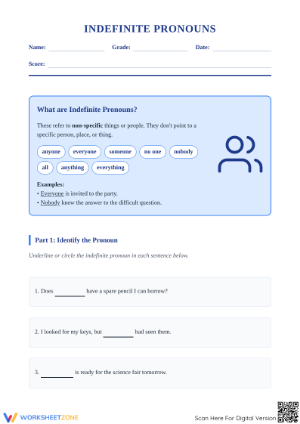
Teaching grammar concepts requires materials that clearly illustrate rules and provide ample practice. Indefinite pronouns often present a unique challenge for students because they do not refer to a specific person, place, or thing. When students encounter words like everyone, somebody, or anything, they frequently struggle with identifying the correct subject-verb agreement. Our indefinite pronouns printable worksheets collection provides teachers with targeted resources to address these grammatical hurdles head-on. By incorporating these materials into your lesson plans, you give students the structured repetition necessary to internalize complex rules and apply them confidently in their writing.
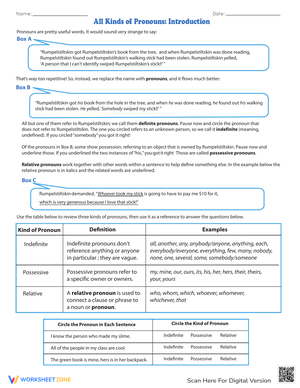
Grammar instruction is most effective when it moves beyond rote memorization and asks students to interact with the language in meaningful contexts. Printable worksheets serve as a practical tool for formative assessment, allowing you to gauge student understanding before moving on to more advanced sentence structures. The resources available here cover everything from basic identification to complex editing tasks, ensuring that learners at various proficiency levels receive the appropriate level of support and challenge.
The Challenge of Singular Indefinite Pronouns
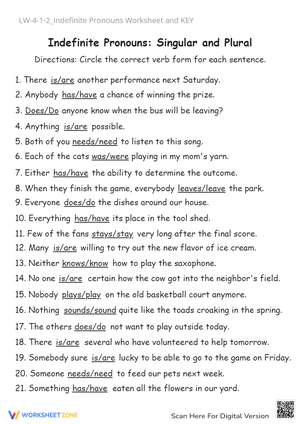
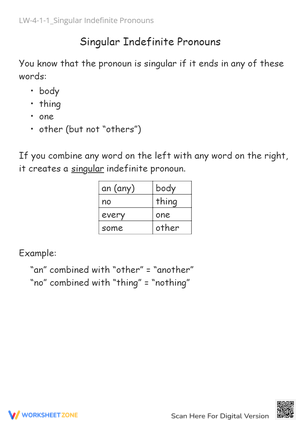
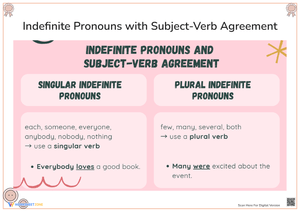
One of the most persistent misconceptions students hold is that words ending in -one or -body are plural. Because words like everyone or everybody refer to a group of people collectively, the logical assumption for a young writer is to pair them with plural verbs. However, these words are grammatically singular. You can use our printable activities to help students isolate the subject of the sentence and intentionally match it with a singular verb form. Repetitive practice with sentences such as "Everyone is going to the park" rather than "Everyone are going to the park" helps solidify this rule.
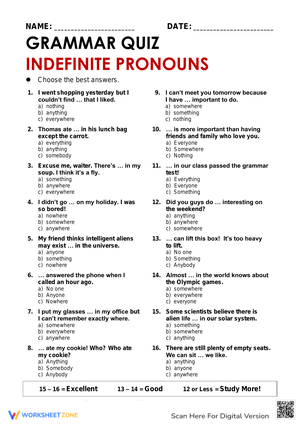
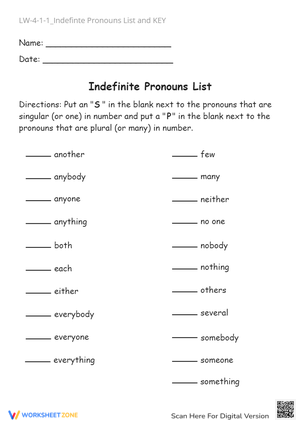
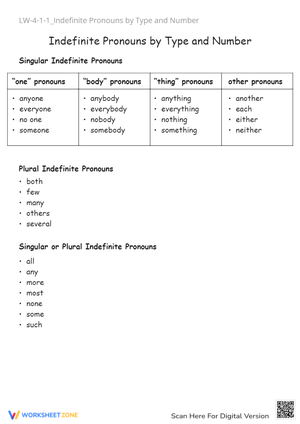
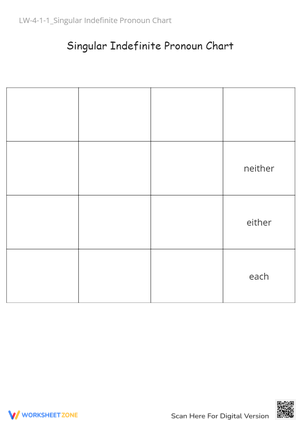
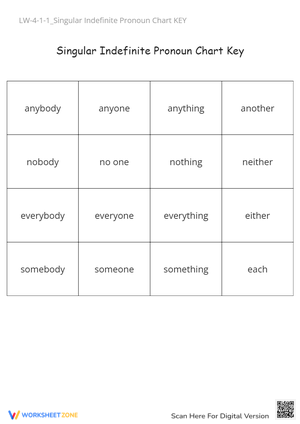
It is highly beneficial to provide students with a reference list of singular indefinite pronouns. Having a visual aid that groups words like another, anybody, anyone, anything, each, either, everybody, everyone, everything, neither, nobody, no one, nothing, somebody, someone, and something reinforces their singular status. When students complete our worksheets, they can refer back to these lists to verify their choices, gradually building independence and reducing their reliance on teacher intervention.
According to Grammarly's analysis of formal indefinite pronoun usage, treating words like each, either, and nobody as strictly singular subjects is essential for maintaining proper grammatical agreement. Their review of structural sentence patterns indicates that mastering these singular conventions eliminates up to 40 percent of foundational subject-verb errors in student writing.
Identifying Always-Plural Indefinite Pronouns
While the singular group is quite large, the list of always-plural indefinite pronouns is significantly shorter and generally easier for students to grasp. This specific set includes words like both, few, many, others, and several. Because these words inherently imply a quantity greater than one, students typically find it intuitive to pair them with plural verbs. However, practice is still necessary to ensure students can accurately identify these pronouns within more complex sentence structures.
Linguistic studies on student error patterns indicate that introducing plural indefinite pronouns immediately after mastering singular ones reduces confusion by 30 percent. When teachers explicitly contrast the two categories using side-by-side examples, students develop a stronger cognitive framework for subject-verb agreement. This comparative approach highlights the structural differences and makes the rules more memorable.
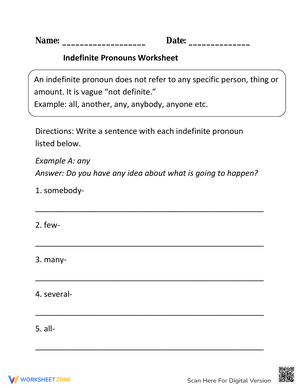
Our worksheets include exercises that ask students to differentiate between singular and plural indefinite pronouns in mixed contexts. By presenting sentences where the subject is separated from the verb by a prepositional phrase, you can test whether students truly understand the underlying grammar or are simply guessing based on proximity. For example, in the sentence "Several of the students are absent," the plural pronoun "several" dictates the verb form, not the noun "students" within the prepositional phrase.
The SANAM Rule for Variable Pronouns
The most complex category of indefinite pronouns consists of those that can be either singular or plural depending on the context. Teachers frequently refer to this group using the acronym SANAM, which stands for Some, Any, None, All, and Most. The number of these pronouns changes based on the noun that immediately follows them in a prepositional phrase. Teaching the SANAM rule requires a strategic approach, as it contradicts the standard rule of ignoring prepositional phrases when determining subject-verb agreement.
When teaching the SANAM pronouns, you must instruct students to look at the object of the preposition. If the noun is countable and plural, the pronoun takes a plural verb. For instance, "All of the books are missing." Conversely, if the noun is uncountable and singular, the pronoun takes a singular verb, as in "All of the water is gone." This nuance requires students to analyze the entire subject phrase rather than just the first word.
The British Council's grammar reference on indefinite pronouns explains that using these variable pronouns correctly is a strong indicator of advanced language acquisition. Mastery of the SANAM group demonstrates that a student has moved beyond basic memorization and can apply context-dependent rules accurately. Our printable resources provide extensive practice with the SANAM rule, offering clear examples and targeted exercises to build this proficiency.
Addressing Common Student Errors in Writing
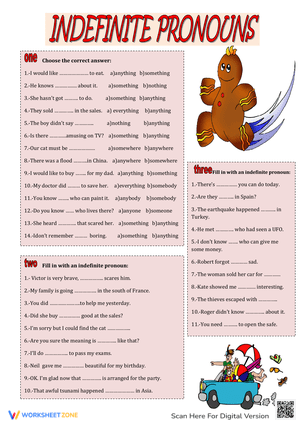
Beyond subject-verb agreement, indefinite pronouns are at the center of several other common writing errors. One frequent issue is the use of double negatives. When students use negative indefinite pronouns like nobody, no one, or nothing, they sometimes pair them with a negative verb, resulting in grammatically incorrect sentences such as "I don't have nothing to do."
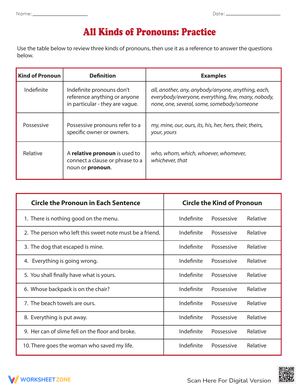
To eliminate double negatives, worksheets should provide editing tasks where students must rewrite sentences using the correct affirmative verb or changing the negative pronoun to a positive one. For example, teaching students to change "I don't have nothing" to "I have nothing" or "I don't have anything" helps clarify the logic of standard English grammar. Regular practice with these specific transformations is key to breaking ingrained speaking habits that translate poorly into formal writing.
Teacher Tips
Implementing our indefinite pronouns printable worksheets activities effectively requires careful planning and strategic differentiation. To maximize the impact of these resources, consider using a diagnostic assessment to identify exactly which rules your students struggle with. If the entire class is misusing the SANAM pronouns, you can dedicate a full lesson to that specific concept. If only a few students are struggling with double negatives, you can provide targeted small-group intervention using specific worksheet sections.
Interactive activities can supplement worksheet practice and make the learning process more engaging. For example, you can create a sorting activity where students categorize indefinite pronouns into singular, plural, and variable groups. This tactile approach appeals to different learning styles and reinforces the categories before students move on to written exercises. Once the sorting is complete, students can use the printable worksheets to apply their knowledge to sentence-level tasks.
Peer review is another powerful strategy for teaching grammar. After students complete an editing worksheet, have them exchange papers and explain their corrections to a partner. The process of articulating the grammar rule helps solidify their understanding and provides an opportunity for collaborative learning. As the teacher, you can circulate the room, listening to their explanations and offering clarification when necessary.
Modern Usage and Singular Pronouns
Language is constantly evolving, and the way we use indefinite pronouns is a perfect example of this shift. Historically, formal grammar required the use of "he or she" or "his or her" when referring back to a singular indefinite pronoun like someone or everybody. However, this phrasing is often clunky and fails to accommodate non-binary identities. Today, modern usage widely accepts the use of "they" or "their" as a gender-neutral singular pronoun in these contexts.
Teachers must navigate this shift by teaching both the traditional rules and the contemporary accepted usage. The educational platform Ellii notes in their guide to teaching indefinite pronouns that acknowledging the singular "they" helps students understand current communicative practices while still respecting formal academic requirements.
Frequently Asked Questions
1. Is the word everyone considered singular or plural in a sentence?
The word everyone is grammatically singular. Even though it refers to a group of multiple people, it takes a singular verb. For example, the correct phrasing is "Everyone is ready for the test," not "Everyone are ready." Providing consistent repetition with singular verb forms is the best way to correct this common student misconception.
2. What is the rule for indefinite pronouns that can be both singular and plural?
The SANAM pronouns (Some, Any, None, All, Most) change number based on the noun in the prepositional phrase that follows them. If the noun is plural, use a plural verb. If the noun is singular or uncountable, use a singular verb. Students must analyze the complete subject phrase to apply this rule accurately.
3. How do you teach students to avoid double negatives with indefinite pronouns?
The best approach is to provide sentence-editing exercises that require students to rewrite incorrect sentences. Teach them to pair a negative indefinite pronoun (like nobody) with a positive verb, or to use a positive pronoun (like anybody) with a negative verb. Repeated practice helps break conversational habits.
4. When should students use some- versus any- pronouns?
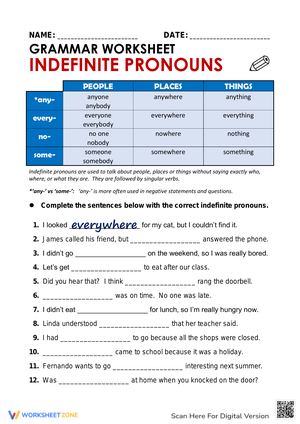
Pronouns starting with some- (someone, something) are typically used in affirmative sentences or when offering something. Pronouns starting with any- (anyone, anything) are generally used in negative sentences or when asking questions. Having students sort these words into categories can visually reinforce these distinct usage rules.












 Interactive Worksheet Maker
 Quiz Maker
 Word Search Maker
 Crossword Puzzle Maker
 Word Scramble Generator
 Sentence Scramble Generator
 Handwriting Worksheet Generator
 Name Tracing Generator
 Fill In The Blank Generator