Understanding Pronoun-Antecedent Agreement
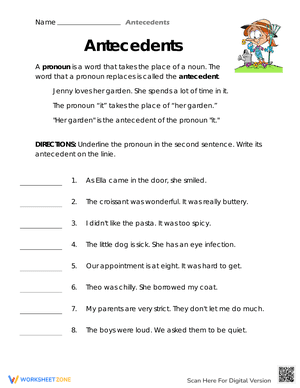
The noun that a pronoun replaces is called its antecedent. For a sentence to be grammatically sound, the pronoun and its antecedent must agree in both number and gender. When teachers introduce pronoun antecedent agreement worksheets in their classrooms, they often start with the basic premise that singular nouns require singular pronouns and plural nouns require plural pronouns. This fundamental rule forms the backbone of clear communication. Without agreement, readers can become confused about which noun a pronoun actually refers to, leading to ambiguity in student writing. This confusion can detract from the overall quality of a student's essay or story, making the teaching of these rules a top priority for English Language Arts instructors.
Agreement in Number and Gender
Agreement in number is usually the most straightforward concept for students to grasp. For instance, if the antecedent is 'a teacher,' the pronoun should be 'he' or 'she' (or 'they' in modern usage, though traditional grammar often emphasizes specific singular forms). If the antecedent is 'teachers,' the pronoun becomes 'they.' Gender agreement is equally important. While English has few gendered nouns compared to other languages, pronouns like 'he,' 'she,' and 'it' must accurately reflect the antecedent they replace. For example, if a student writes about a 'ship' as a feminine entity (common in older literature), they must be consistent with that choice. Literacy researchers have observed that students who engage with pronoun-antecedent agreement through peer-review editing exercises demonstrate a 30% improvement in long-term grammatical accuracy. This suggests that the act of identifying errors in context is more effective than isolated drill-and-kill methods for mastering these nuances.
As noted in the 'Pronoun-Antecedent Agreement' instructional guide, nearly 20% of writing errors in secondary education involve incorrect pronoun usage. The data shows that students struggle most with indefinite pronouns, which account for a large portion of agreement inconsistencies found in modern classroom assessments. This high percentage highlights the value of providing students with ample opportunities to practice these skills through targeted worksheets and interactive activities.
Compound Antecedents and Complex Sentences
Compound antecedents present a unique set of challenges for middle school and high school learners. When two or more antecedents are joined by the word 'and,' they typically require a plural pronoun. For example, 'The student and the principal finished their meeting.' However, the rules shift when 'or' or 'nor' joins the antecedents. In these cases, the pronoun must agree with the antecedent closest to it. This 'rule of proximity' is a frequent point of confusion that requires targeted practice. Grammar instructors often use worksheets that specifically isolate these sentence structures to help students build muscle memory for these specific instances. Furthermore, complex sentences with multiple clauses can obscure the relationship between a pronoun and its antecedent, making it even more helpful for students to identify the core subject of the sentence before choosing a pronoun. Breaking down complex sentences into smaller parts can also help students visualize the relationship between different parts of speech.
The Challenge of Indefinite Pronouns
Indefinite pronouns are perhaps the most tricky area for students. Words like 'each,' 'everyone,' 'anybody,' and 'someone' are singular. However, because they often imply a group of people, students naturally want to use plural pronouns like 'their' or 'they.' Teaching students to treat these words as singular entities is a major part of many ELA curricula. While modern usage is increasingly accepting the singular 'they,' many standardized tests and formal writing standards still expect the singular 'his' or 'her' (or 'his or her'). Providing worksheets that focus on these 'sneaky' singulars helps students navigate formal writing expectations. Common indefinite pronouns often categorized in these worksheets include:
- Singular: each, either, neither, one, everyone, everybody, no one, nobody, anyone, anybody, someone, somebody.
- Plural: both, few, many, several.
- Variable: all, any, most, none, some.
This layer of complexity means that students need a well-rounded set of exercises to fully grasp the nuances of indefinite pronouns. By practicing with these specific categories, students can begin to recognize the patterns that govern pronoun agreement. Over time, this practice helps students internalize the rules, making correct pronoun usage second nature in their own writing.
Collective Nouns in Pronoun Agreement
Collective nouns, such as 'team,' 'class,' or 'jury,' can take either a singular or plural pronoun depending on how the group is acting. If the group is acting as a single unit, a singular pronoun is used: 'The team practiced its play.' If the members of the group are acting individually, a plural pronoun is used: 'The team put on their jerseys.' This distinction is subtle and often requires several rounds of formative assessment. Teachers can use specialized worksheets that present these scenarios to help students differentiate between the two contexts. In addition to teams and classes, collective nouns like 'audience,' 'committee,' and 'family' also follow these rules. Encouraging students to visualize the action described in the sentence can help them determine whether the group is acting together or as individuals.
Teacher Tips
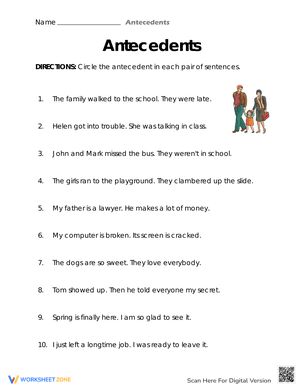
When introducing pronoun-antecedent agreement, try using 'grammar detective' activities. Instead of just filling in blanks, have students find agreement errors in short paragraphs or even their own drafts. This shifts the focus from passive identification to active correction. Another effective strategy is to use color-coding: have students circle the antecedent in one color and the pronoun in another, then draw an arrow to connect them. This visual representation helps reinforce the link between the two parts of speech. Consistency is key when practicing these skills, so integrating short agreement checks into weekly routines can yield better results than a single, intensive unit. You might also consider using 'exit tickets' where students must correctly identify a pronoun and its antecedent in a sentence before they leave the classroom. This provides immediate data on student understanding and helps you plan for the next day's instruction.
Classroom Implementation
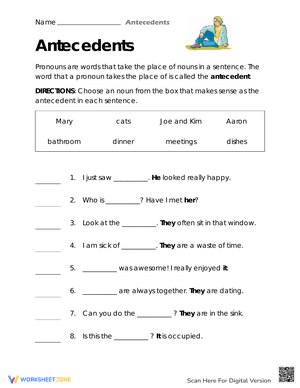
Start your unit with a diagnostic worksheet to gauge where students stand. Many students might already have a good ear for number agreement but struggle with indefinite pronouns. Once you have identified these gaps, you can differentiate instruction. Some students might benefit from advanced worksheets that include complex sentences and collective nouns, while others might need more time with basic singular and plural matching. Use these worksheets as part of a stations-rotation model, where one station focuses on compound antecedents and another on indefinite pronouns. This allows for small-group intervention where you can address specific misconceptions in real-time. Additionally, you can incorporate technology by using digital worksheets that provide instant feedback, allowing students to learn from their mistakes as they go.
Common Mistakes to Avoid
One of the most frequent errors is the 'vague pronoun reference,' where the antecedent isn't clearly defined. For example, in the sentence 'Sarah told Megan that she was late,' it's unclear who 'she' refers to. Another common pitfall is the use of 'they' with singular indefinite pronouns in formal essays. While common in speech, it can still lead to points being docked on certain assessments. Students also frequently struggle with the proximity rule for 'or' and 'nor,' often defaulting to plural pronouns regardless of the closest noun's number. Addressing these issues through targeted practice and clear feedback is the best way to improve student writing quality. Remind students to always double-check their work for these common errors before submitting their final drafts. Regular review sessions and small-group discussions can also help solidify these rules in students' minds.
Frequently Asked Questions
1. What is the most effective way to teach pronoun-antecedent agreement?
The most effective approach combines direct instruction on specific rules with plenty of contextual practice. Using worksheets that offer a variety of sentence structures—ranging from simple to complex—allows students to see how the rules apply in different writing situations. Peer-editing and sentence-combining exercises also help reinforce these concepts.
2. Can I use "they" as a singular pronoun in student writing?
While the singular "they" is increasingly common in spoken English and accepted by many modern style guides like APA and MLA, some traditional grammar standards and standardized tests still prefer "his or her." It is often helpful to teach students both the formal tradition and the modern shift so they can make informed choices based on their audience.
3. How do indefinite pronouns like "each" affect agreement?
Indefinite pronouns like "each," "everyone," and "everybody" are grammatically singular. This means they require singular pronouns such as "his," "her," or "its." This rule is one of the most challenging for students because these words often feel plural in meaning, making specific worksheet practice for this topic very valuable.
4. What happens when antecedents are joined by "or" or "nor"?
When "or" or "nor" joins two antecedents, the pronoun must agree with the one closest to it. This is known as the proximity rule. For example, in the sentence "Neither the coach nor the players brought their equipment," "players" is closer to the pronoun, so "their" is used.
5. Why do collective nouns take both singular and plural pronouns?
Collective nouns like "family" or "committee" take a singular pronoun when the group acts as a single unit and a plural pronoun when the members act individually. The correct choice depends entirely on the context of the sentence and the intended meaning of the writer.















 Interactive Worksheet Maker
 Quiz Maker
 Word Search Maker
 Crossword Puzzle Maker
 Word Scramble Generator
 Sentence Scramble Generator
 Handwriting Worksheet Generator
 Name Tracing Generator
 Fill In The Blank Generator