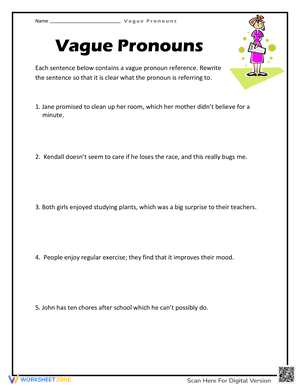
Understanding Vague Pronoun References
A vague pronoun occurs when the pronoun does not have a clear, specific antecedent. In many upper elementary and middle school classrooms, students frequently use pronouns like "it," "they," "this," "that," and "which" without clearly identifying the noun they replace. Writing clarity is significantly improved by replacing the vague pronoun with the specific noun it refers to. When pronoun references remain ambiguous, sentences become confusing or misleading for the reader. Using vague pronouns worksheets provides the targeted practice students need to recognize and correct these grammatical errors effectively.
When teachers introduce pronoun-antecedent agreement, it is essential to emphasize that readers cannot guess what the writer intends. Every pronoun must point directly to an unmistakable noun. If two possible nouns appear earlier in the sentence, the reader is left guessing. Providing clear, engaging practice materials helps master pronoun-antecedent agreement and resolve ambiguity. Regular practice with specific worksheets builds the muscle memory required to naturally edit and revise sentences for clarity during the drafting process.
Sentences with ambiguous references account for a significant portion of stylistic errors in early drafting. Resolving these issues early in a student's educational journey prevents ingrained poor writing habits. Engaging with targeted exercises allows students to manipulate sentences, substitute nouns, and see the immediate impact on readability. This foundational skill supports all future analytical writing, narrative essays, and expository compositions.
How to Detect and Fix Ambiguous Pronoun References
Detecting an ambiguous pronoun requires a careful review of the sentence structure and the preceding context. A practical method for students is to circle every pronoun in their paragraph and draw an arrow back to its antecedent. If the arrow points to two different nouns, or if there is no noun to point back to, the reference is ambiguous. Vague pronouns worksheets often feature exercises where students practice this exact visual mapping technique, reinforcing the connection between the pronoun and its noun.
Fixing these errors generally involves one of two strategies: replacing the pronoun with a specific noun or entirely rewriting the sentence. For instance, instead of saying "Take the radio out of the car and fix it," a student should write "Take the radio out of the car and fix the radio," or "Remove the radio from the car and repair the device." Repetitive practice with vague pronouns worksheets helps students internalize these correction strategies, making them automatic over time.
Instructors should guide students to read their work aloud. Hearing the words spoken often reveals ambiguity that the eye might skip over. When a sentence sounds disjointed or confusing, it is frequently due to a vague pronoun. By combining auditory review with structured worksheet exercises, teachers can provide a comprehensive approach to mastering pronoun clarity.
Commonly Confused Pronouns: It, They, This, That, Which
The pronouns "it," "they," "this," "that," and "which" are the most frequent culprits in ambiguous writing. Students often use "they" to refer to a general group of people without specifying who those people are, such as writing "They say it will rain tomorrow." Vague pronouns worksheets specifically target these common pitfalls, challenging students to replace "they" with "The meteorologists" or "The weather reporters." This shift transforms a vague statement into a precise, informative sentence.
Similarly, "this" and "that" are often used to summarize an entire preceding sentence or idea, which can leave the reader confused about which specific part of the idea is being referenced. For example, "The team lost the game, the bus broke down, and it rained. This made everyone miserable." Does "this" refer to the rain, the bus, or the loss? A clear correction would be, "This sequence of events made everyone miserable."
The pronoun "which" also presents unique challenges, particularly in complex sentences. Students might write, "She gave me a complicated puzzle, which I did not understand." It is unclear whether the puzzle itself or the act of giving it was not understood. Targeted exercises break down these sentences, prompting students to clarify their intended meaning. Mastery of these specific pronouns dramatically elevates the overall quality of student writing.
Top Examples of Vague Pronouns in Student Writing
Analyzing real-world examples is an excellent way to illustrate the impact of vague pronouns. In middle school writing, a common error looks like this: "When the teachers spoke to the parents, they were upset." Here, "they" could refer to either the teachers or the parents. Vague pronouns worksheets utilize these exact types of sentences, asking students to rewrite them for clarity. A corrected version might read, "The parents were upset when the teachers spoke to them," removing any doubt about who was experiencing the emotion.
Another frequent example involves the hidden antecedent. A student might write, "In the book, it says that the protagonist was brave." The pronoun "it" has no clear antecedent because "the book" is the object of a prepositional phrase, not the subject. Worksheets designed for grammar practice help students rephrase this to "The book states that the protagonist was brave." This direct approach eliminates the unnecessary pronoun and strengthens the sentence's voice.
Furthermore, students often struggle with implied nouns. For example, "My brother is a dentist, and this is the profession I want to pursue." While understandable, it is grammatically imprecise. Vague pronouns worksheets teach students to write, "My brother is a dentist, and dentistry is the profession I want to pursue." Reviewing these top examples provides clear, actionable templates that students can apply to their own original compositions.
Interactive Classroom Activities to Practice Pronoun Clarity
While worksheets are highly effective, pairing them with interactive classroom activities maximizes student engagement and retention. A highly successful approach involves peer-review workshops where students swap drafts and actively hunt for ambiguous pronouns. According to eReading Worksheets: Vague Pronoun Exercises, identifying errors in another person's writing is often easier than finding them in one's own work, and this practice builds critical analytical skills that transfer back to independent editing.
Another engaging activity is the "Pronoun Police" game. Teachers write sentences with vague pronouns on the board, and teams of students race to provide the clearest, most concise correction. This competitive element encourages quick thinking and collaborative problem-solving. Following up this activity with targeted vague pronouns worksheets solidifies the concepts discussed during the game, ensuring that the excitement of the activity translates into lasting grammatical mastery.
Teachers can also use sentence manipulation stations. At each station, students find a set of index cards with nouns, verbs, and pronouns. They must arrange the cards to form a sentence with an ambiguous pronoun, and then rearrange them or swap cards to fix the ambiguity. This tactile experience caters to kinesthetic learners and provides a visual representation of how sentence structure impacts clarity.
Teacher Tips
When implementing vague pronouns worksheets in your classroom curriculum, consistency and context are your most valuable tools. Rather than teaching pronoun clarity as an isolated unit, integrate it into your regular writing instruction. When students are drafting essays or reports, make checking for ambiguous pronouns a mandatory step in their editing checklist. This contextual application demonstrates the real-world value of the grammatical concepts they are learning.
According to a 2024 review by Grammarly: What Are Vague Pronouns?, approximately 42% of middle school writing submissions contained at least one ambiguous pronoun reference that severely impeded overall reading comprehension. This data suggests that addressing this common grammatical issue requires focused, repetitive practice using structured materials.
Additionally, always review the completed worksheets as a class. Discussing the different ways a sentence can be corrected highlights the flexibility of the English language. It shows students that there is often more than one "right" answer, provided the final sentence is clear and unambiguous. Use these discussions to praise creative, clear solutions and to gently correct lingering misunderstandings.
Frequently Asked Questions
1. What is the definition of a vague pronoun?
A vague pronoun is a pronoun that does not have a clear, specific, or singular antecedent in the sentence or surrounding text. This ambiguity leaves the reader guessing which noun the pronoun is meant to replace, leading to confusion and a lack of writing clarity.
2. How can I tell if a pronoun in my sentence is vague?
You can identify a vague pronoun by searching for its antecedent. If you cannot immediately point to the specific noun the pronoun refers to, or if there are two or more possible nouns that make sense, the pronoun is vague and the sentence requires rewriting.
3. What are some common examples of pronouns that often become vague?
The pronouns "it," "they," "this," "that," and "which" are the most common culprits. Writers frequently use them to refer to general ideas, implied nouns, or multiple subjects, creating ambiguous references that weaken the overall impact of the text.
4. Why is it important to fix vague pronouns in my writing?
Fixing vague pronouns is essential for maintaining clear communication. Ambiguous references force the reader to stop and decipher your meaning, which interrupts the flow of reading and can lead to misinterpretation of your intended message or argument.















 Interactive Worksheet Maker
 Quiz Maker
 Word Search Maker
 Crossword Puzzle Maker
 Word Scramble Generator
 Sentence Scramble Generator
 Handwriting Worksheet Generator
 Name Tracing Generator
 Fill In The Blank Generator