Mastering Consistency with Pronoun Shifts in Number and Person Worksheets
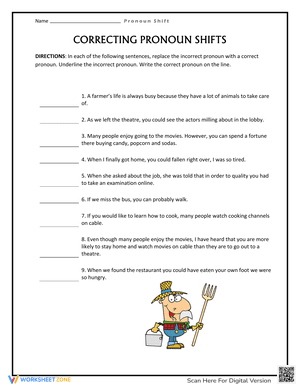
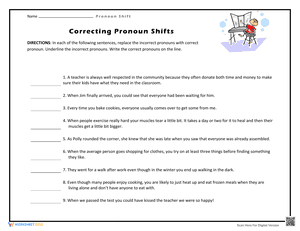
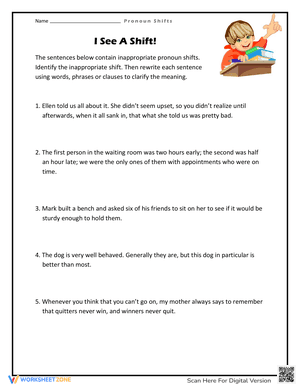
When a writer begins a sentence in one number or person and shifts to another without reason, the logic of the text breaks down, leaving the reader confused. Teachers often find that students struggle with these shifts because informal speech patterns frequently allow for looser pronoun agreement. However, formal writing requires strict adherence to consistency to ensure clarity and professionalism. Our collection of pronoun shifts in number and person worksheets provides the structured practice needed to identify these errors and rectify them before they become ingrained habits.
According to the Common Core State Standards Initiative, Grade 6 students are expected to recognize and correct inappropriate shifts in pronoun number and person under the L.6.1.C standard. This foundational skill ensures that over 90% of formal academic writing remains coherent and professional during the transition to middle school literacy. By focusing on these specific grammatical rules, teachers can help students build a strong foundation for the more advanced writing requirements of high school and beyond. Using targeted worksheets allows for repetitive practice, which is essential for mastering the nuances of pronoun-antecedent agreement in both number and person.
Understanding Inappropriate Shifts in Pronoun Number
A pronoun shift in number occurs when a pronoun does not agree in number with its antecedent. An antecedent is the noun or pronoun that the pronoun replaces or refers back to. If the antecedent is singular, the pronoun must be singular. If the antecedent is plural, the pronoun must be plural. Common errors often involve indefinite pronouns such as "everyone," "someone," or "nobody," which are grammatically singular but often feel plural in context. For example, a student might write, "Every student should bring their own lunch." While common in spoken English, traditional formal grammar suggests "his or her lunch" or restructuring the sentence to avoid the shift entirely.
Worksheets that target shifts in number help students recognize that consistency is key to logical flow. When a writer shifts from singular to plural mid-sentence, it creates a disconnect. For instance, in the sentence "If a person wants to succeed, they must work hard," the shift from the singular "a person" to the plural "they" is a common point of contention. While modern usage is evolving to accept the singular "they," many academic standards still require students to recognize this as a shift in number. Practice exercises that prompt students to rewrite these sentences for consistency are highly effective in reinforcing the rule that singular antecedents require singular pronouns.
Identifying Shifts in Pronoun Person
Shifts in person occur when the writer unnecessarily changes the point of view between first person (I, we), second person (you), and third person (he, she, it, they, one). These shifts are particularly common in persuasive or descriptive writing where a student might start by talking about people in general (third person) and suddenly address the reader directly (second person). An example of this error would be: "When one enters the library, you should remain quiet." The sentence starts with the third-person "one" but shifts to the second-person "you," creating an inconsistent perspective that can distract the reader from the intended message.
Our pronoun shifts in number and person worksheets focus on helping students maintain a steady point of view throughout their paragraphs. Teachers can use these resources to show students how to stick to the third person for formal essays or the first person for personal narratives. Correcting a shift in person often involves identifying the primary subject of the sentence and ensuring every subsequent pronoun aligns with that subject. For example, the incorrect sentence "If students study hard, you will get good grades" should be corrected to "If students study hard, they will get good grades." This alignment is vital for creating a cohesive and professional tone in academic work.
Teacher Tips for Navigating Grammar Instruction
Teaching pronoun consistency requires a mix of direct instruction and interactive practice. One effective strategy is to have students peer-edit each other's work specifically looking for pronoun shifts. By focusing on just one grammatical element at a time, students become more adept at spotting errors that they might otherwise overlook in their own writing. Additionally, teachers can create "pronoun shift hunts" using short paragraphs where several errors have been intentionally inserted. This gamified approach keeps students engaged while reinforcing the technical aspects of the CCSS.ELA-LITERACY.L.6.1.C standard.
Many middle school students struggle with pronoun shifts because their spoken English often uses "you" as a generic pronoun, which then bleeds into formal third-person writing styles during classroom assignments. Recognizing that this is a natural consequence of linguistic habits helps teachers approach the topic with more empathy. Instead of simply marking an error as wrong, teachers can explain the difference between the informal "universal you" used in conversation and the formal requirements of academic prose. This distinction helps students understand when and why consistency is required, making them more mindful writers in the long run.
Classroom Implementation of Pronoun Worksheets
Integrating pronoun shifts in number and person worksheets into your weekly curriculum can be done through various methods. Small-group interventions are ideal for students who consistently struggle with pronoun-antecedent agreement. During these sessions, the teacher can walk through specific examples, highlighting the antecedent and the pronoun to show where the shift occurs. For the whole class, worksheets can serve as a quick "bell-ringer" activity to start the period. Five minutes of focused practice each day can lead to significant improvements in writing clarity over the course of a semester.
Another approach is to use these worksheets as a formative assessment tool. By reviewing the completed exercises, teachers can identify which students have mastered the concept and which need further instruction. For advanced learners, worksheets that require paragraph-level revision are more appropriate than simple sentence-level corrections. These complex tasks challenge students to maintain consistency across multiple sentences, which is a key requirement for high-quality writing at the middle school level. Providing a variety of worksheet formats ensures that every student is met at their current level of understanding while being pushed toward mastery.
Strategies for Self-Correction and Revision
Empowering students to find and fix their own pronoun shifts is the ultimate goal of grammar instruction. Teachers should encourage students to read their work aloud, as the ear often catches inconsistencies that the eye misses. When a student hears themselves shift from "a writer" to "you," the error becomes more apparent. Instruction should also include lessons on how to restructure sentences to avoid the need for singular-to-plural shifts, such as making the antecedent plural from the start (e.g., "Writers must check their work" instead of "A writer must check their work").
Using the resources available on Worksheetzone, teachers can provide students with the tools they need for independent study. Our worksheets include clear definitions and examples that serve as a reference guide for students as they work through their revisions. By internalizing the rules of pronoun consistency, students become more confident in their ability to produce clear, logical, and professional text. Consistent practice with pronoun shifts in number and person worksheets turns a complex grammatical rule into a natural part of the student's writing process, reducing the need for extensive editing in the future.
Frequently Asked Questions
1. What exactly is a pronoun shift in person?
A pronoun shift in person occurs when a writer changes the point of view within a sentence or paragraph without a logical reason. For example, moving from the third person ("a person") to the second person ("you") is an inappropriate shift. Maintaining a consistent person is vital for ensuring the reader understands who is being discussed or addressed throughout the piece of writing.
2. How does a pronoun shift in number affect writing?
Shifts in number happen when a pronoun does not match its antecedent in terms of being singular or plural. This can make a sentence feel disjointed and confusing. For instance, using "their" to refer back to "each student" is a shift from singular to plural. Correcting these shifts helps maintain the logical flow and professional tone required in formal academic environments.
3. Why do students often struggle with pronoun consistency?
Many students struggle because informal spoken English is much more former flexible with pronoun rules than formal written English. In conversation, people often use the second-person "you" or the plural "they" as generic pronouns. When students translate these habits into their essays, they inadvertently create shifts that violate formal grammar standards like CCSS.ELA-LITERACY.L.6.1.C.
4. Can worksheets effectively teach pronoun-antecedent agreement?
Yes, worksheets are an excellent tool for providing the repetitive, focused practice needed to master grammar rules. By working through various exercises—from identifying errors to rewriting full paragraphs—students build the muscle memory required to maintain pronoun consistency in their own original writing. They serve as both an instructional aid and a valuable formative assessment tool.
5. What is the best way to correct a shift in number?
The best way to correct a shift in number is to ensure both the antecedent and the pronoun are either both singular or both plural. Often, the easiest fix is to make the antecedent plural at the beginning of the sentence. For example, instead of "Every runner must wear his or her bib," you could write "Runners must wear their bibs," which avoids the clunky singular pronouns while maintaining perfect agreement.















 Interactive Worksheet Maker
 Quiz Maker
 Word Search Maker
 Crossword Puzzle Maker
 Word Scramble Generator
 Sentence Scramble Generator
 Handwriting Worksheet Generator
 Name Tracing Generator
 Fill In The Blank Generator