




























Views
Downloads
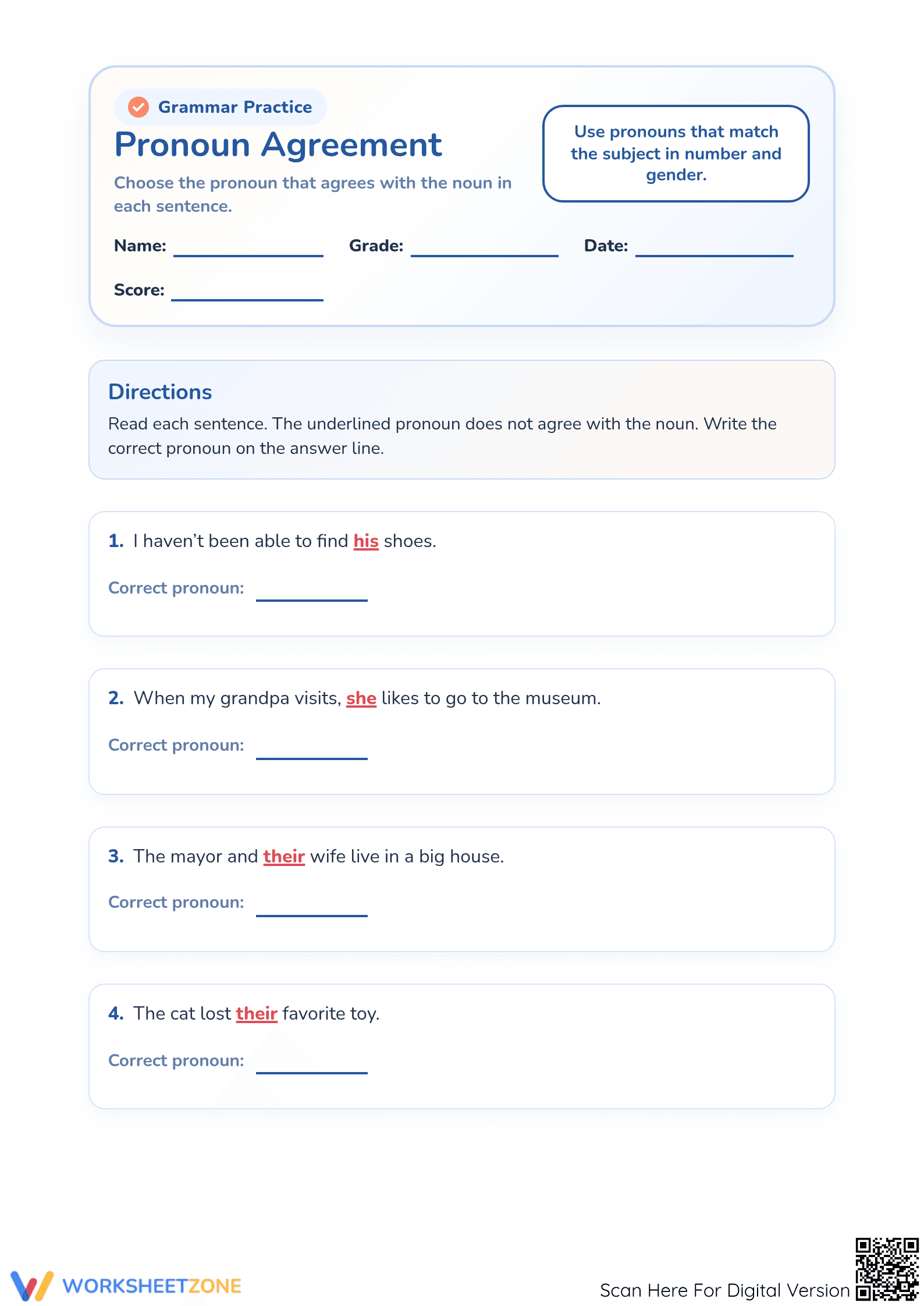


Essential Pronoun Agreement Worksheet | Grades 3-5

Paste this activity's link or code into your existing LMS (Google Classroom, Canvas, Teams, Schoology, Moodle, etc.).
Students can open and work on the activity right away, with no student login required.
You'll still be able to track student progress and results from your teacher account.
This Grade 3-5 pronoun agreement worksheet helps students identify and correct errors in pronoun-antecedent alignment. By focusing on number and gender consistency, learners develop the grammatical precision necessary for clear writing. Students analyze 10 specific sentences to ensure every pronoun correctly reflects its noun, leading to improved sentence structure and overall literacy mastery.
At a Glance
- Grade: 3-5 · Subject: ELA
- Standard:
CCSS.ELA-LITERACY.L.3.1.F— Ensure pronouns agree with their antecedents in number and gender- Skill Focus: Pronoun-Antecedent Agreement
- Format: 2 pages · 10 problems · Answer key included · PDF
- Best For: Independent practice or quick grammar assessment
- Time: 15–20 minutes
This comprehensive 2-page resource features 10 targeted practice problems. Each task presents a sentence with an underlined pronoun that incorrectly matches its antecedent. Students must evaluate the noun's number and gender to provide the correct replacement on the provided answer line. A complete answer key is included to facilitate rapid grading or student self-correction.
The zero-prep workflow is designed for maximum efficiency. First, print the 2-page PDF (30 seconds). Next, distribute the sheets to students for independent work or a warm-up activity (1 minute). Finally, use the included answer key to review responses as a whole class or during small-group intervention (5 minutes). Total teacher preparation time is under 2 minutes. This makes it an ideal resource for substitute plans or unexpected schedule changes.
This resource aligns with CCSS.ELA-LITERACY.L.3.1.F, which requires students to "Ensure subject-verb and pronoun-antecedent agreement." It also supports Grade 4 and 5 language standards regarding conventional grammar usage. Both standard codes can be copied directly into lesson plans, IEP goals, or district curriculum mapping tools.
Use this worksheet during the independent practice phase of a gradual release lesson on word classes. It serves as an excellent formative assessment tool; observe if students struggle more with gender-based errors (e.g., "grandpa/she") or number-based errors (e.g., "cat/their"). Expect completion within 15 to 20 minutes depending on student reading speed and prior knowledge of antecedents.
This practice is ideal for general education students in upper elementary, English Language Learners (ELL) focusing on function words, and students receiving Tier 2 intervention. It pairs naturally with a pronoun anchor chart or a direct instruction lesson on singular and plural nouns. The clear layout ensures that students with visual processing needs can focus on the text without distraction.
Research from Fisher & Frey (2014) emphasizes that grammatical accuracy, specifically pronoun-antecedent agreement, is a foundational component of cohesive writing. This worksheet addresses CCSS.ELA-LITERACY.L.3.1.F by requiring students to actively correct errors rather than simply identifying them, a higher-order task that reinforces long-term retention. According to the NAEP framework, mastery of these functional word classes in the elementary years is a strong predictor of middle-school writing proficiency. By providing 10 structured opportunities for correction, this resource ensures students move beyond rote memorization toward applied understanding. The inclusion of an answer key supports immediate feedback loops, which are critical for correcting misconceptions in real-time. This evidence-based approach to grammar instruction provides the repetition necessary for students to internalize the rules of number and gender agreement in diverse sentence contexts, ultimately improving their ability to communicate complex ideas clearly.


