


























Views
Downloads


Essential Pronoun Agreement Practice | Grade 3 ELA
Paste this activity's link or code into your existing LMS (Google Classroom, Canvas, Teams, Schoology, Moodle, etc.).
Students can open and work on the activity right away, with no student login required.
You'll still be able to track student progress and results from your teacher account.
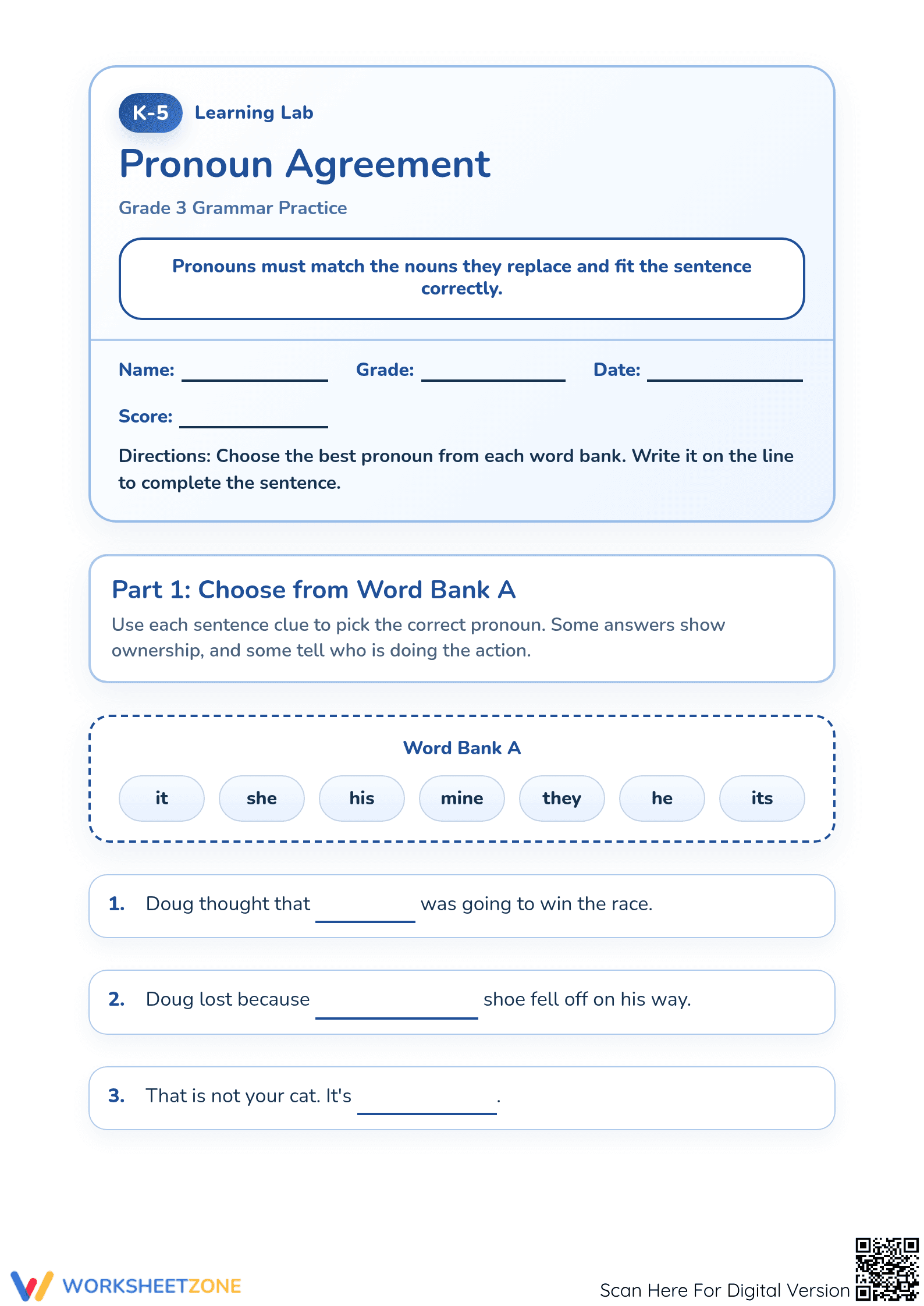
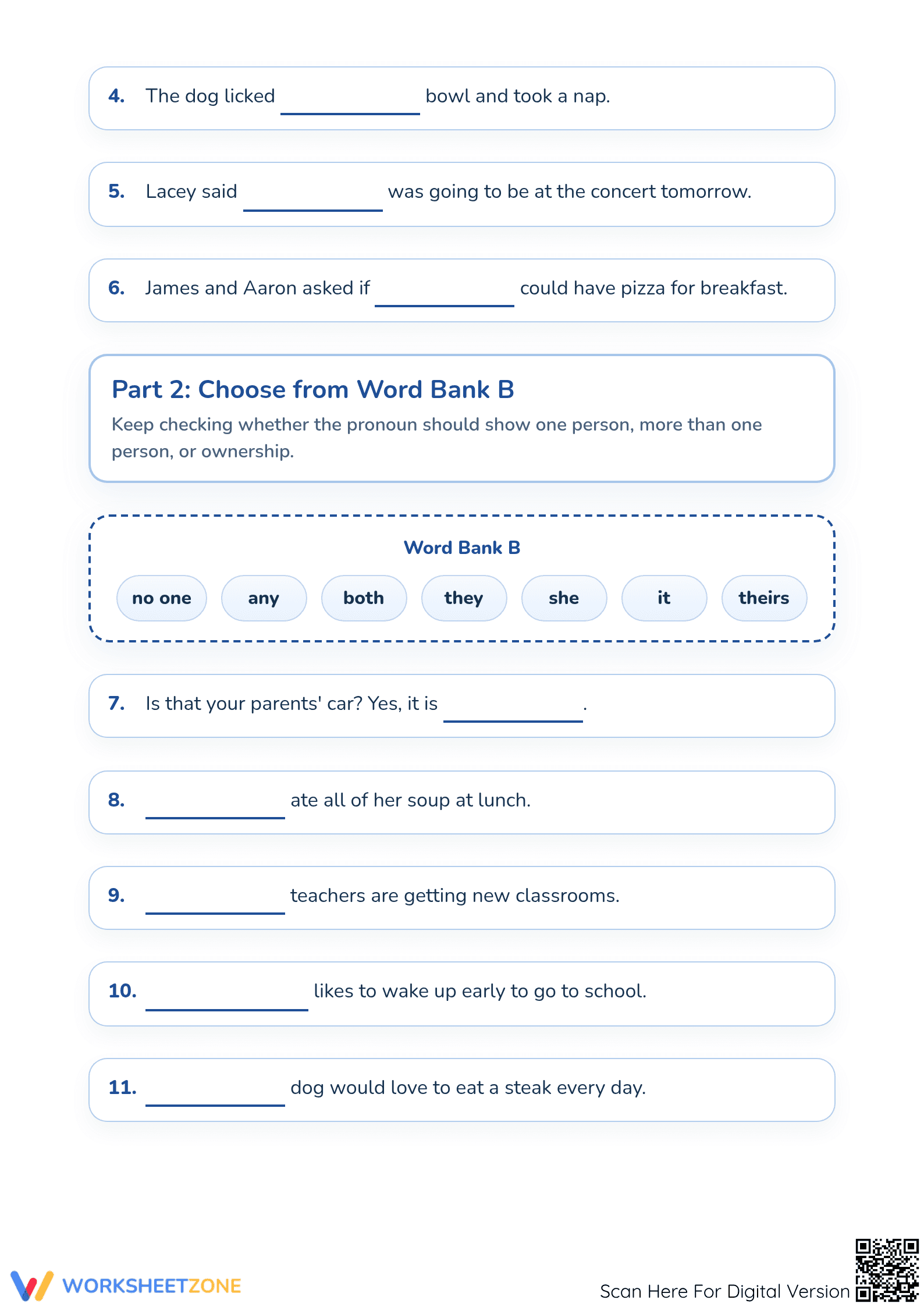
This Grade 3 pronoun agreement worksheet ensures students can accurately match pronouns to their antecedents across various sentence structures. By completing 15 targeted exercises, learners develop a functional understanding of how pronouns replace nouns while maintaining clarity and grammatical correctness. This resource provides immediate practice for mastering essential language conventions.
At a Glance
- Grade: 3 · Subject: ELA
- Standard:
CCSS.ELA-LITERACY.L.3.1.F— Ensure that pronouns and their antecedents agree in number and gender- Skill Focus: Pronoun-Antecedent Agreement
- Format: 3 pages · 15 problems · Answer key included · PDF
- Best For: Independent grammar practice and formative assessment
- Time: 15–20 minutes
This three-page packet features two distinct word banks to scaffold the selection process, covering subjective, objective, and possessive pronouns. The 15 tasks are distributed across three sections, including a Bonus Challenge for higher-order application. A dedicated Quick Tips section on the final page offers reminders about gender, number, and ownership to support student self-correction. A full answer key is provided for rapid grading.
This resource is optimized for a zero-prep classroom environment. Teachers can follow a simple three-step workflow: Print the three-page PDF (30 seconds), Distribute to students for independent or guided work (1 minute), and Review using the included answer key (5 minutes). Because the worksheet includes built-in reminders and clear word banks, it functions perfectly as a standalone sub plan or a quiet-time activity requiring minimal teacher explanation.
The primary focus is CCSS.ELA-LITERACY.L.3.1.F, which requires students to ensure that pronouns and their antecedents agree. The worksheet specifically targets the nuances of number and gender. Additionally, it supports L.3.1.A by reinforcing the function of pronouns in general sentences. Both standard codes can be copied directly into lesson plans, IEP goals, or district curriculum mapping tools.
Use this worksheet during the independent practice phase of a lesson. After modeling pronoun replacement, assign the first page as a check for understanding. For a formative assessment tip, observe if students struggle more with possessive pronouns versus subject pronouns. Completion typically takes 15 to 20 minutes, making it an ideal bell ringer or exit ticket activity.
This resource is tailored for third-grade students but serves as an excellent intervention tool for fourth graders needing a refresher. The inclusion of word banks and visual tips makes it highly accessible for English Language Learners (ELL) navigating the complexities of English pronoun cases. It pairs naturally with an anchor chart displaying common pronoun-antecedent pairs.
Research by Fisher & Frey (2014) emphasizes the importance of scaffolded grammar instruction, where students move from recognition to independent application. This worksheet aligns with those findings by providing word banks that reduce cognitive load before asking students to complete the Bonus Challenge. According to the RAND AIRS 2024 report, high-quality printable materials that focus on specific CCSS.ELA-LITERACY.L.3.1.F sub-skills significantly improve student performance on standardized language assessments. By isolating the skill of pronoun-antecedent agreement, this resource allows for targeted intervention that addresses common misconceptions in early writing. The structured format ensures that 100% of the tasks are directly mapped to grade-level expectations, providing teachers with reliable data for progress monitoring. This systematic approach to grammar helps bridge the gap between isolated skill practice and fluent composition in student writing.


